This Boardcast is sponsored by Board Game Beat. Become a supporting member today!
The Boardcast is audio narrations of select articles. Listen to all episodes (or find out how to get them in your favorite podcast app) here.
Prototype+ members can access an ad-free version here. You can also listen on your favorite podcast app using the private invite and link you received via email. Lost your link? Email admin@wericmartin.com.
If you're not familiar with Clues by Sam, let's start with an example of what you'll find when visiting the site:
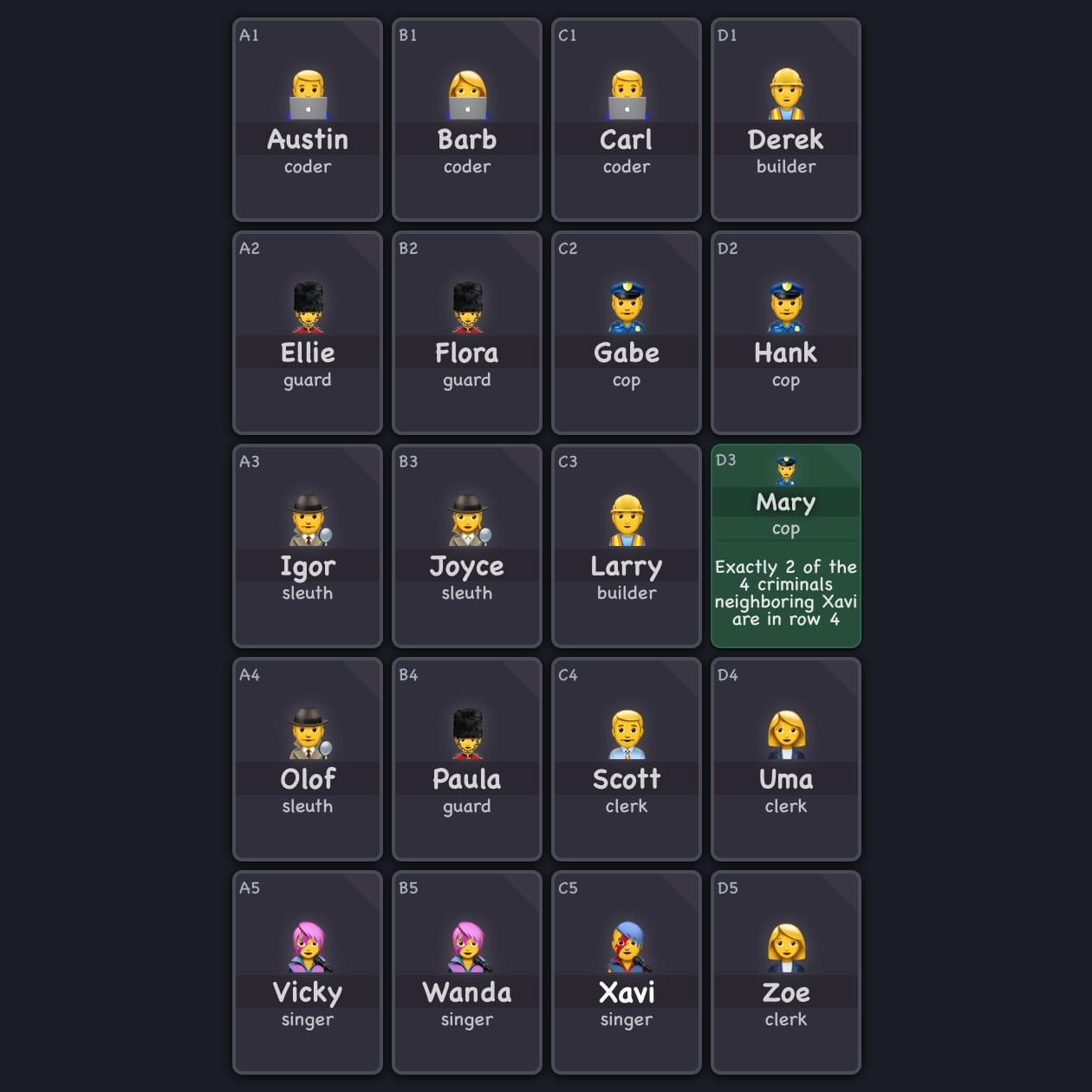
In case it's not clear, Clues by Sam is a logic puzzle. You're given a 4x5 grid of cards, with each card in the grid representing a named person; the names all start with a different letter and are arranged alphabetically, with each person's profession being listed under their name.
Your challenge is to discover who among these people is innocent and who is a criminal, and the only information you have to start with is a single clue under a person whose status has already been revealed: green = innocent, and red = criminal. That clue will allow you to determine the status of at least one other person, and when you correctly identify them as innocent or a criminal, you will often receive a new clue that will help you identify someone else, and so on. (The website details the meaning of words like "neighboring", "more", "all", and so on. In this puzzle, Xavi has five neighbors around them, four of whom are criminals.)
I think I first saw Clues by Sam thanks to Ambie of Board Game Blitz sharing images on social media, and as soon as I tried one of these puzzles, I was hooked. A new puzzle is available daily for free, and if you discover that one puzzle per day isn't enough — which has been the case for me — two packs of fifty new puzzles are available for purchase.
Starting with Murder
Clues by Sam is the work of Finnish designer and programmer Johannes Ahvenniemi, which might prompt the question: "Who's Sam?"
Says Ahvenniemi, "I always liked how Sid Meier's games were named after him. Another company name I like is Toys for Bob. The names made it feel like there was a person behind the games, creating a connection between the player and the creator. I wanted to do the same with my games, but 'Games by Johannes' didn't quite fit in a logo. Both Sid and Bob are three-letter words, so after thinking about it for two seconds, I picked Sam — a friendly, gender-neutral name. I did figure that tagging a name onto the brand would make any potential licensing much harder since what is 'Clues by Sam' without Sam? But this also helped me make a mental decision early on: I would be making games I can be proud of, games I would personally own and grow for years to come."
Ahvenniemi is 37 years old and guesses that he started coding pretty much around the time that he learned to read and write: "The first words I learned to spell were probably 'LINE' and 'CIRCLE' since those were the commands I used to draw characters on my older brother's Amstrad's green screen, with one goal in mind: I wanted to make games."
His first money from game design came in 2007 thanks to Flash games he created. Says Ahvenniemi, "It wasn't big money, but while it was of some help to a poor IT student, the amazing part was the validation. Now that I was being paid for my games, I knew I was doing something right. That was a very rewarding, even addicting, sensation. I knew I was hooked for life."
Flash games didn't pay the rent, but by chance Angry Birds — which was created by Finnish game designer Jaakko Iisalo — became a smashing success almost immediately upon release in 2009, and the office of Angry Birds publisher Rovio Entertainment was essentially next to door to Ahvenniemi. "I was super lucky to get a junior position there," he says, "and so I was pulled into the world of mobile games and free-to-play monetization. It took me ten years to pull myself back out from there."
Why leave a comfortable position like that? Because external success sometimes hides internal dissatisfaction. Says Ahvenniemi, "While working for bigger VC-funded mobile F2P companies, I grew tired of the fact that I didn't really ship games. I was part of one successful game launch, while all my other endeavors never saw the light of day. This is understandable since investors expect high returns for their money, and the games that don't show exceptional promise early on are killed. The model makes total sense to me, but it doesn't make me happy. Like so many others, what I wanted to do was make fun games and put them in the hands of players!"
Ahvenniemi decided to quit and launch out on his own, and he had time to figure out what he wanted to do. "My wife, Vilma, still had a day job as an artist, also on mobile games, in a company run by Touko Tahkokallio, creator of the Eclipse board game, and I had some savings. I could work on my own things full-time for a couple of years, then we'd see what would happen. The safety nets here in Finland are great, so I wasn't too worried."
What’s more, Johannes and Vilma had already started a company, Ad Artis Oy, in 2020. "We liked going to escape rooms", says Ahvenniemi, "but that summer we had to settle for the ones you do at home. We were playing one of the EXIT games outside, and the puzzles were fun, but the toughest part was fighting the wind as it was trying to blow away all the various cards and cutouts. Vilma asked, why can't this just be a magazine? We both thought it was a fantastic idea, so Vilma created our first Cluehound Puzzle Magazine, and I would soon join her to make more."
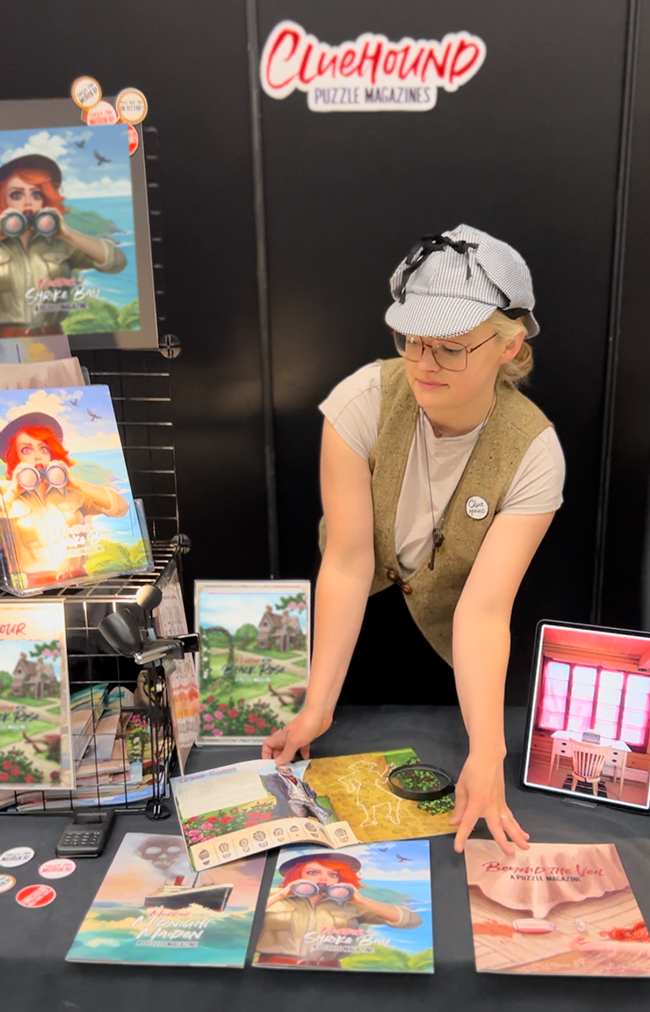
Cluehound features illustrated, murder-mystery, escape room-style challenges, and the couple attended conventions to sell their creations. Says Ahvenniemi, "The magazines were very well received, and we soon internalized something fascinating: Everyone loves crime, mysteries, and puzzles. Give these to people in an accessible, familiar format, and they will take it."
To stay on top of what others were doing in the genre, the couple would check out the competition, which led to the purchase of a Murdle puzzle book in February 2025 — but while Ahvenniemi enjoyed the book, he was less a fan of the daily digital puzzle, which was how Murdle had started. "The concept required too many UX tradeoffs, especially on mobile," he says. "I wanted to see if anyone had attempted to improve the UX and typed 'Murdle' in AppStore search, and there it was: Clue Master, an accessible crime-themed puzzle game, with people and clues laid out in a grid."
However, says Ahvenniemi, "Immediately I detected severe flaws and lackings in the way the game worked, but I knew exactly how to fix them and create my own take on the mechanic — and I knew it had to be a free daily puzzle. All this took place in one evening. The following week I put all my other projects on hold, and in May I launched the game to the world."
The format for Clues by Sam originated from Ahvenniemi's desire to make the puzzle work similarly on mobile devices and on browsers without scrolling or zooming. Thus, everything had to fit in the 4x5 grid format he adopted. "This meant that the time spent per deduction had to be fairly long," he says, "so I had to make it quite hard. And due to this, the solve path would have to be quite strict. Therefore, doing a wrong move shouldn't reveal any information since that would break the flow for the rest of the puzzle."
He continues, "This last part was tricky. How do I prevent players from accidentally revealing information too early? Basically it's like Minesweeper, but when you try to guess, the game tells you, 'Hey, there's not enough information yet! That could be a mine!' I had to ensure not only that illogical choices aren't allowed, but also that ALL logical choices are allowed. However, what if a player is smarter than me and finds a logical deduction I missed? I knew I couldn't trust my own wits, but I also knew I had to nail this feature to make the game work. Luckily I had experience in constraint programming. I created something I call 'The Solver', and it has worked flawlessly!"
Ranking the Riddles
The publication format for Clues by Sam matches that of crossword puzzles in The New York Times and elsewhere, with the Monday puzzle being classified as an "Easy" challenge, Tuesday's puzzle being of "Medium" difficulty, and so on, with the rest of the difficulty scale consisting of "Tricky", "Hard", "Brutal", and "Evil".
Ahvenniemi says The Solver generates metrics that indicate the difficulty of a puzzle, such as how advanced the solving techniques are required to be or how many clues the solver must look at simultaneously, but he modifies the difficulty rating based on personal experience: "One clue that causes constant headaches is 'Everyone has at least one criminal neighbor.' You scan and scan and scan, and you can't find anything until you finally spot the obvious. (Usually you should check the corners first since they have only three neighbors.) The Solver sees this as just one simple deduction and ranks it Easy, but all human solvers know how hard this can be, so sometimes a puzzle that is algorithmically easy can be really hard for humans." He describes the difficulty levels as follows:
- In an Easy puzzle, you never need to look at three clues simultaneously, you re-use clues maybe three times in total, and newly revealed clues are usually immediately useful.
- Medium puzzles are much like easy ones, but with clues revealed "too early" as a distraction, more deductions where you need to look at two clues simultaneously, and more re-using of previous clues.
- Hard puzzles can require bifurcation, that is, creating hypothetical scenarios and proving someone can or can't be a criminal in any of them.
- Evil puzzles can be more about bifurcating than using common techniques.
Says Ahvenniemi, "These 'rules' keep shifting. For example, the puzzles used to never require bifurcation since personally I dislike it in classic puzzles like Sudoku and Nonogram. But after sharing a really nasty puzzle in a newsletter, I realized many actually do enjoy the process, so I started introducing them more in daily puzzles as well. It's not for everyone, but hey, you can always use a hint!"
Bifurcation makes puzzles more challenging, especially since you can't write on a Clues by Sam puzzle the way that you might with a Sudoku puzzle, so Ahvenniemi introduced corner tags, a system in which you tap on the upper right corner of a card and that corner rotates through four labels: yellow, red, green, and nothing. You can use this tagging system as you like to record information or make suppositions. By tagging two card corners yellow, for example, you can note that these cards are linked, with one being innocent and the other a criminal, but without you yet knowing which is which.
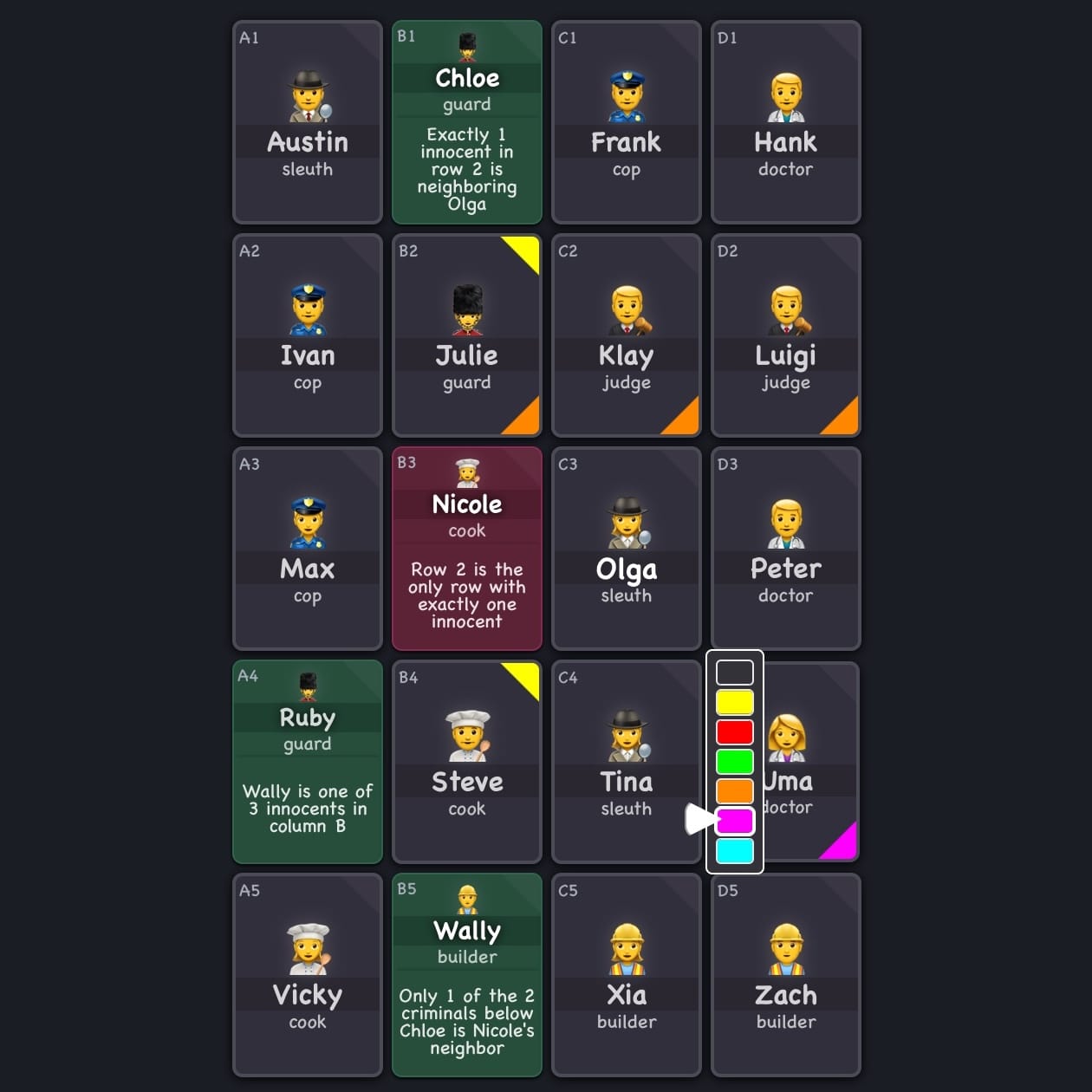
"Using tags made all puzzles easier", says Ahvenniemi, "so now I had to bring up the overall difficulty! And then, of course, players are getting better at solving these, asking for more of a challenge. Balancing this with new players is particularly tricky. That's why I start the week with an easy one and end on Sunday with a real head-scratcher, but sometimes if I notice there's a lot of new players, I keep the overall difficulty lower for that week. It's all very organic, but there is some design behind the madness!"
While the format of Clues by Sam is fixed, the types of puzzles that can be created within that format is more varied. Says Ahvenniemi, "The game is essentially a mash-up of several puzzle games, but the exact rules are revealed as you go. Sometimes you feel like you're solving a Minesweeper, then suddenly it's like Nonogram, or Xs and Os, or Queens, but you don't need to know how any of these games work, and you can in theory start playing without reading any rules outside the gameboard! This, I think, is the magic of logic puzzles based on natural language. You enter a new puzzle every day, and you never know what it'll be like. You need to familiarize yourself with the world, its characters, their occupations, their relationships, and of course the rules."
He continues, "This ties in well with the characters having some personality. Tom is not just a cell number, but a criminal ratted out by Anna, which is a good source for funny lines to further build the world."
Dividing the Innocent from the Guilty
Before we start diving into the personalities of the twenty individuals who show up in a puzzle each day, let's look at how puzzles are constructed. Ahvenniemi says that the process of making a puzzle is half manual and half algorithmic:
I mentioned The Solver that is responsible for listing all valid deductions. It can also work the other way: It can also suggest a clue that gives the missing piece of information for some deduction. It is terrible at understanding what a fun clue looks like, but it is very imaginative! It has a massive pool of clues to randomly pick from, while my brain is stuck running in circles between a handful of options, so it's a fantastic source of inspiration. In the end, the process feels more like curating than coming up with clues. This allows me to create puzzles at a pretty good pace!
Once I have a fun puzzle, I sprinkle the clues around the solve path, with The Solver always verifying that the solve path stays unchanged. There's a lot of room for moving clues around since not all clues are useful alone, and not every person has a clue.
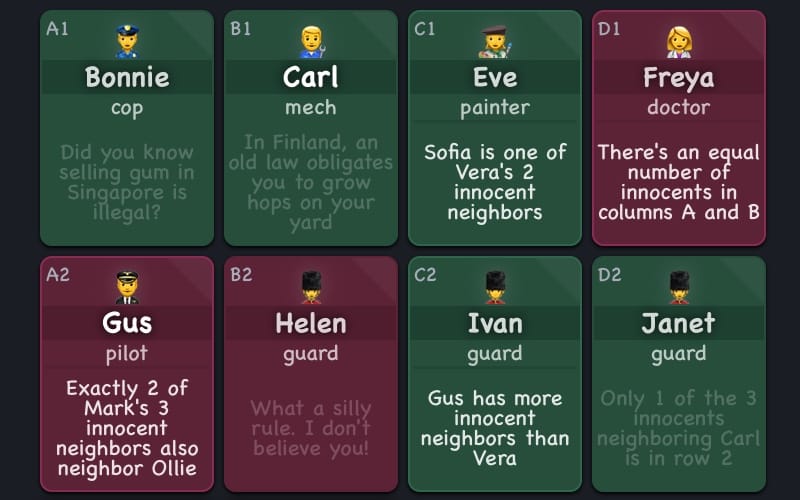
Then the final step is to fill in the gaps. Since there are characters without a clue, it would feel like a waste not to use that space for world building, so I solve the puzzle once more myself, and while doing that, I add quips to the persons without a clue. Usually I start by picking a random line for the first one, then spiraling that into surprising directions, while trying to maintain a common thread. The story can be tied to the puzzle, such as everyone commenting on the large number of criminals or blaming someone for ratting on them, and sometimes it's just random jokes. Sometimes they end up pretty funny, but at times I wonder if it's really worth it. It can take more time coming up with these lines than the puzzle itself.
Not everyone likes these lines, but they also receive lots of good feedback, and I do believe that making people smile while solving a logic puzzle is something pretty rare and valuable.
Bringing about a sense of joy drives Ahvenniemi in his creations. He says, "In each puzzle, I want to challenge the player enough to make them frown, then to wipe that frown away with a smile, to make the player connect with a world. I kind of get the same feeling when solving a good Sudoku — the numbers start feeling special and alive somehow, but I feel like this is way easier to achieve with talking faces!"
Solving the Profit Puzzle
Ahvenniemi has published a few other puzzles — Bee Sort, Words by Sam, and Block Puzzle by Sam — but they're all free, similar to the daily Clues by Sam puzzles, which doesn't seem like an ideal business model, yet his previous business experience led him to believe he was on the right path.
"Clues by Sam has been running as a daily puzzle since May 2025", he says. "From the player numbers and very rough conversion guesstimates I took from my F2P experience, I figured I could pay part of my living expenses by publishing a puzzle pack now and then, so I wanted to try that before downgrading the experience with ads. My estimates proved astonishingly accurate, and for the first time since my early Flash career, I'm making some money with my own games!"
Ahvenniemi has also done freelance work for Netflix Puzzled, a daily puzzle platform developed in Helsinki, and hopes to continue doing this in the future, but purchases of puzzle packs will allow him to continue creating and improving Clues by Sam. "I will most likely introduce new ways for the game to generate revenue, once I have something I deem worthy of paying for", he says. "Accessing all past puzzles is something many have announced being ready to pay for, but you can also find links to them floating around the internet. (The scenario sharing functionality makes this inevitable.) I could just break all the old links and put them behind a paywall, but that doesn't feel like the right thing to do. That said, I have some ideas I believe everyone will find fair and fun!"
After all, says Ahvenniemi, "this is slowly becoming my day job now — in addition to the puzzle magazines, which are also growing! Vilma also resigned recently so that she can focus on them full-time. We're now trying to figure out logistics since shipping them individually from Finland is slow, expensive, and sometimes quite impossible. (Sorry, USA!) It'll be a crazy year for us, for sure!"
If you want a sampling of what Clues by Sam is like, you can try this Easy puzzle from Jan. 19, 2026, this Medium puzzle from Jan. 20, and this Hard puzzle from Jan. 18 — or you can spend US$1 to get fifty puzzles in one go, ranging from Easy to Evil. Recommended!
Alternatively, you can follow along as I show the steps of one solution. Try to figure out the next step before you scroll down...
A Step-by-Step Solution
Although admittedly some steps are larger than others...
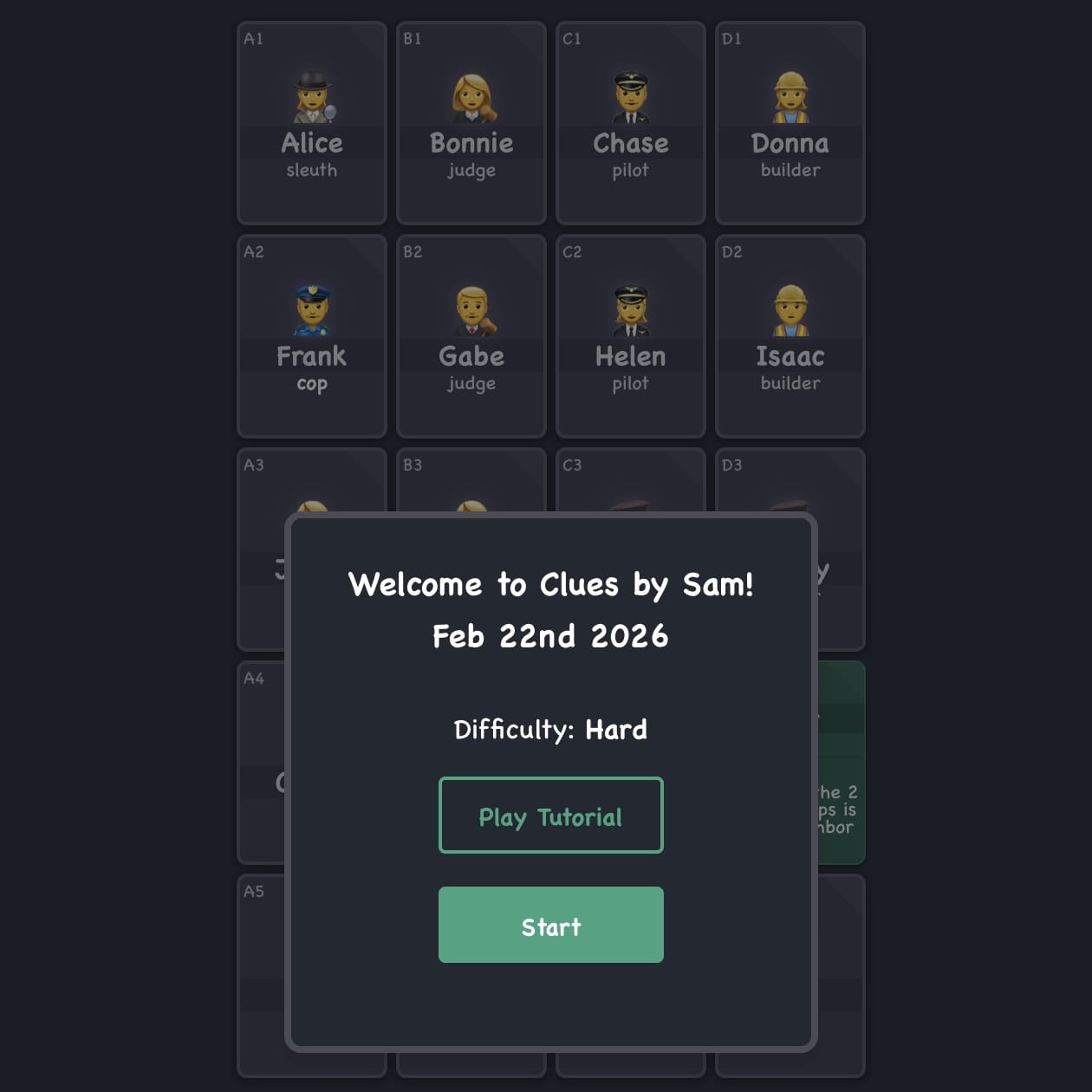
This is a Sunday puzzle, and those will typically be Hard or Evil, so you'll have a decent amount of cross-referencing and hypotheticals.
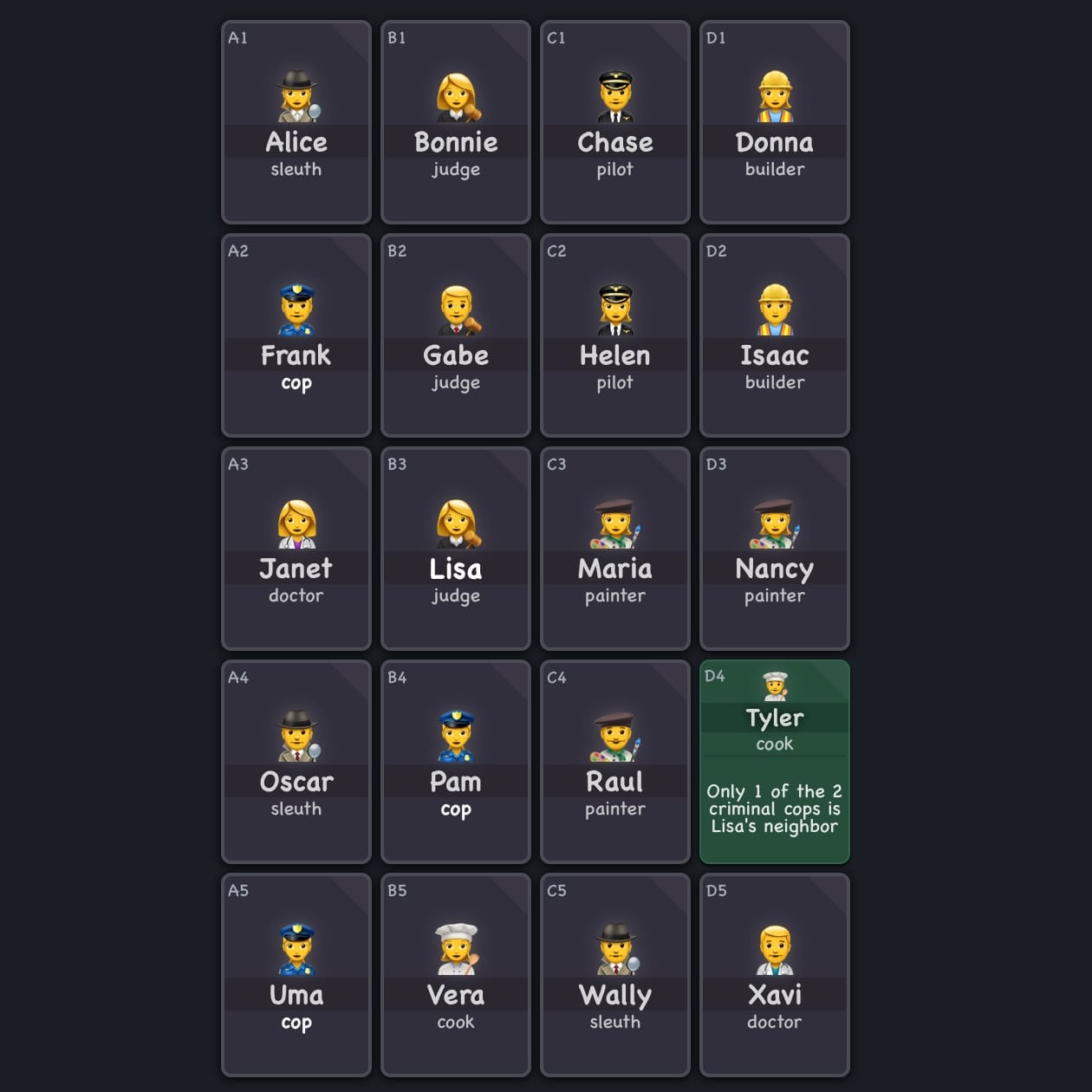
Here's the starting point, so what can we derive from this. "Neighbor", by the way, means any card orthogonally or diagonally adjacent, so Lisa (B3) has eight neighbors, with two of those neighbors being cops. A third cop, Uma, is at A5.
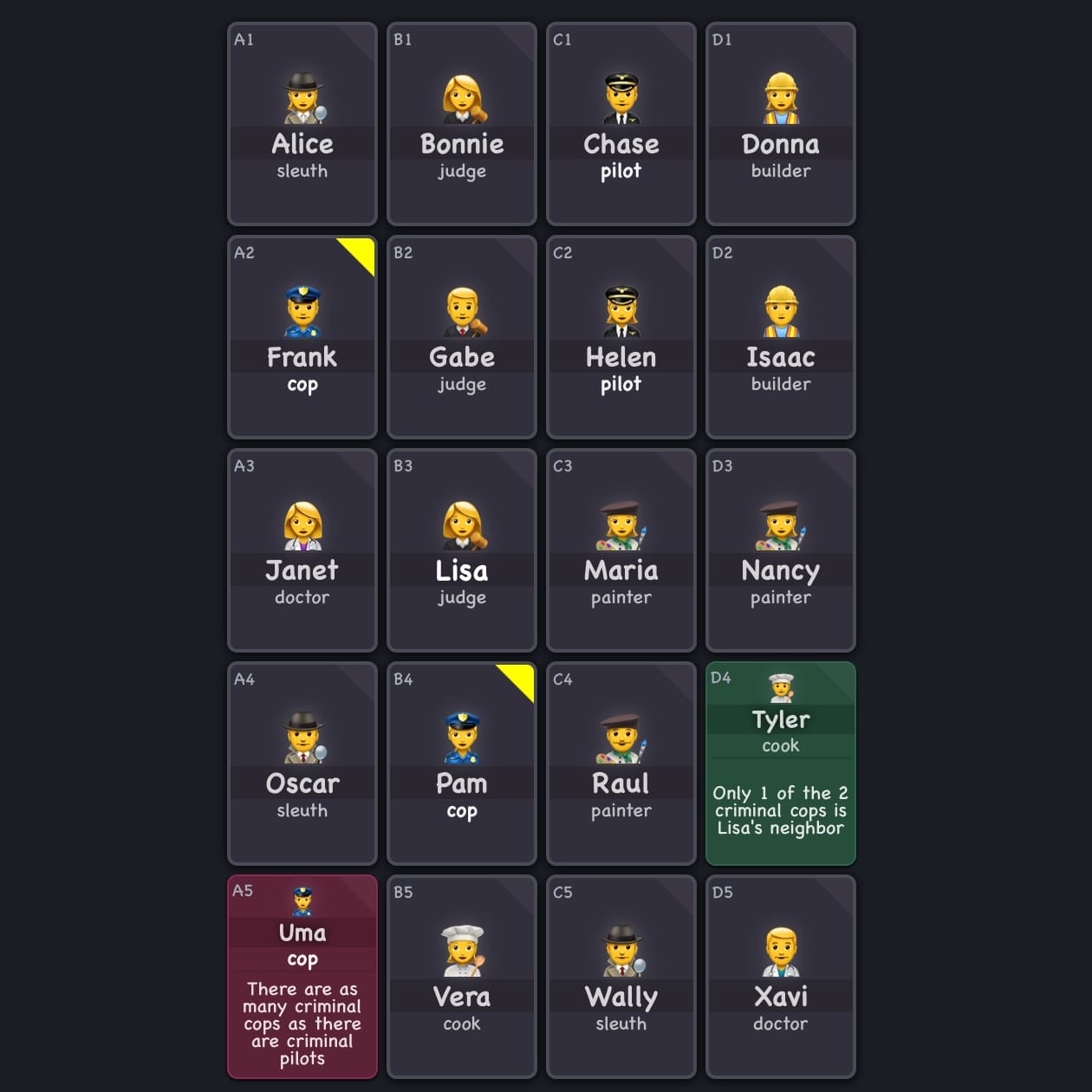
The grid has three cops, and Tyler's clue says two cops are criminals, but only one of those is a neighbor to Lisa, so that means the third one must be a criminal. Let's tag Frank and Pam to indicate their link; one is a criminal and the other innocent, but we don't know which is which for now. Will Uma's clue help us resolve this?
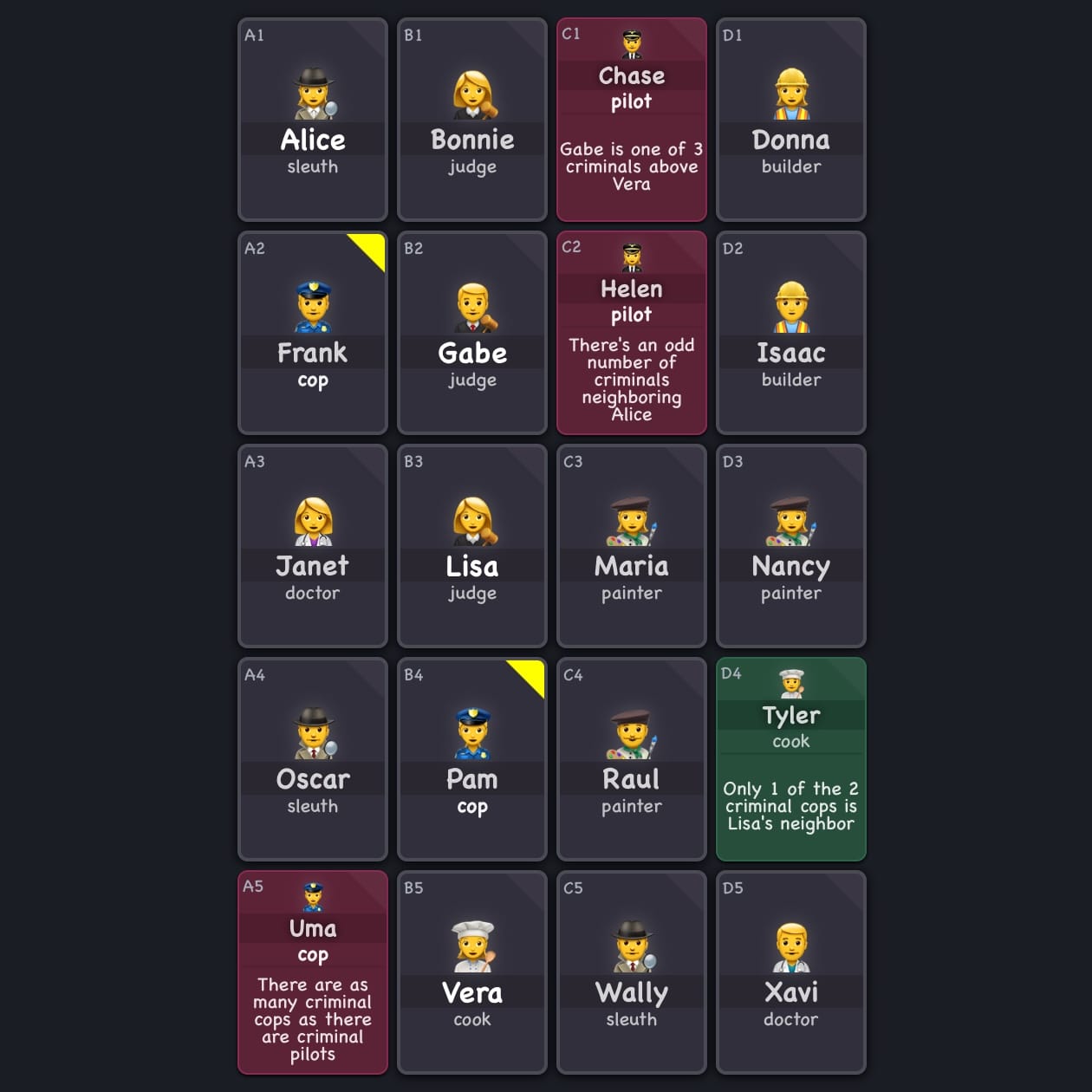
We know two cops are criminals, and only two pilots are in the grid, so if Uma tells us "There are as many criminal copes as there are criminal pilots", then we can resolve the status of the two pilots. Criminals!
Sometimes clues give you direct information, in addition to info that's more fuzzy. Chase (C1) says "Gabe is one of 3 criminals above Vera", so we can immediately resolve Gabe:
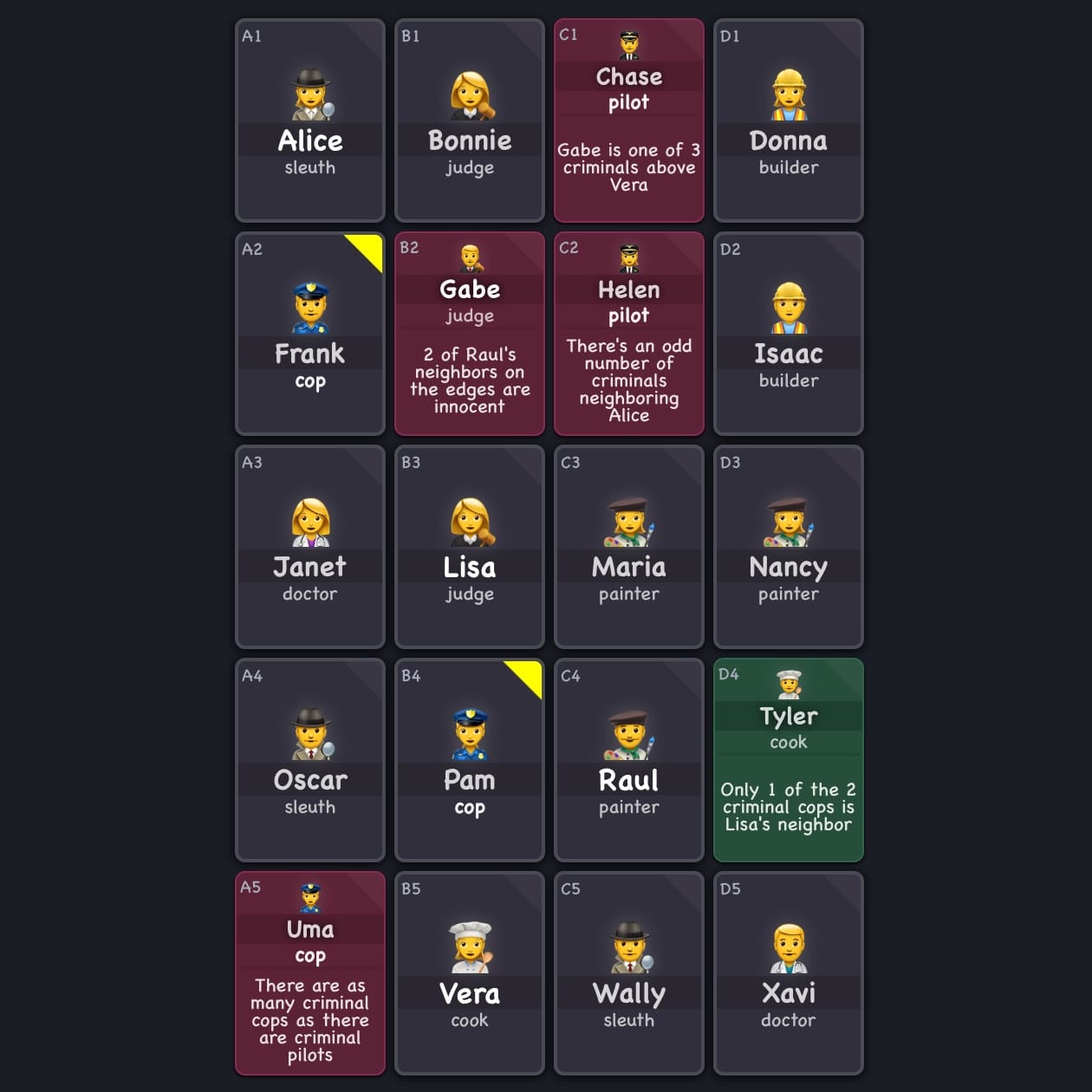
Gabe's clue is now revealed: "2 of Raul's neighbors on the edges are innocent"...which doesn't tell us much. We already know Tyler (D4) is one of those neighbors, but we have four choices for the other one, so what else do we know?
Helen (C2) tells us "There's an odd number of criminals neighboring Alice". Gabe is a criminal neighboring Alice, so the other two neighbors — Bonnie (B1) and Frank (A2) — must be both innocent or both criminals. Better to look at a situation with two possibilities than one with four, so let's tag them both as criminals, then see what else we can figure out.
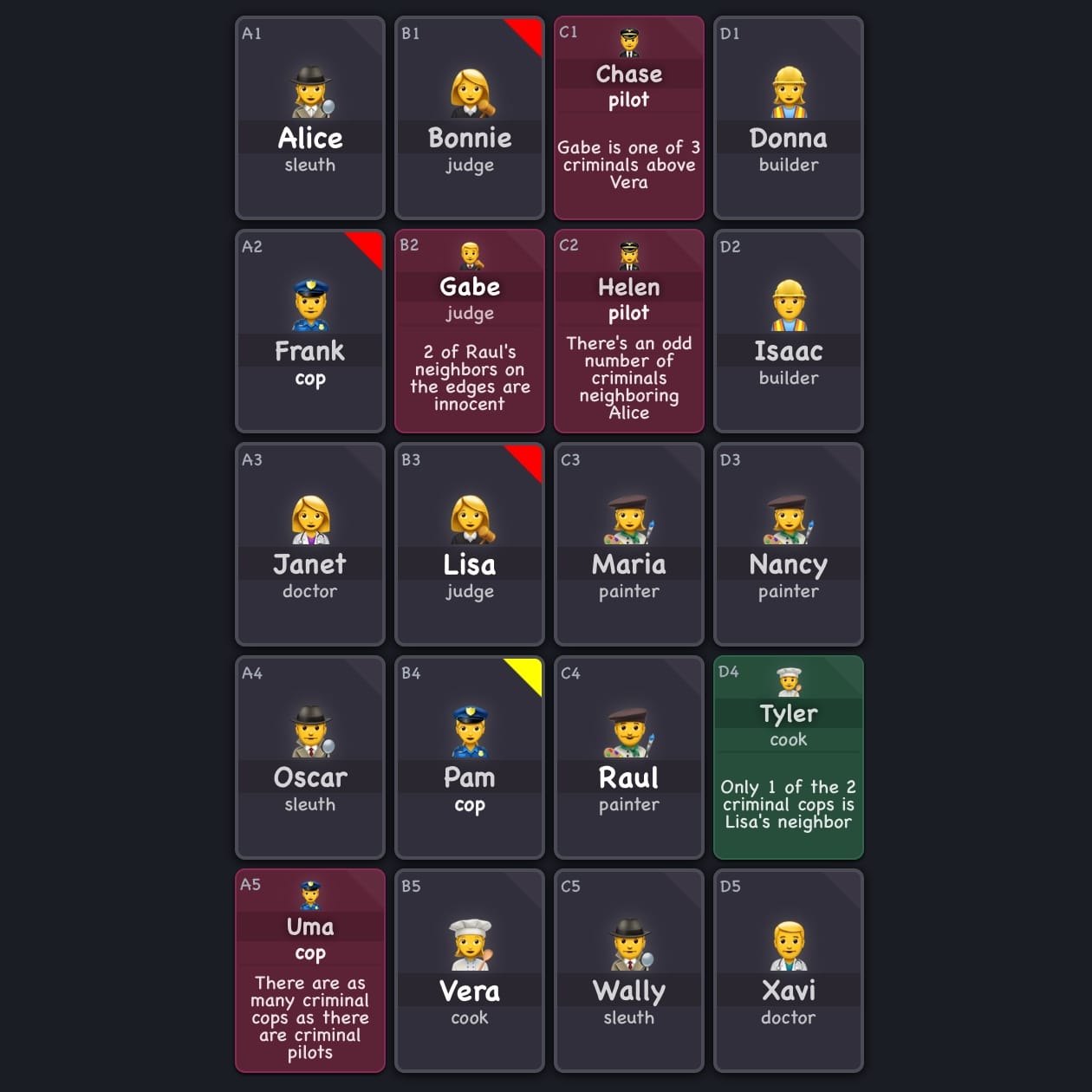
Bonnie (B1) and Frank (A2), a cop, are both tagged with red to indicate their criminal status, but this means Pam (B4), the other cop, must be innocent because of their previous link via Tyler, which means that Lisa must be a criminal since Chase told us that "Gabe is one of 3 criminals above Vera".
Now let's consider the other possibility:
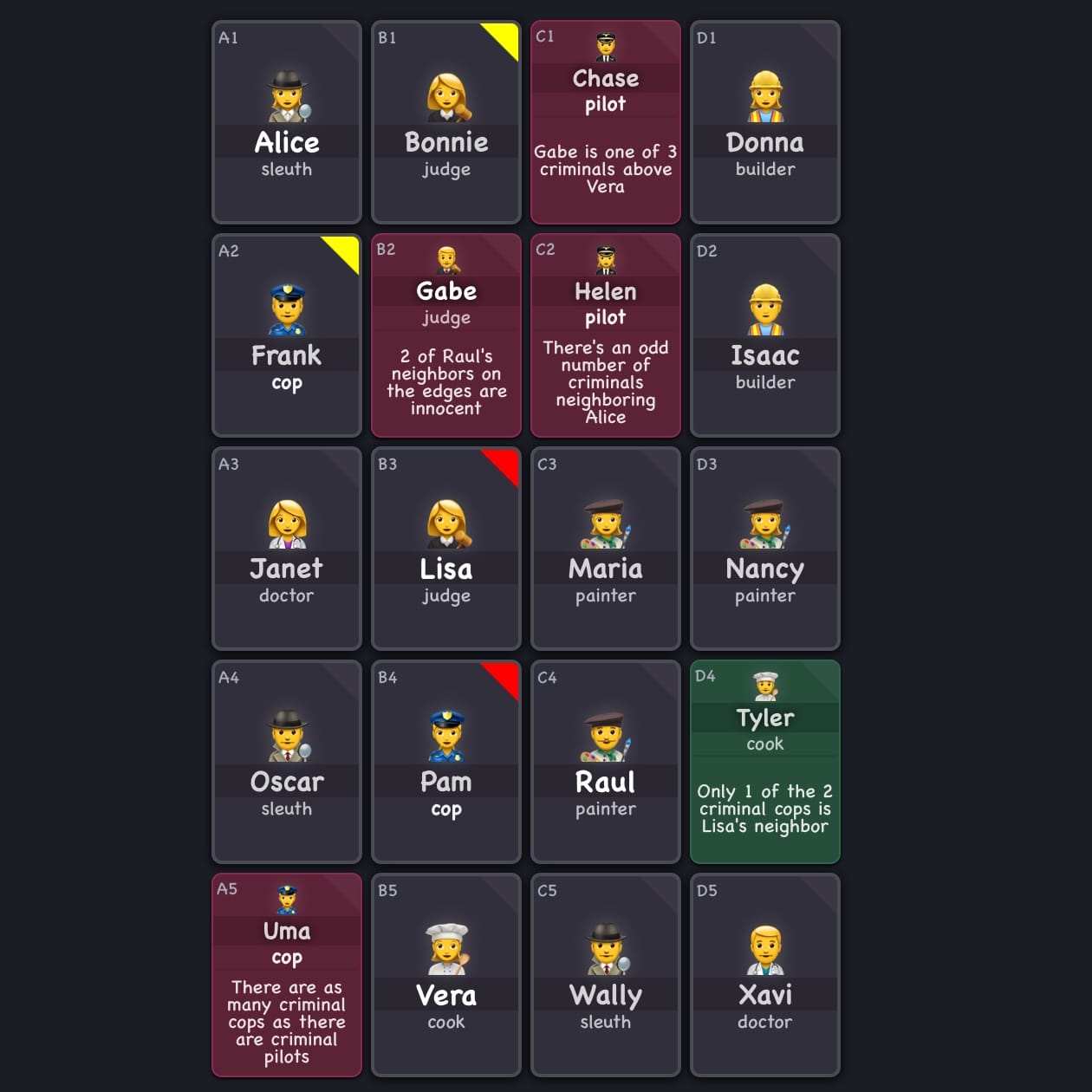
Bonnie (B1) and Frank (A2), a cop, are now both tagged with yellow to indicate their innocent status, but as before this means Pam (B4), the other cop, must be a criminal because of their previous link via Tyler. Once again, though, we have only two criminals above Vera, with Lisa's status being forced as a criminal in order to satisfy Chase's clue, so no matter the status of Bonnie and Frank, Lisa (B3) is a criminal.
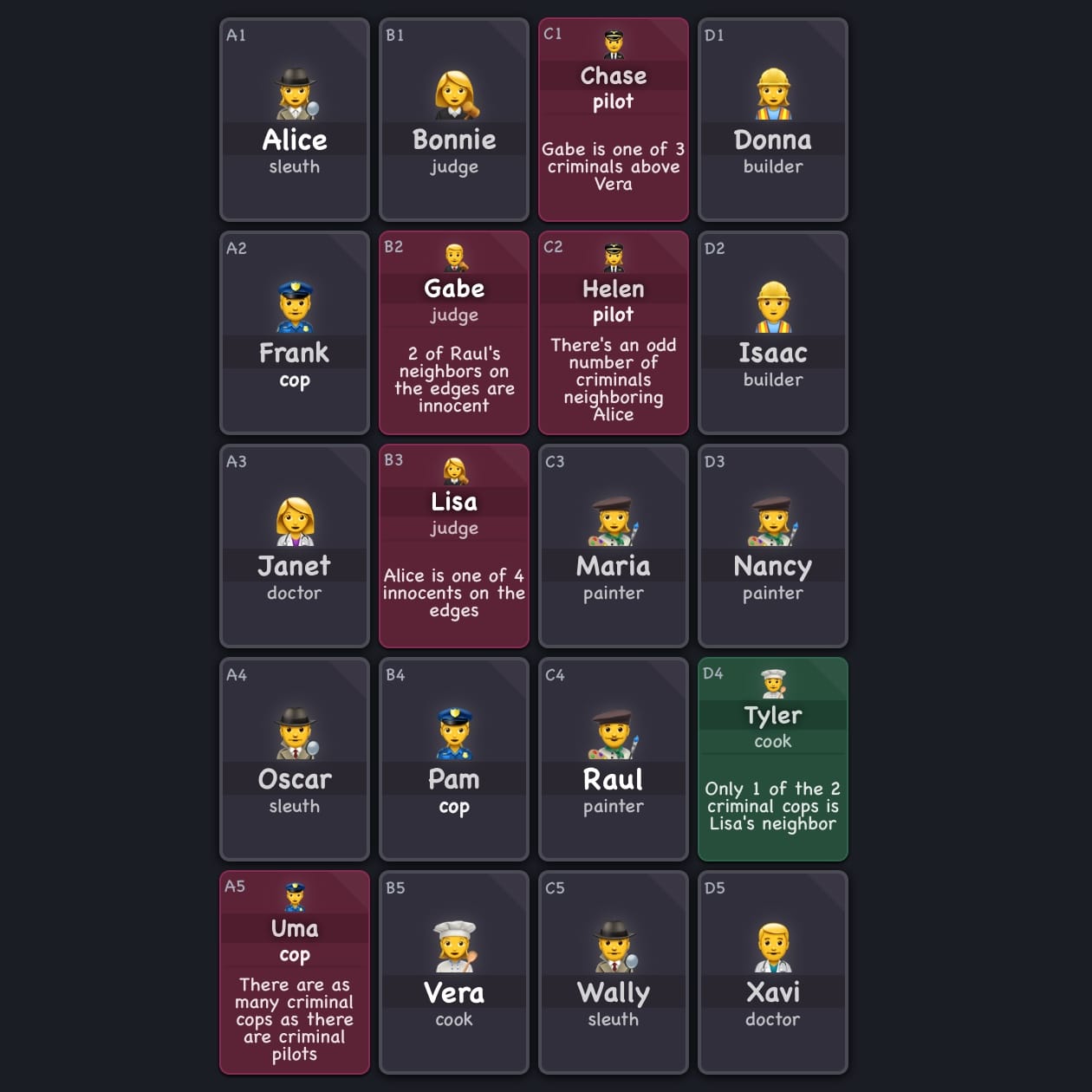
What does Lisa (B3) tell us now that she's been revealed? "Alice (A1) is one of 4 innocents on the edges". The grid has fourteen edge spaces, with only four innocents among them — and now Alice joins Tyler as an innocent.
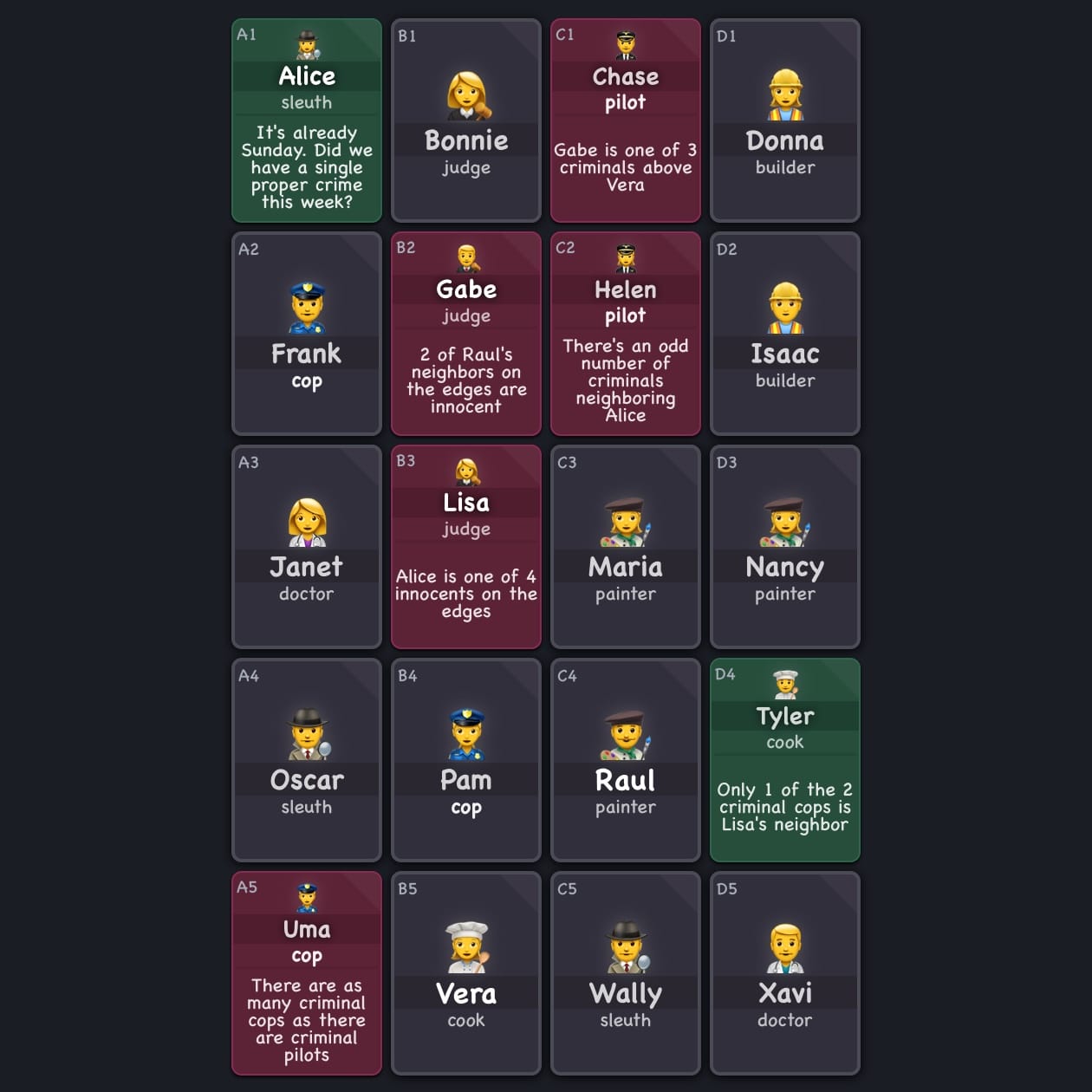
Alice's "clue" is a joke, which means we don't get any new information...other than Alice's innocent status, which is itself a clue, right?
What can we look at along these lines? Alice is one of four innocents on the edges. Tyler is another one, and from Gabe (B2) we know that Raul has a second innocent on the edge, so that's three innocents — which means that our previous speculation about Frank and Bonnie both being innocent can't be true because that would bring us up to five innocents on the edges.
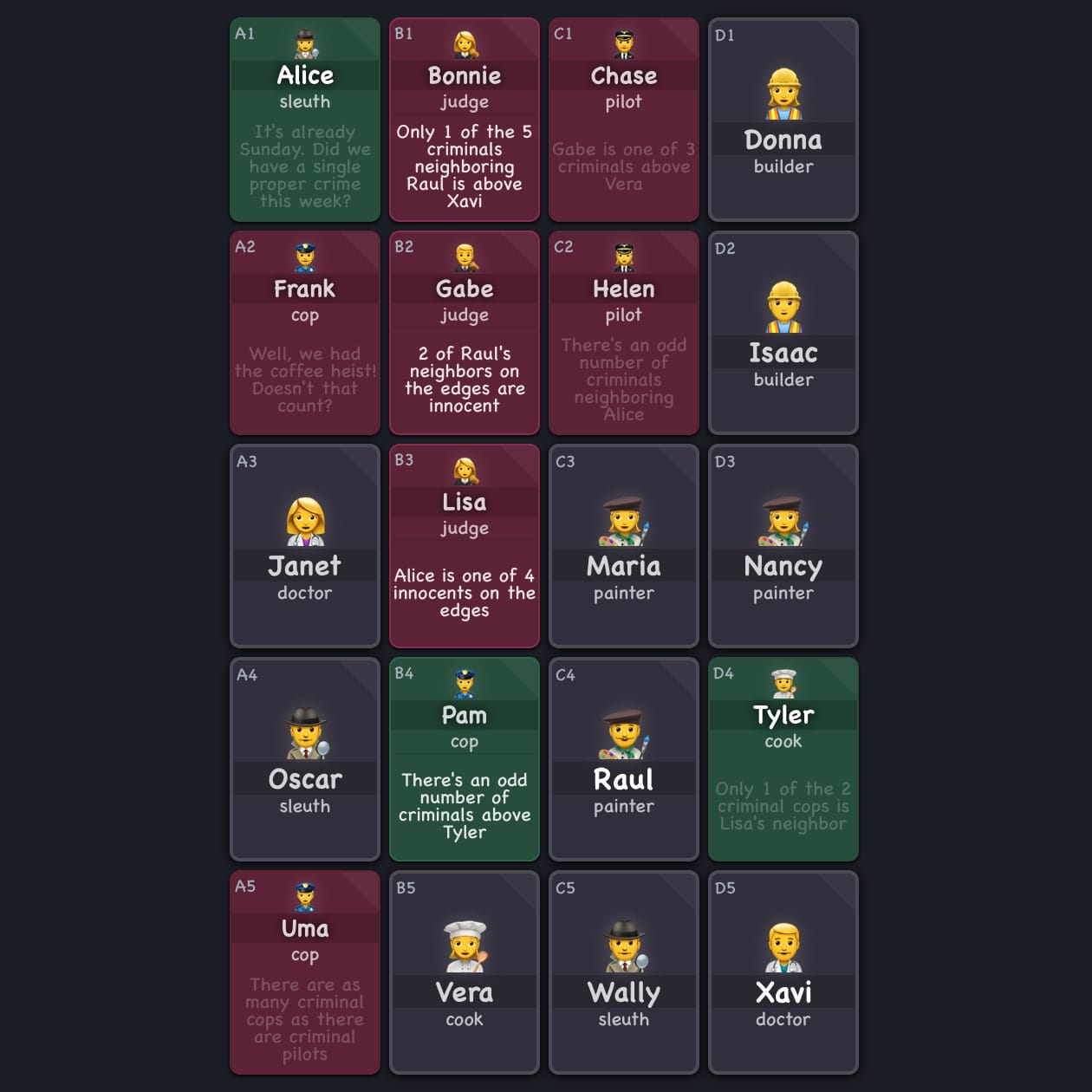
Therefore, Bonnie (B1) and Frank (A2) are both criminals, which means that Pam (B4), the final cop, must be innocent. Resolving these three cards lets us gray out many clues since we've wrung all the information from them that we can. Frank has a joke, so we can grey that as well, leaving us with new information from Bonnie and Pam.
Bonnie says, "Only 1 of the 5 criminals neighboring Raul is above Xavi". Raul (C4) has two neighbors above Xavi (D5), with Tyler (D4) already known as innocent, so Nancy (D3) must be a criminal.
Pam says, "There's an odd number of criminals above Tyler", which means one or three, and Nancy is already known as a criminal, so the other two — Donna (D1) and Isaac (D2) — must be both innocent or criminal.
But by the same reasoning we used before with Bonnie and Frank, we know they must both be criminal or else we'd have more than four innocents on the edges.
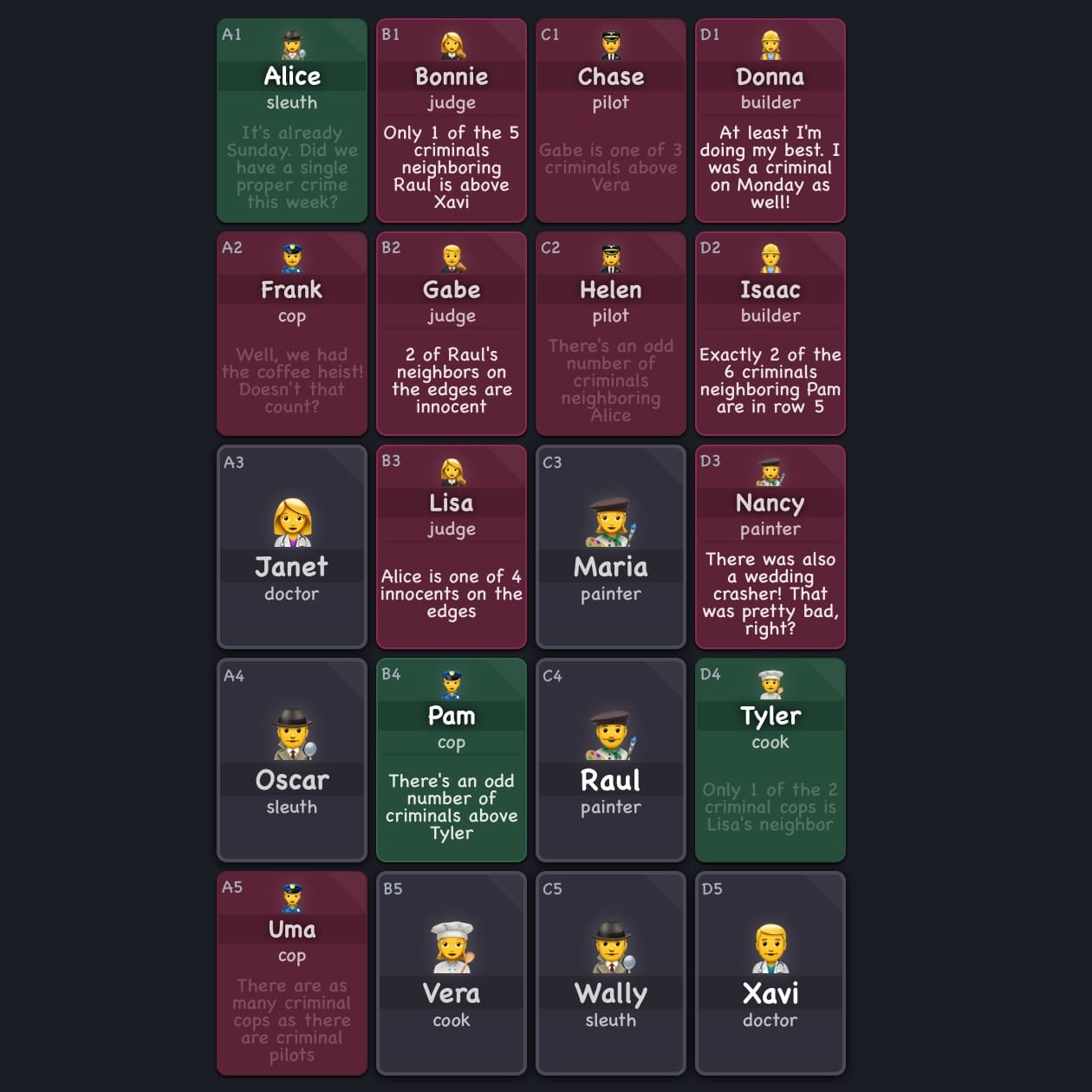
Donna (D1) and Nancy (D3) give us jokes, so let's focus on what Isaac (D2) says: "Exactly 2 of the 6 criminals neighboring Pam are in row 5". Uma (A5) is already known as a criminal neighboring Pam (B4), which means that either Vera (B5) or Wally (C5) must be a criminal — and whichever one isn't a criminal is innocent, and that will be, recalling Gabe's clue, the second of Raul's neighbors on the edges who are innocent.
And since Raul's "innocent edge neighbor" count will be satisfied, that means Xavi (D5) must be a criminal.
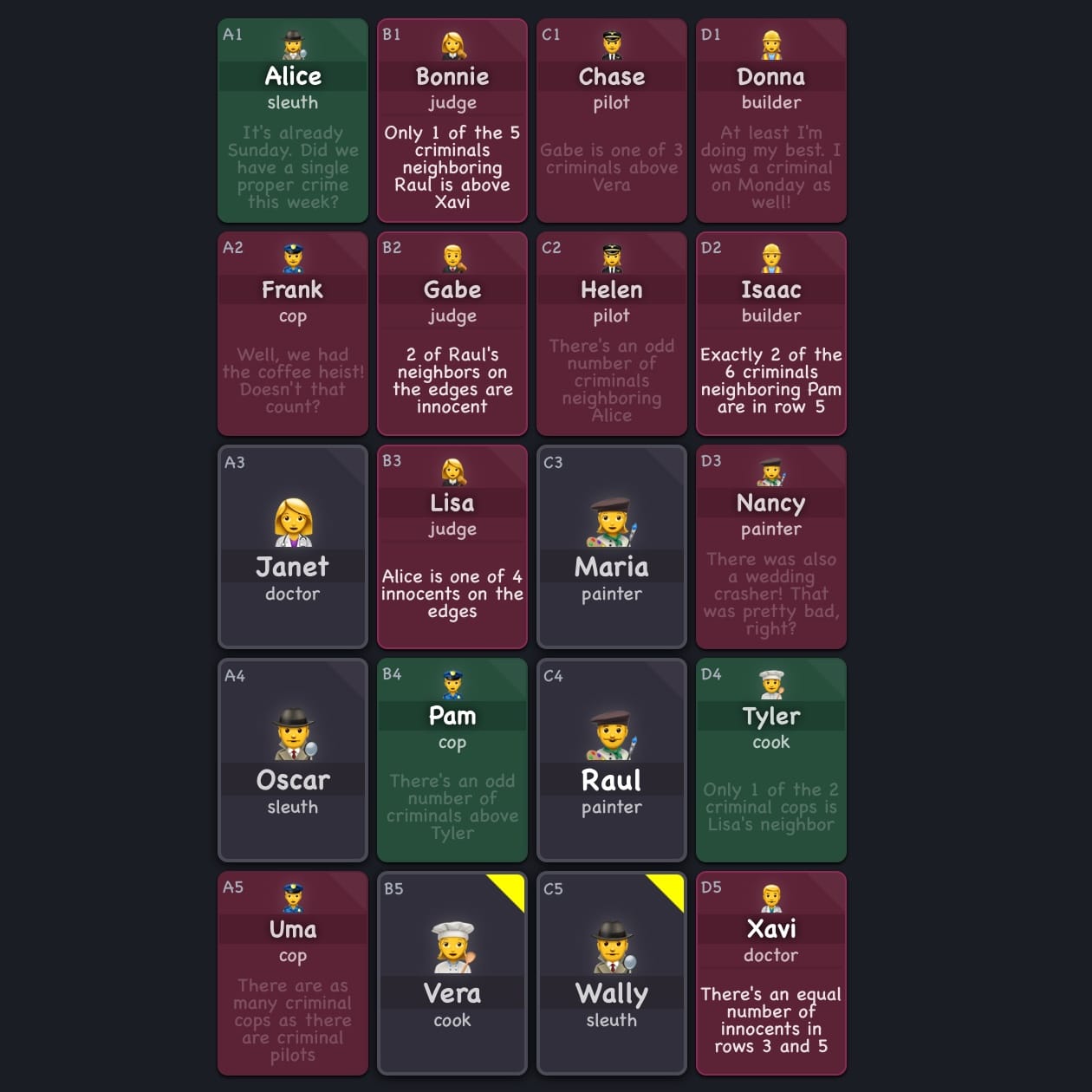
I've tagged Vera and Wally in yellow to show their connected, yet unresolved Schrödingerian status. Xavi (D5) tells us "There's an equal number of innocents in rows 3 and 5", and the Vera/Wally status tells us row 5 contains only one innocent, so the same will be true of row 3. Can we determine whether Janet (A3) or Maria (C3) is the innocent party?
Well, reviewing the unresolved clues reminds us that Bonnie (B1) gave us two clues in one. The clue, "Only 1 of the 5 criminals neighboring Raul is above Xavi", let us resolve Nancy's status as a criminal, but the clue contains a far simpler fact: "Five criminals neighbor Raul". We already know three of these criminals — Lisa, Nancy, and Xavi — and a fourth will be either Vera or Wally, which leaves only one unresolved person neighboring Raul: Maria (C3), who must be that fifth criminal.
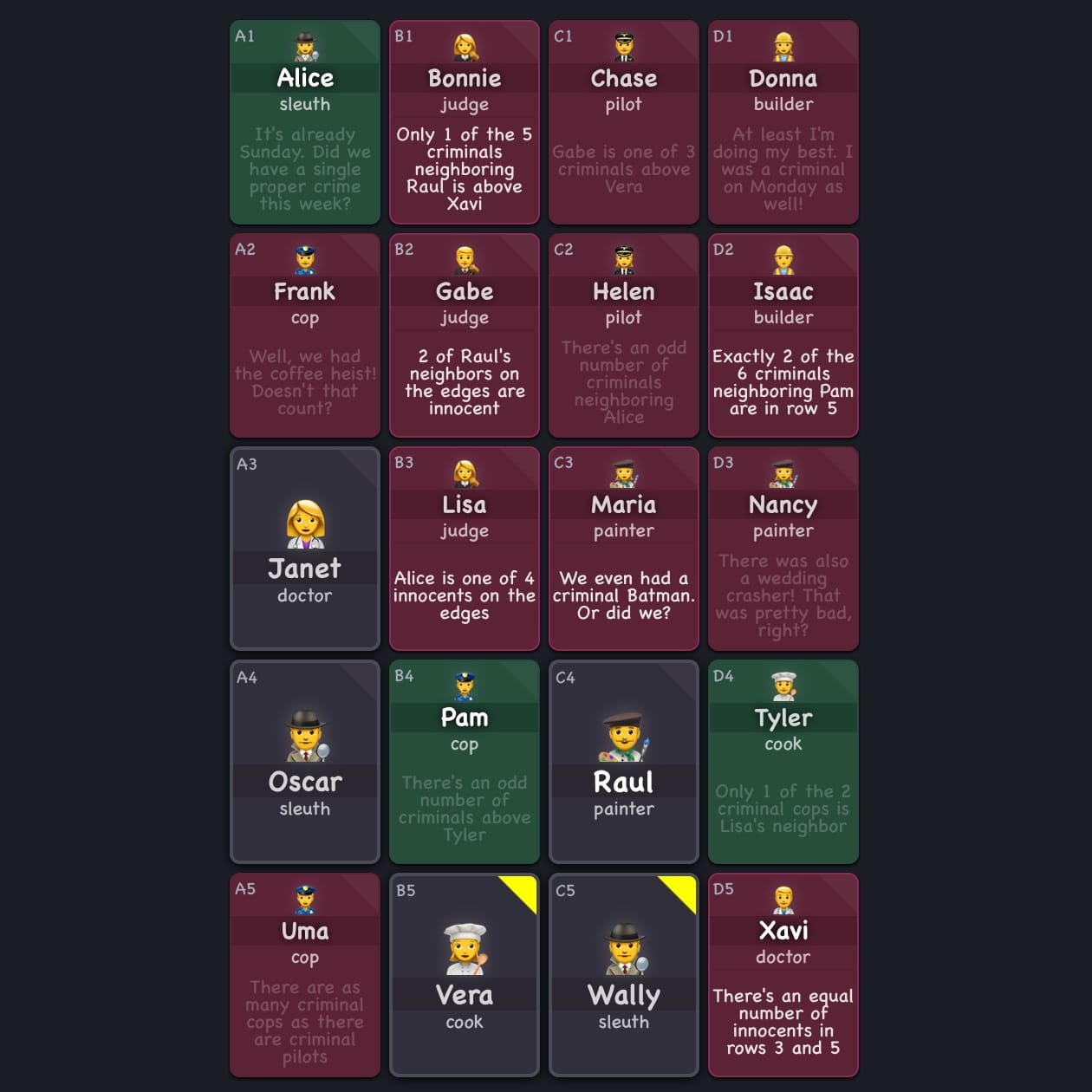
Now that Maria (C3) is the third criminal in row 3, we can use Xavi's clue to determine that Janet (A3) must be innocent.
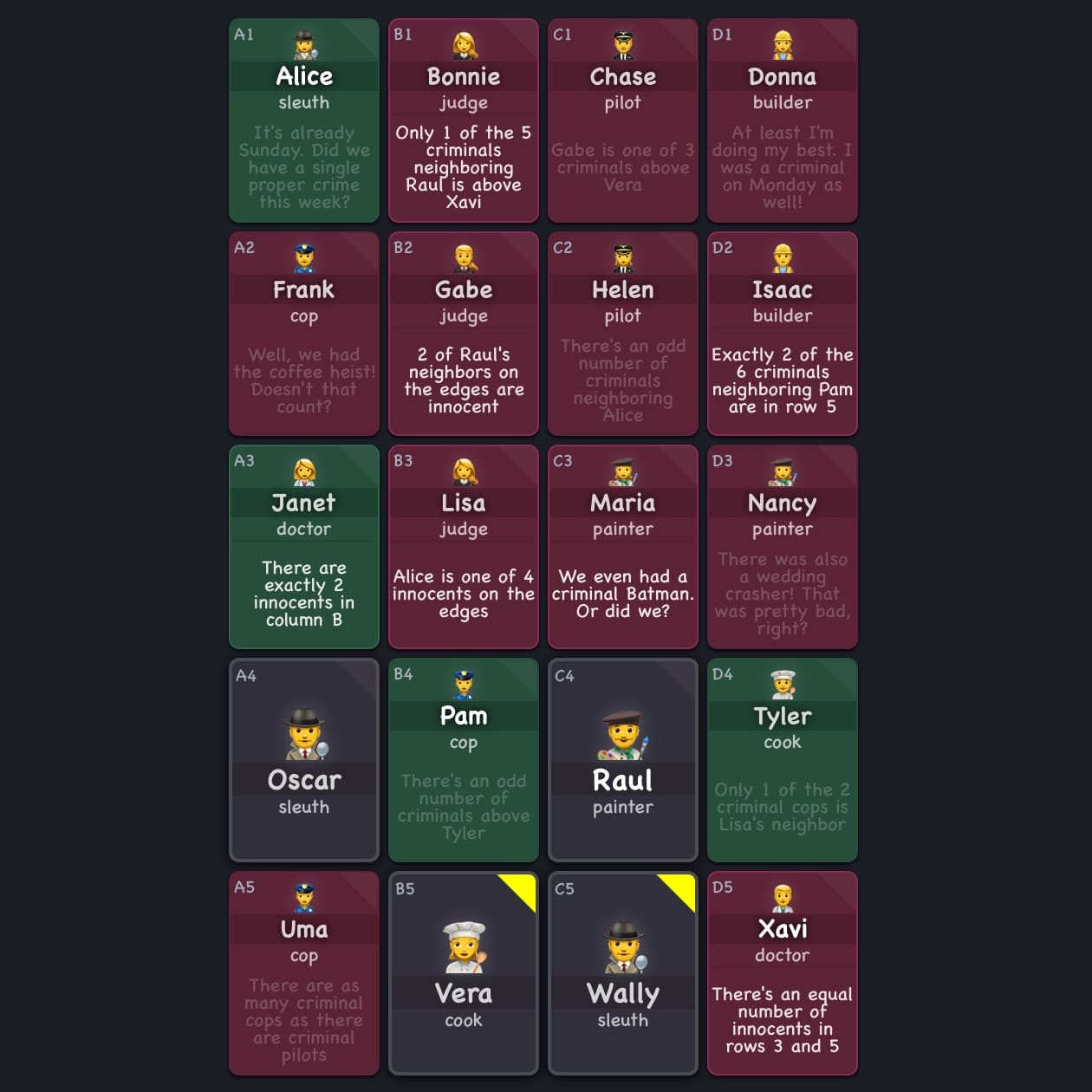
Janet's clue is "There are exactly 2 innocents in column B", which lets us untangle Vera, now locked in as innocent, and Wally, who must be a criminal.
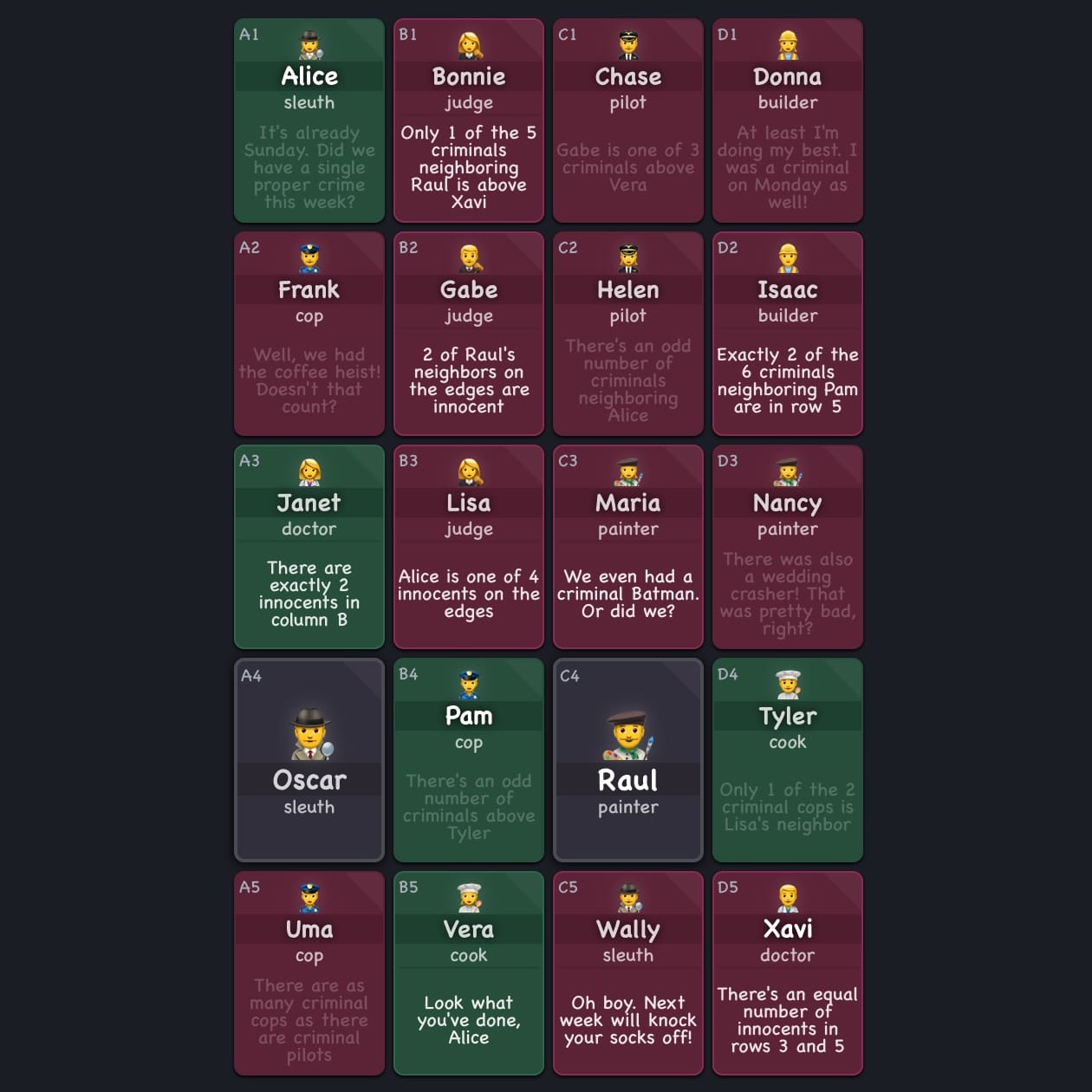
And with both Vera's and Wally's clues being jokes, we must return to past clues to see where to go from here. Yet again we can turn to Lisa's clue: "Alice is one of 4 innocents on the edges". How many innocents are currently on the edges? Four?! Okay, then we know what to make of Oscar (A4).
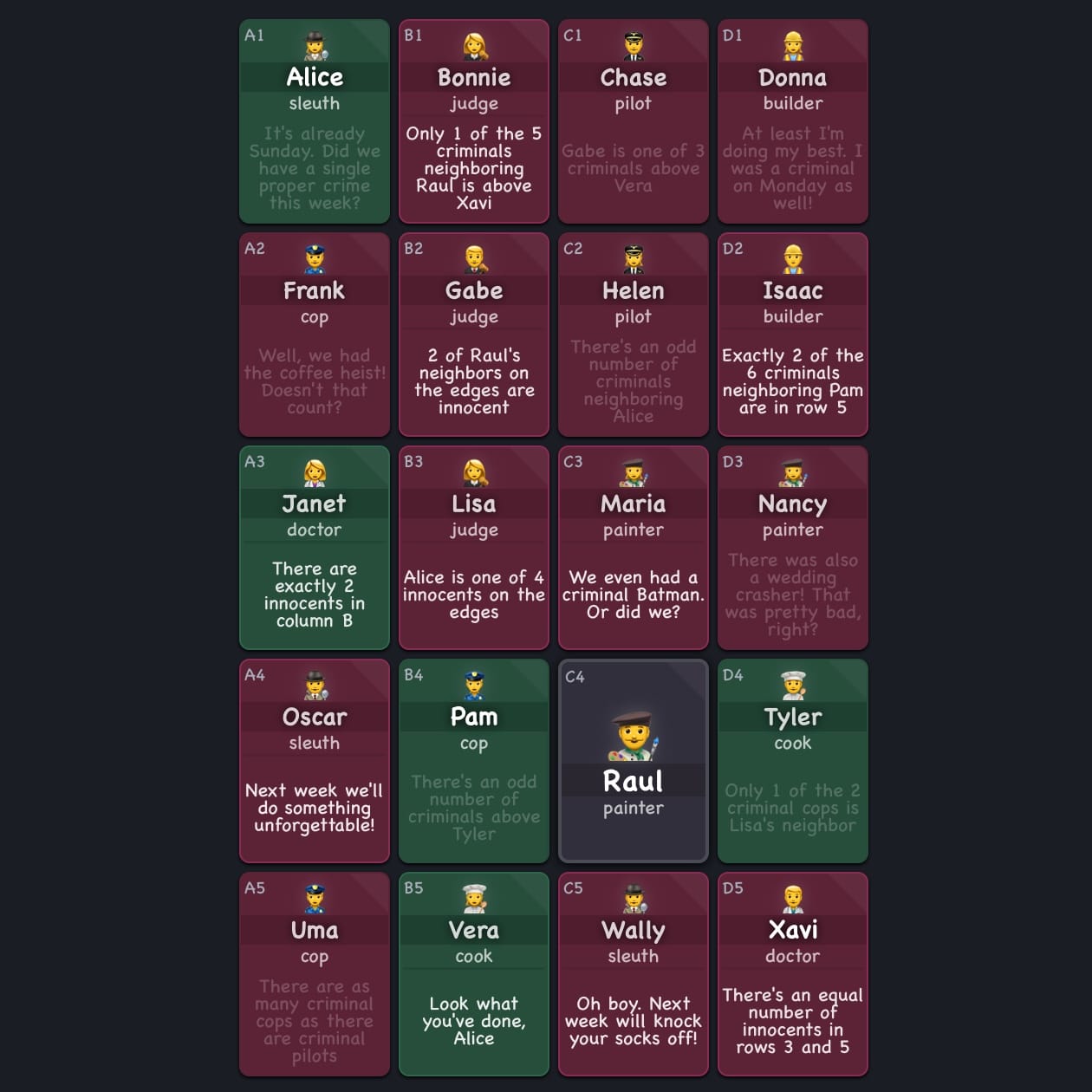
Oscar (A4) must be a criminal, which leaves only Raul (C4). Isaac's clue is similar to Bonnie's in being a twofer, and with only five criminals neighboring Pam so far, Raul must be the final bad egg in that criminal half-dozen.
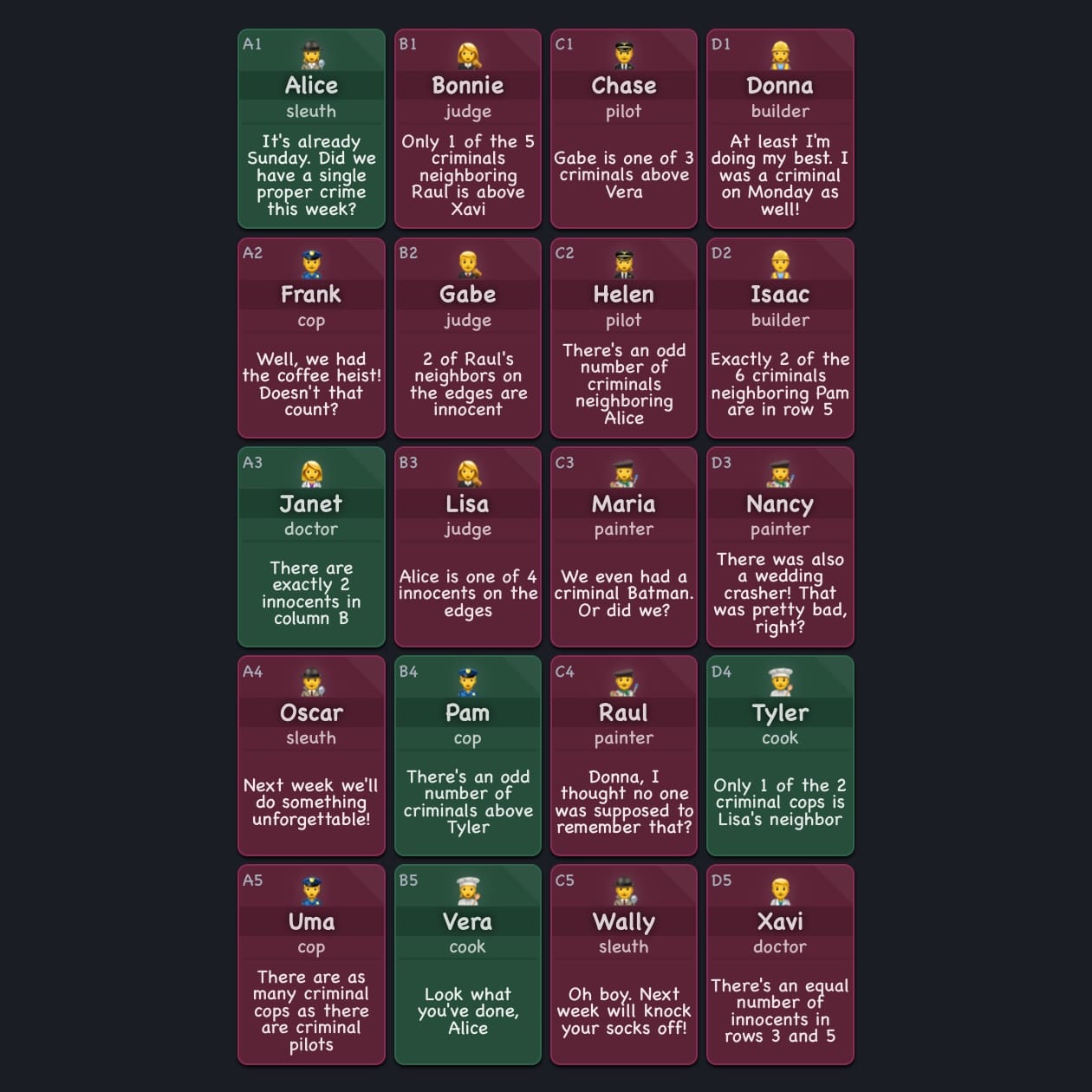
And that's that! We don't care how many people are innocent and criminal; only that everyone's status is resolved. Uncertainty has been banished, at least until tomorrow...