In a March 22, 2026 post on his "Illuminating Games" Substack, Chris Farrell posted the following, which I reprint here with his permission, slightly altered so that it stands on its own apart from the rest of the post:
When I sit at home and game with small local groups, I am vaguely aware of the absolutely unsustainable torrent of games being published each year, but cruising the halls of Dice Tower West in mid-March 2026 really drove home that the hobby is not in a great place right now. Growth is still robust, of course, vendors seem to be doing well, and fans seem to be happy — but how much of this stuff actually matters?
My context for this, as a classical musician, is the explosion of music in Europe from the middle of the 18th century through the beginning of the 19th. A bunch of factors came into play here including patronage networks, the growing middle class, the expansion and professionalization of orchestras, and the addition of new instruments (like the clarinet!) and technological improvements of others (like the piano), all of which created some kind of tipping point where both the audience size and the expressive possibilities exploded. A ton of concert music got created. Very little of it survived, but the stuff that did is likely to be relevant as long as humans are around and still humaning.
The interesting thing to reckon with is that boardgaming is no longer an emerging medium. Monopoly was published ninety years ago. Acquire, sixty. Squad Leader, fifty. CATAN, thirty. Every fiber of my being believes that board games are legitimate art. If what we make today is going to make a difference, going to be something that matters enough that people will care about them in one hundred years, it’s a little worrisome to me that I’m not sure we’re really moving on that. After all, it was only fifty years from the motion picture being a novelty to Casablanca.
This framing was informed by recent research on mancala games. Bao, Chess, Backgammon, Go: these games are a millennium or millennia old and still avidly played. They still speak to people. Why? I’m not a scholar of the history of games, but it seems like they capture something about how people relate to the world. They give people a way to contemplate existence: the direct conflict and hierarchical structure of Chess, the control and fluidity and extreme mastery requirements of Go, the circular flow and shared resources of Bao.
What ideas are modern board games working with? There are certainly some that are developing these classic ideas, like Tigris & Euphrates or Heat. Overwhelmingly, though, modern games are about building and optimizing an economy and personally accumulating surplus stuff. It’s capitalism all the way down and a framing that would have made zero sense before the mid-20th century.
The more we understand about human psychology, the more we understand that while capitalism may be the most powerful structure for lifting people out of poverty (when well-regulated), it’s also the worst system except for everything else we’ve tried and just not fundamentally how people relate to the world. We tolerate capitalism because we like having our basic physical needs met without too much hassle. We relate to the world through our relationships with ourselves, other people, our communities, our neighbors, our mortality. Capitalism is one of the vehicles through which people pursue status, which is vitally important to us — but it’s the status that matters, not the vehicle. As the 21st century hurtles towards whatever doom it’s hurtling towards, it’s become increasingly clear that capitalism as an organizing principle says nothing about what we as people really care about, so it can’t be great that when you chip away the paint, capitalism is the framing device for such an huge percentage of the hobbyist games on the market.
I think that the crippling lack of diversity in game design is a not unrelated huge problem. It’s impossible that if you were actually looking for the most qualified, most creative, most interesting and expressive voices that our roster of game designers would look the way it does — overwhelmingly male, overwhelmingly white. Would we have more games that were not fundamentally about capitalism, conflict, and exploitation if we had more female designers or more people from cultures who were on the pointy end of colonialism? Hard to say for sure, but it’s also hard to imagine that things would be worse. I certainly think it’s indicative that the most deeply interesting game of the last five years is Molly House: a collaboration between a trans designer with little game design experience, and an industry veteran who was willing to both lend experience and get out of the way. It resulted in a game that is, in fact, not about capitalism but how we relate to each other.
Farrell's observations spoke to me, partly because of the never-ending tsunami of games that has me running for cover these days, more interested in observing from a distance than getting soaked with newness, but also because of the "capitalism all the way down" callout.
We often think of games as having a narrative arc similar to books and movies, with the game's set-up serving as exposition to put all of the story elements in place. The game begins, with rising action as we each progress on our own paths, conflict resulting from competing desires before we reach the climactic peak of tension, which resolves via falling action and the denouement, a.k.a. score-tallying.
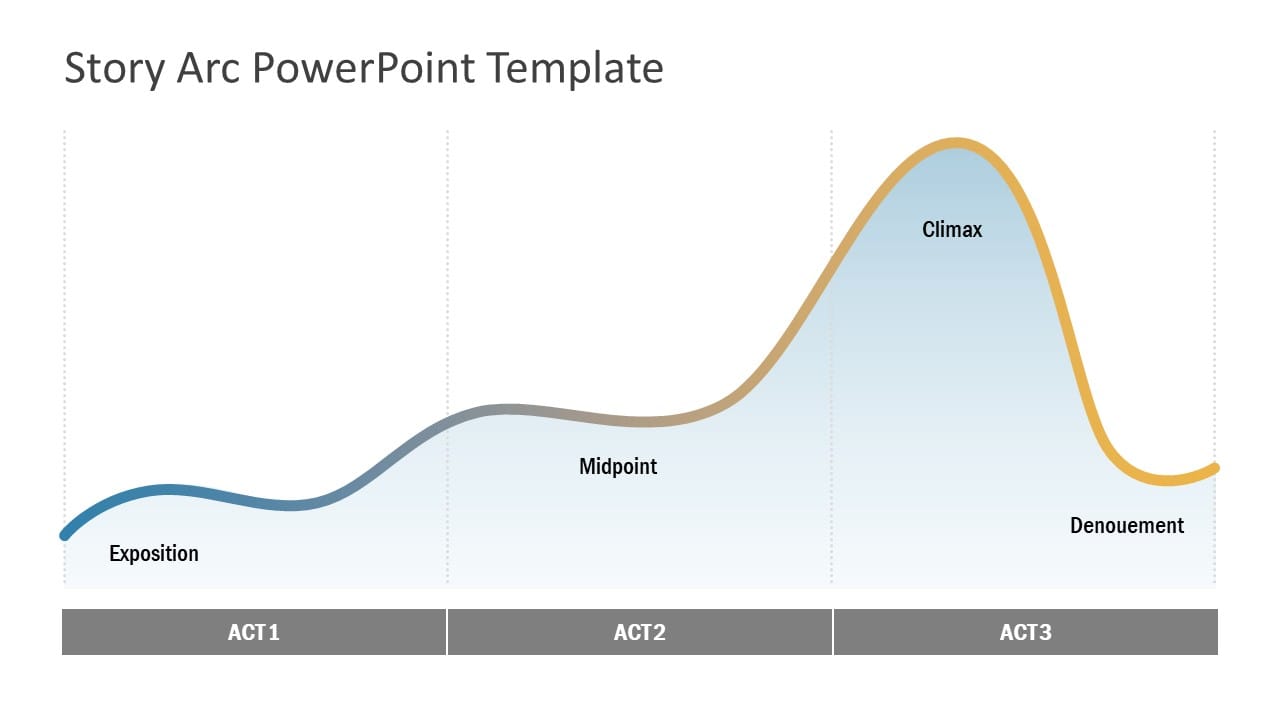
This story arc structure of a rising pyramid is reproduced in many games through the growth of elements within the game, with Agricola being an obvious example. We start with only two actions per round with a narrow selection of action choices, but as the game progresses, we gain new family members and thus new actions, with an additional choice coming into play each round. Resources start piling up on cards, allowing you to take grander, more meaningful turns. As you near the game's end, you start sweating out whether you can complete all of your grand plans before the scoresheet comes out for the aforementioned tallying.
Even simple games feature growth along these lines, as in Meister Makatsu, which I reviewed in June 2025. Playing the high card on a turn earns unwanted points, with points escalating from 1 to 3 over the course of three rounds to make later actions more consequential.
This growth pattern within games makes sense narratively as it represents the rising complications confronting the protagonists, that is, players. P.G. Wodehouse excelled with these situations in his "Jeeves" novels such as The Mating Season, which features a cast of characters brought onto stage bit by bit, each introducing a twist in the ongoing story that escalates to cyclonic speeds before Jeeves rights all and dissipates the storm.
But that growth pattern within games also mimics capitalistic behavior in which growth is the prime directive, with everything in the world seen only as a resource to be mined, crafted, or otherwise manipulated in order to sell or rent it to someone. The vast diversity of the world is sifted into two categories — products and customers — and all that matters is marketing the former to extract money from the latter.
From Farrell's perspective, games often feel "capitalistic" due to the player actions, regardless of whatever the setting might be. Earlier in his post, he said this in a review of Endeavor: Deep Sea:
I've heard people say they really like Endeavor: Deep Sea for the theme. And I get that; the ocean tiles particularly have great illustrations that are very evocative of different sea environments. I want to like the theme, too. Here's where I end up at on this. Somewhat similarly to say Ra or Amun-Re, these are abstract games where the art is doing a lot of the heavy lifting. That can be OK; with Ra and its various spin-offs particularly the core game engine is so strong that it can blend successfully with the nice trappings. With Endeavor, I'm not so sure. It's an engine that's pure economic exploitation (unsurprisingly, given the original theme!) with chrome that's nominally about pure scientific exploration and conservation. It's a fundamental clash that makes the game feel profoundly dissonant. There is a reason why so many games are about economics and trade and capitalism and exploitation; we don't really have the language and grammar to do games about science and discovery. There have been a few — Catan: Starfarers Duel, Lost Cities, maybe Alchemists — but there just haven't been that many people working in that space. Games like Molly House which successfully tackle social issues are incredibly rare. It's hard! I do think though that if you want to make a game about conservation, discovery, and protection, you have to commit to the bit and use a core system that makes sense in the context of those themes.
Another reason that Farrell's comments resonated with me is that by chance I had just been looking at Rayroads, a February 2026 release from Amabel Holland of Hollandspiele.
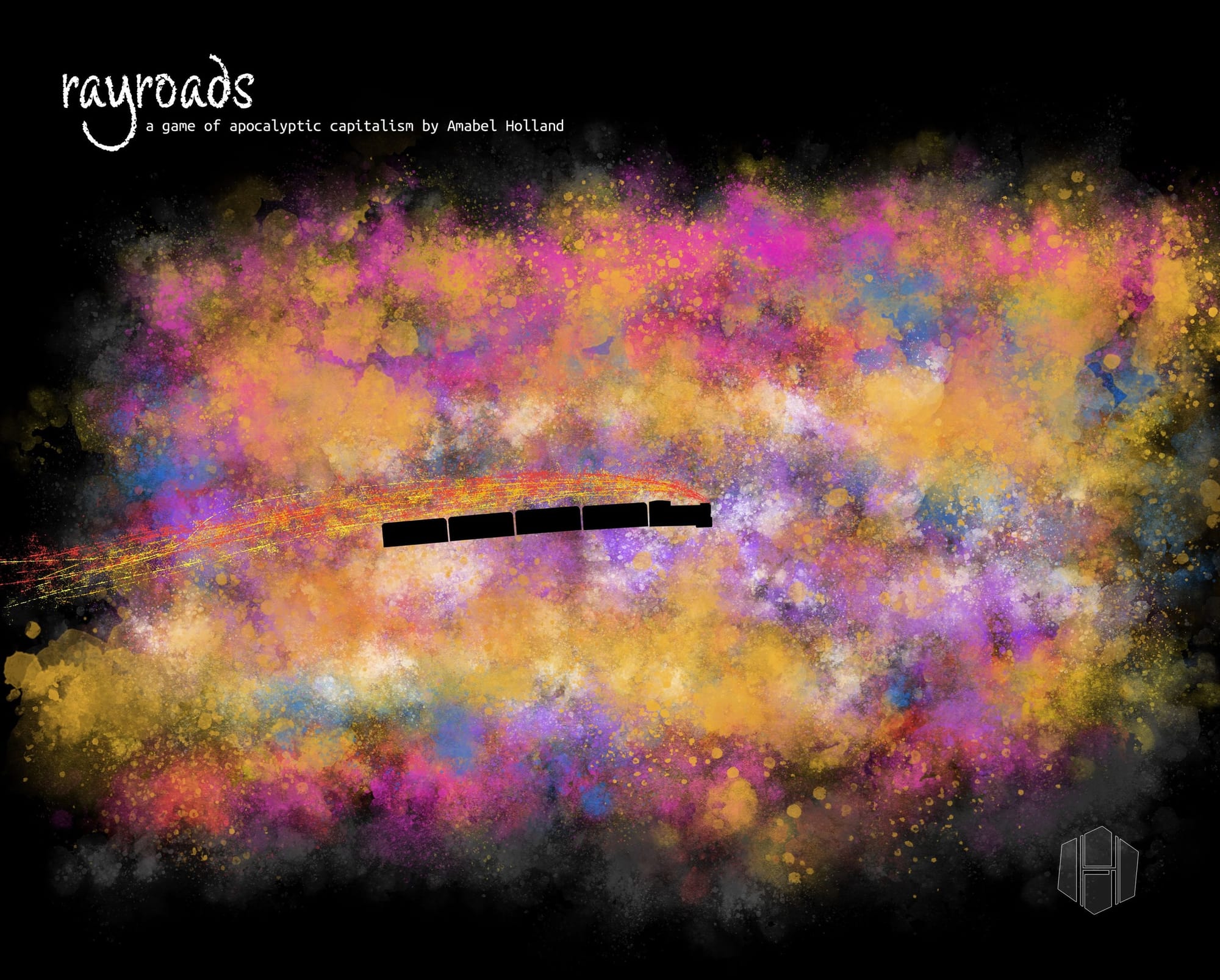
Holland has designed multiple train-network games over the years, most recently Dual Gauge in 2020, but whereas that game's action is set in Portugal and around Detroit, Rayroads is functioning on a grander scale in terms of both geographic area and the consequences of what players do. Here is her description of this 3-4 player game:
Your world is dying. Soon, the last of its resources will be extracted from its husk, and it will no longer be able to support life. Now you turn your attention toward the stars. You'll drain the life from your sun to propel your trains through the void, crack open the other planets in your system to exploit their precious minerals, and increase your company's value to shareholders as all of you go extinct.
The first new train game from Amabel Holland in six years, Rayroads is an unusual approach to the genre that extends the logic of capitalism to its nihilistic conclusion.
Each round of Rayroads will see players take resources from their dying planet — making it less inhabitable — in order to take an action. You might plan a route for your space train — taking into account the orbits of planets — powered by the sun you're intentionally collapsing. You might build a moonbase to begin cracking open other planets; they're probably uninhabited, but you haven't really bothered to check. Or you'll tear open the fabric of space itself to make your travels more efficient — pity about what it does to the orbits of nearby planets.
The game ends when you've collapsed your sun, destroyed your home planet, or been destroyed by your capitalist-fascist eugenics doomsday cult. Players tally their profits, subtract their debits, and apply some multipliers to arrive at their final scores. The highest score wins, but as everyone is now dead, what does it matter?
Bleak and accurate!
I asked Holland about the origin of Rayroads, and she said that while normally her game designs are about exploring a subject or making an argument, her train games have tended to be "purely mechanical exercises".
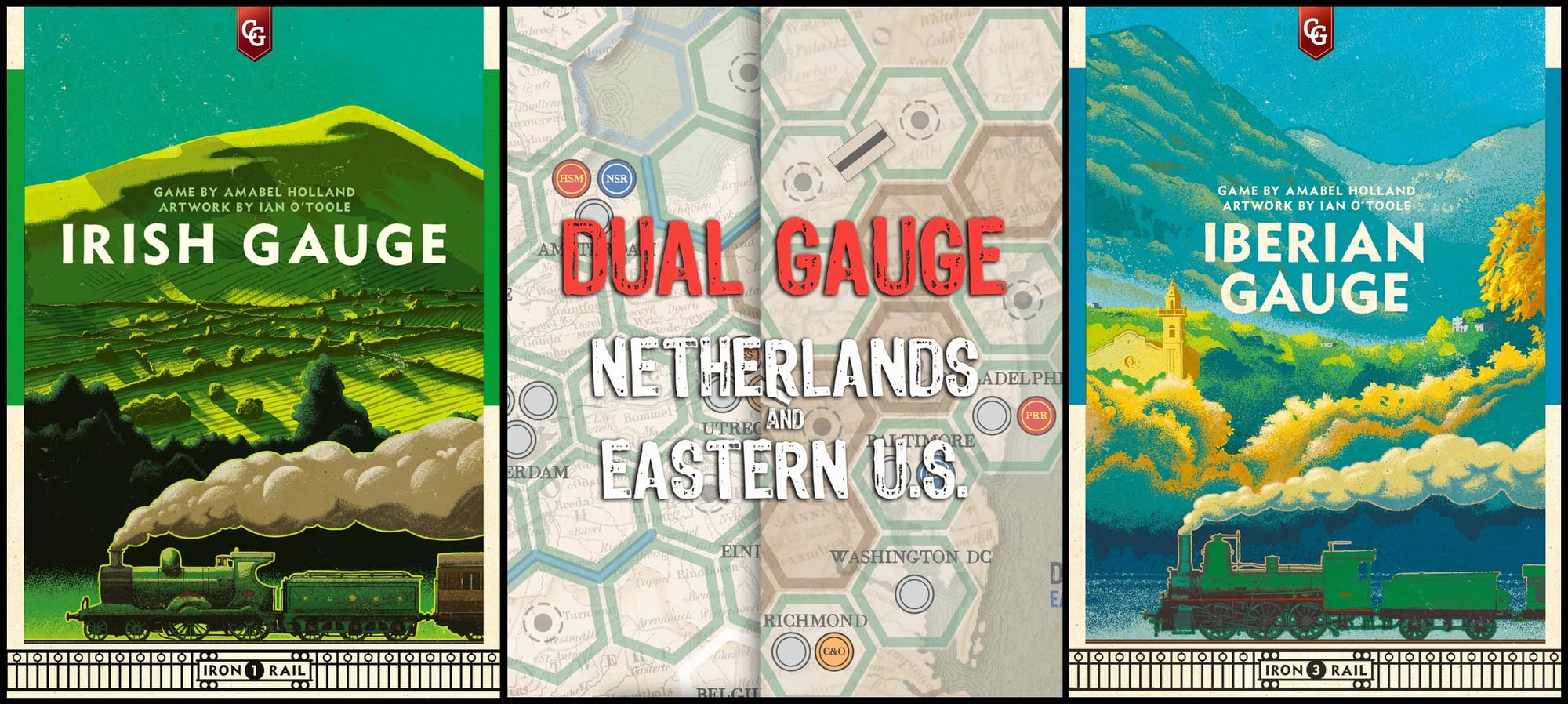
"That's actually something that's bothered me about them as time has gone on", she says. "I'm well-known for my work that engages with history seriously, but with something like Irish Gauge or Northern Pacific, I'm not really doing that. Not every game has to, but it started to feel particularly egregious given how many horrific things — the staggering human and ecological costs — are papered over to make these pleasant little cutthroat capitalism games. That's actually a reason why I haven't made a train game in a very long time, and I've certainly been thinking over the course of the last several years, how would I make a train game that also made an argument or was expressive?"
While all these thoughts were in her head, someone happened to tease Holland about her pronunciation of "railroads". Instead of being annoyed, her "rayroads" neologism unlocked the answer she had been seeking. "For whatever reason when I was made fun of this time, I thought, 'Ooh, heck yeah, space trains'. Because while I don't actually care very much about trains, I do love 'trains in outer space', something which dates back to when I was a kid and caught a few episodes of the 1978 anime Galaxy Express 999, which is a very bleak science fiction western with some rudimentary class politics at its heart."
Holland says that she's usually struck with a game's theme first, with the mechanisms arriving split-second later — and that's what happened here, too: "In that moment, simultaneously, I thought, I should do a space train game called Rayroads, and I can use that to be more expressive or even satirical, and I've never seen a space game where the planets actually have an orbit that you need to take into account. And all of that together was the origin of the thing."
This happened in the early 2020s, but as she tried to instantiate this design, she kept having trouble making the planets cleanly orbit at different speeds. "There were some early prototypes where there wasn't a map at all", she says, "but free-floating planet counters that were moved according to rulers. Very fiddly stuff, and it would end up being quite expensive."
In 2024, Hollandspiele licensed Xoe Allred's self-published game Persuasion, and during development Mary and Amabel Holland opted for dry erase markers as a way to make the gameplay less fiddly...and with dry erase markers now on the table as a potential game component, Holland realized they could solve many problems related to trains in space.
She says, "This turned out to be the key to making Rayroads less fiddly and to give it a smaller footprint that we could produce and offer at a price in line with the prices of our other train games. A lot of the specific mechanisms — the depletion of resources, planning of routes, building of warp gates, etc. — all come out of using dry erase markers. I think if it hadn't been for that I would still be trying to find a way to implement the feel I wanted at an affordable pricepoint."
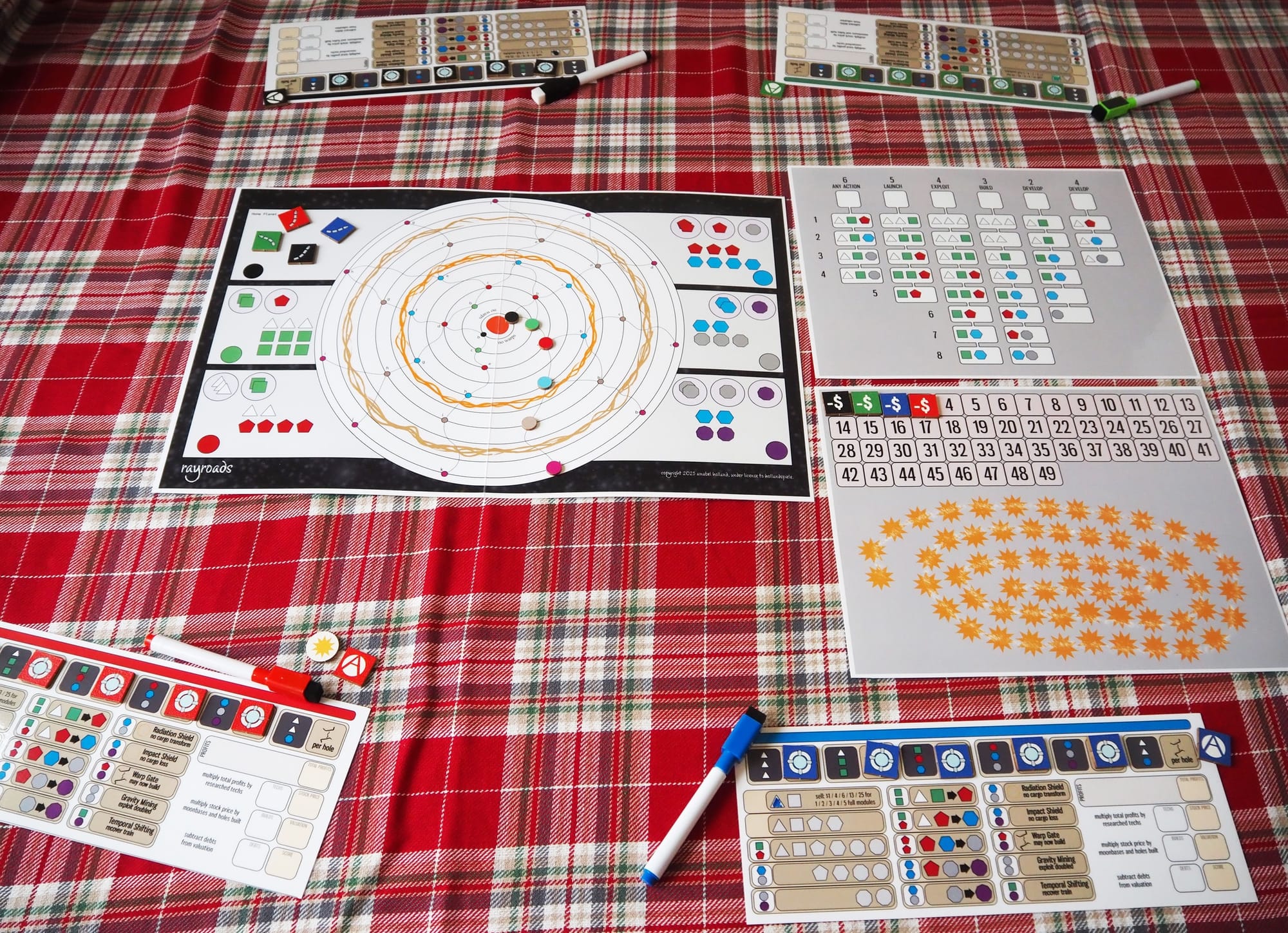
Rayroads' central game board above shows the starting set-up, with six planets starting in a near 2001 linear arrangement. All of the space trains start on the innermost planet, and each planet on the central board shows 2-3 spaces where moonbases can be built, as well as the resources that can be acquired.
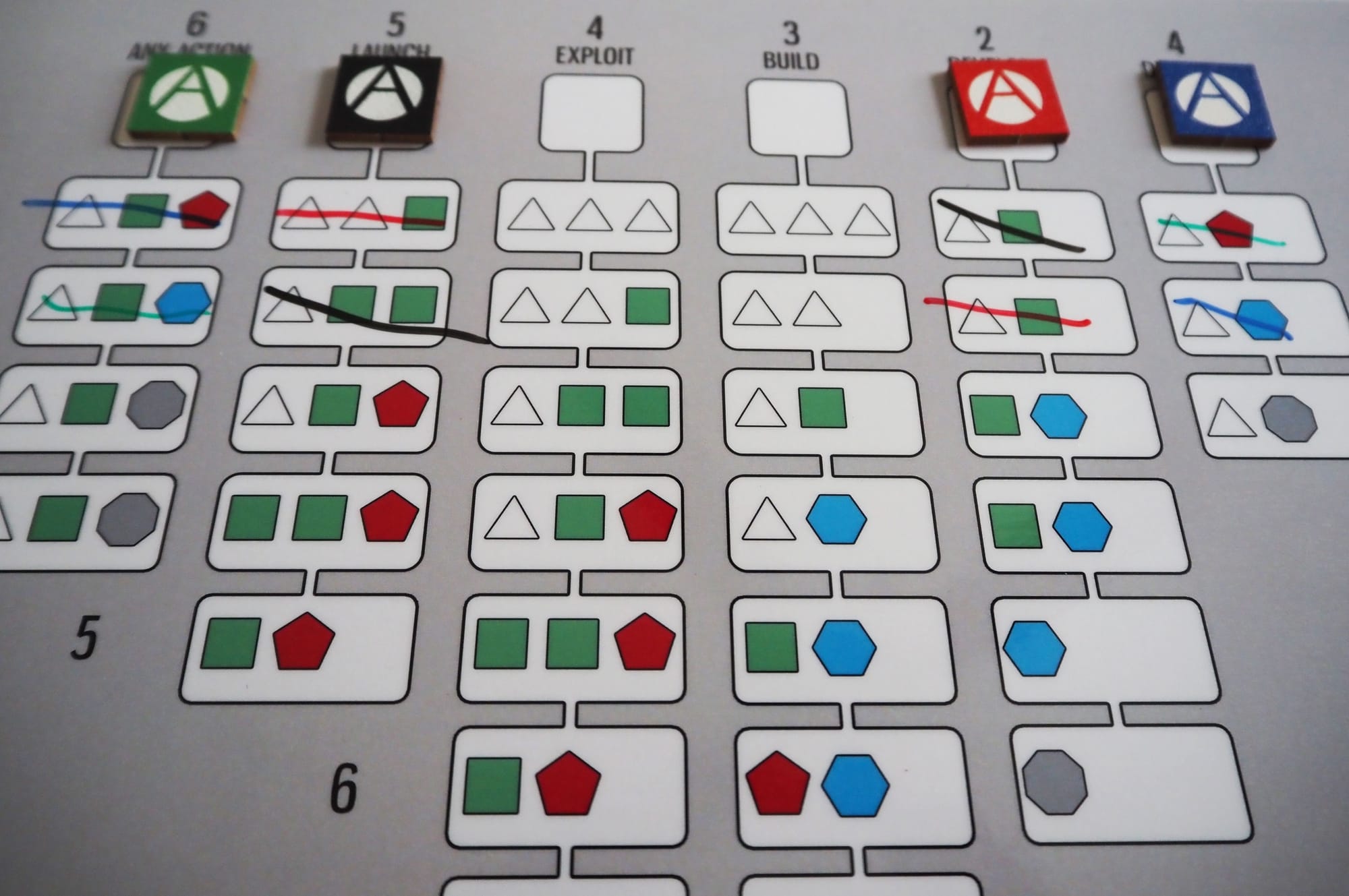
Each turn, players choose actions, with each action giving the player 2-6 debt; actions are resolved left to right, with each player receiving the resources depicted in the highest unmarked space under their action. Resources go into storage modules on your personal board in the appropriate spaces, and you'll spend them to build moonbases — which will allow you to exploit those moons later for more resources — and develop technologies, such as more storage modules, synthetic processes that allow resource conversion, and technologies such as warp gates and radiation shields.
Oh, and you can sell filled storage modules for profit, but you probably already assumed that. After all, your bank balance will survive into the afterlife to impress all who will come later.
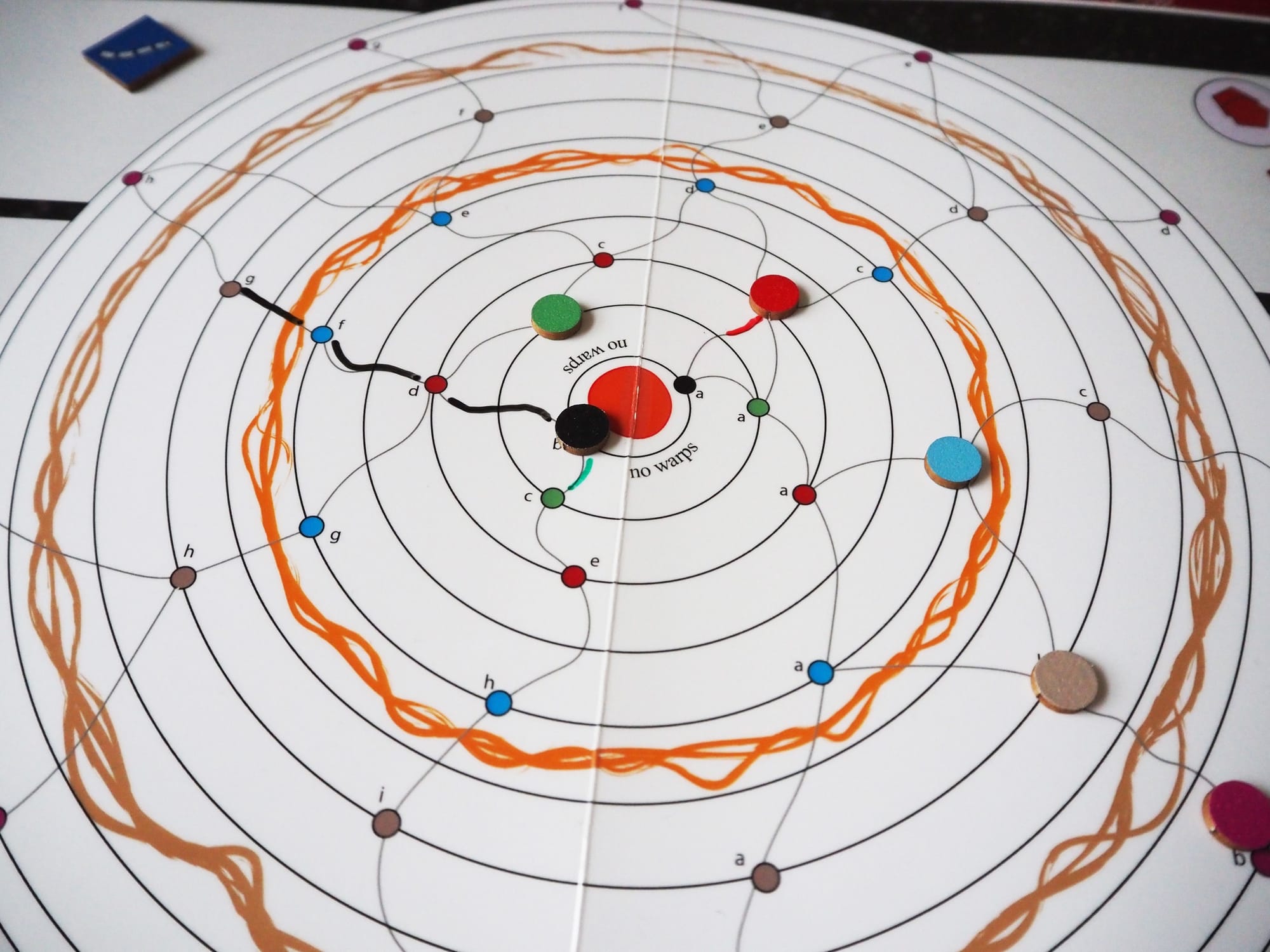
The "launch" action allows you to take on debt to mark segments between planets, and at the end of each round your train will advance one segment while each planet moves one space clockwise...unless someone has built a warp gate near a planetary position, which will bump it ahead another space. Ideally you plan correctly and manage to have your train and the intended planet meet at the same point so that you don't have to incur more debt.
You'll have to brave the radiation and asteroid belts to reach the outermost planet, but where else are you going to get those sweet nonagons that everyone craves?
Like Holland's other train games, Rayroads is deterministic aside from determining the player order, but one big difference is that you don't have to handle money or budget purchases. She says, "There's profit, which you score, and there's debt, which you accumulate, but you'll never be a dollar short of doing something. In that way, it's more forgiving and even a little freeform: do you want to plan a quick jaunt to the neighboring planet for a handful of debt, or do you want to plunge yourself into a ruinous trek to the far reaches of the solar system on turn one? That's up to you."
That said, you do want to pay attention to building moonbases and gates and developing technologies because at game's end your profit total will be multiplied by both your builds and your techs. "And you know what happens when you multiply by zero!" says Holland. In addition, "There are steep debt penalties for miscalculating your planned route, and because the other players can do things like destabilize a planet's orbit, you might run afoul of that. The planning aspect — drawing your route before you launch, and visualizing where relevant planets will be during each step of that flight unfolding across the next several turns — makes it a far 'nerdier' game I think."
She continues, "It's also the first train game to 'feel' like 'an Amabel Holland game', if that makes sense? I think there's a marked shift in the nature and tone of my work since the name change five years ago, and I think this game feels much more in-line with that recent work and that sensibility than the other train games, which were all made earlier."