

I'm still not through with coverage of Gen Con 2026, so let me chip away at that boulder and try to move toward completion before the end of August. One month should be plenty of time to cover everything, yes?
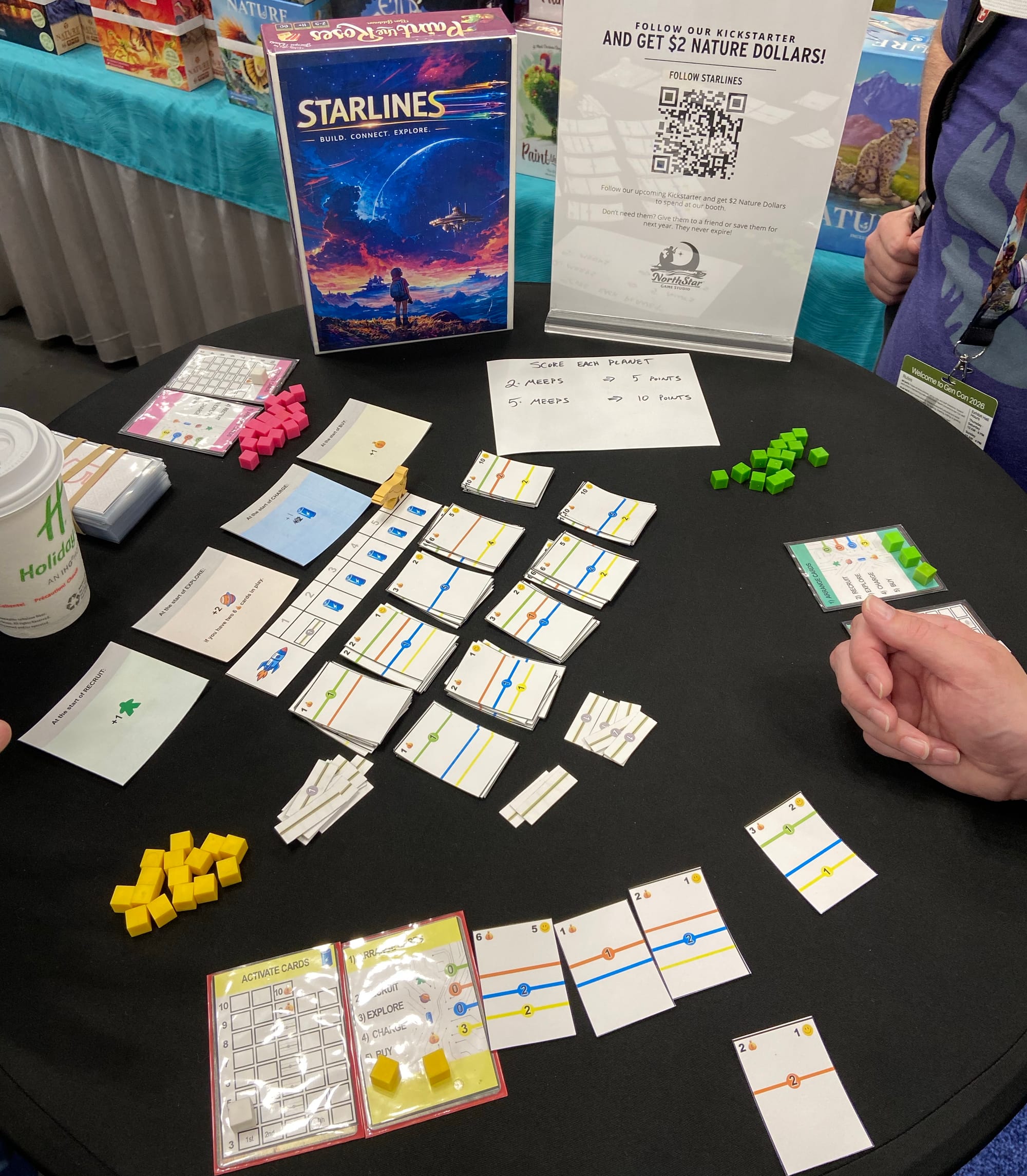
Starlines is a deck-building game of sorts from Dominic Crapuchettes of NorthStar Game Studio, with this 1-4 player game being crowdfunded ahead of a planned release in mid-2027.
The game lasts six rounds, and in each round you use the "starlines" that you've acquired to gain and use resources. To do this, you arrange cards in the order of your choice next to your starbase, with you initially being able to place only three cards. You then "activate" each starline that extends from the base by summing up the numbers on that line:
- Recruit (green) — Take X astronauts from your reserve and place them on your starbase.
- Explore (orange) — Take X astronauts from your starbase and place them on the four "space stations" that provide action bonuses.
- Charge (blue) — Move the "charge" marker X spaces in your starbase, thereby allowing you to place more cards on a turn and giving you a bonus "connector" every fifth movement. Move far enough, and you receive 6 or 10 money as bonuses.
- Buy (yellow) — Gain X coins to spend on new cards or connectors.
Cards cost 1, 2, 3, 6, or 10 money, and you can buy only the top card of any pile. The connectors have a solid line on one side (at a cost of 1) and a (1) number on the other (at a cost of 2). Each connector is a one-shot ability to extend a line that would otherwise end. In the image above, for example, if I had a connector, I could connect the yellow line on card #1 to the yellow line on card #3...but doing that would be pointless since the yellow line on card #3 doesn't boost how much I can buy.
In the image above, which was during the rules explanation and not a sample turn, you can see that I have values of recruit 0, explore 1, charge 2, and buy 5.
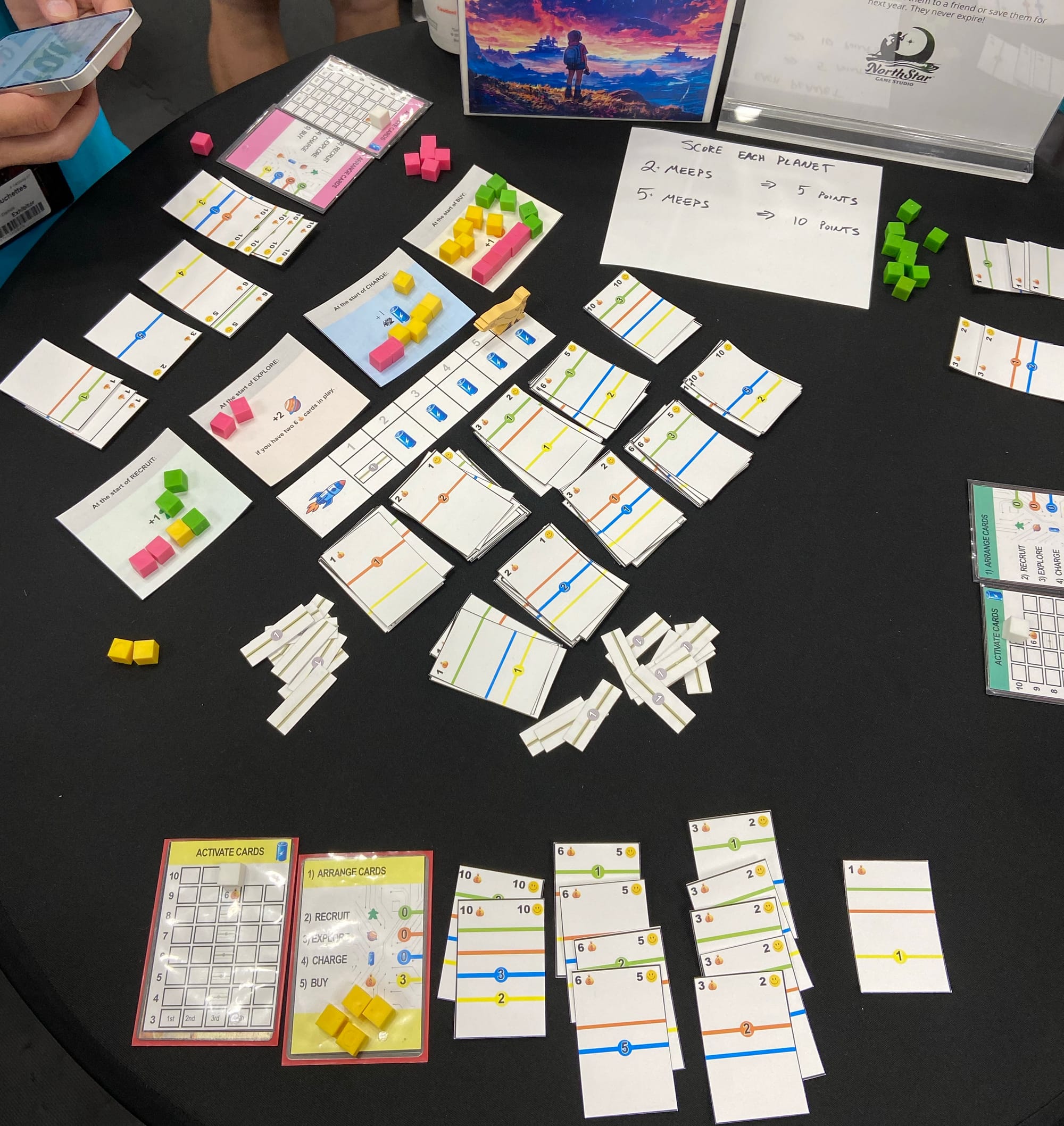
You can think of Starlines as akin to Splendor as you'll build an engine of sorts that gives you more purchasing power in later rounds, but you can arrange the cards as you like at the start of each round, which means you're not locked in to using specific cards that you've acquired — but since your starbase sets a building limit, you also can't use all of the cards you've acquired.
You want connectors to extend lines and cover gaps. Yes, they're single-use items, but ideally you can use them to boost your lines, thereby giving you more gas in the tank for your engine.
The space stations work similarly to boost your engine. Here, I've placed five astronauts on the "+1 charge" station, which meant that each turn I'd move at least five spaces on my starbase, thereby allowing me to play one more card next turn, while also giving me a connector. Five astronauts on a station also gave me 10 bonus points, with your cards being the main way you earn points. Even if you never use a purchased card on a turn, you still score its points at game's end.
Obviously the game is still being developed at this point, but different space stations will be included, allowing for variability in the bonus effects each game.
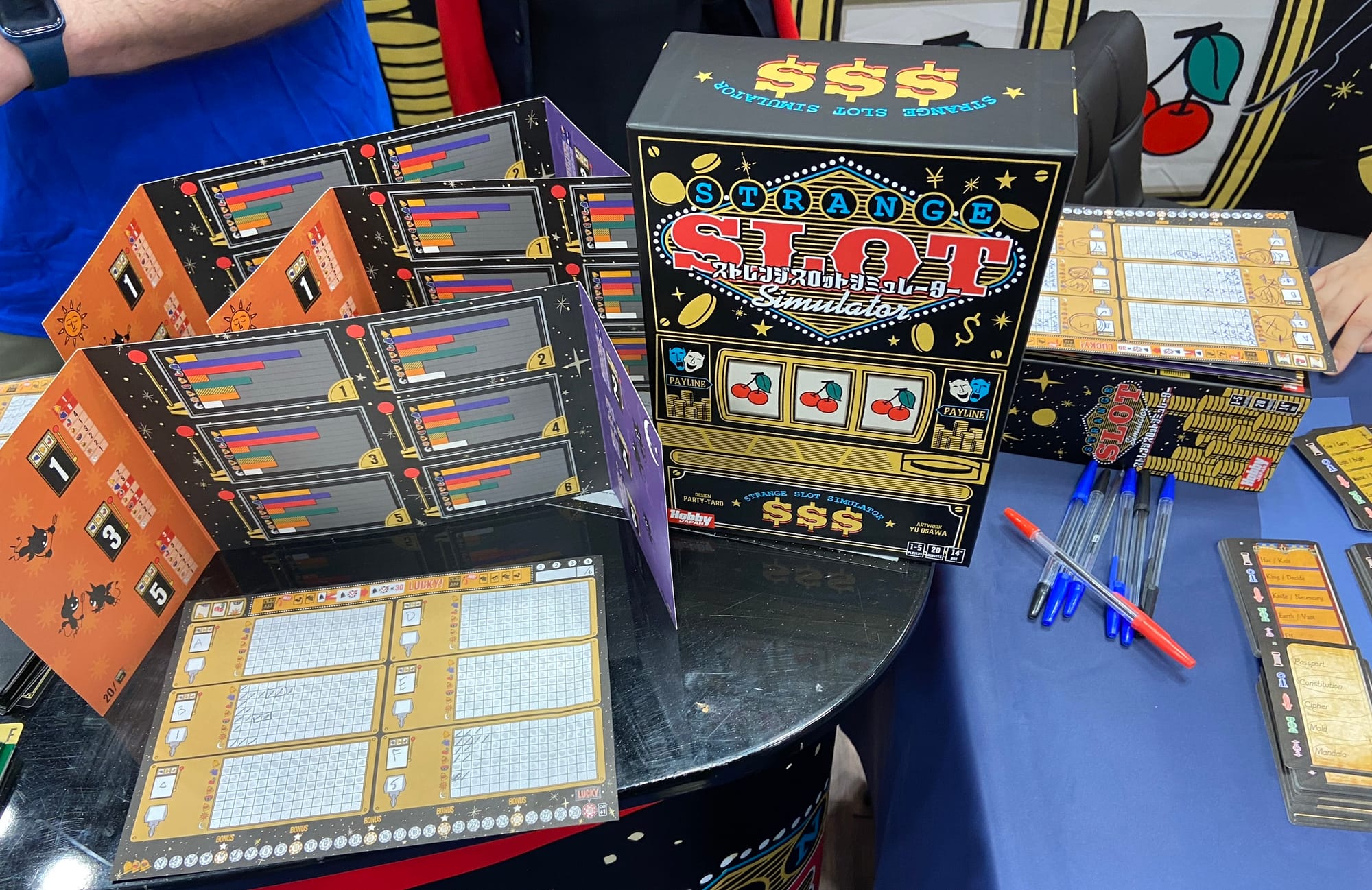
Hobby Japan featured an unusually large game compared to what it normally releases, with Party-Taro's Strange Slot Simulator being just what the title says: a simulation of strange slot machines.
Your goal is not to win money at these machines, which are represented by 20-card decks, but to determine which machine is which. Each of the six machines has different odds for what will appear in its windows, and in a round you're typically going to pull three cards from the deck of cards that represents a machine, shuffle those three back in, then draw another three cards, repeat. Alternatively, you can swap your machine for another machine that was unchosen. Bonus symbols can let you draw more cards, giving you a better sense of the card distribution in a machine.
After four minutes, you take notes, then everyone returns all of the machines before you draft again, and after four rounds, you try to deduce which machines are which.
Sounds weird and unlike anything else, so I bought a copy, but haven't yet played...
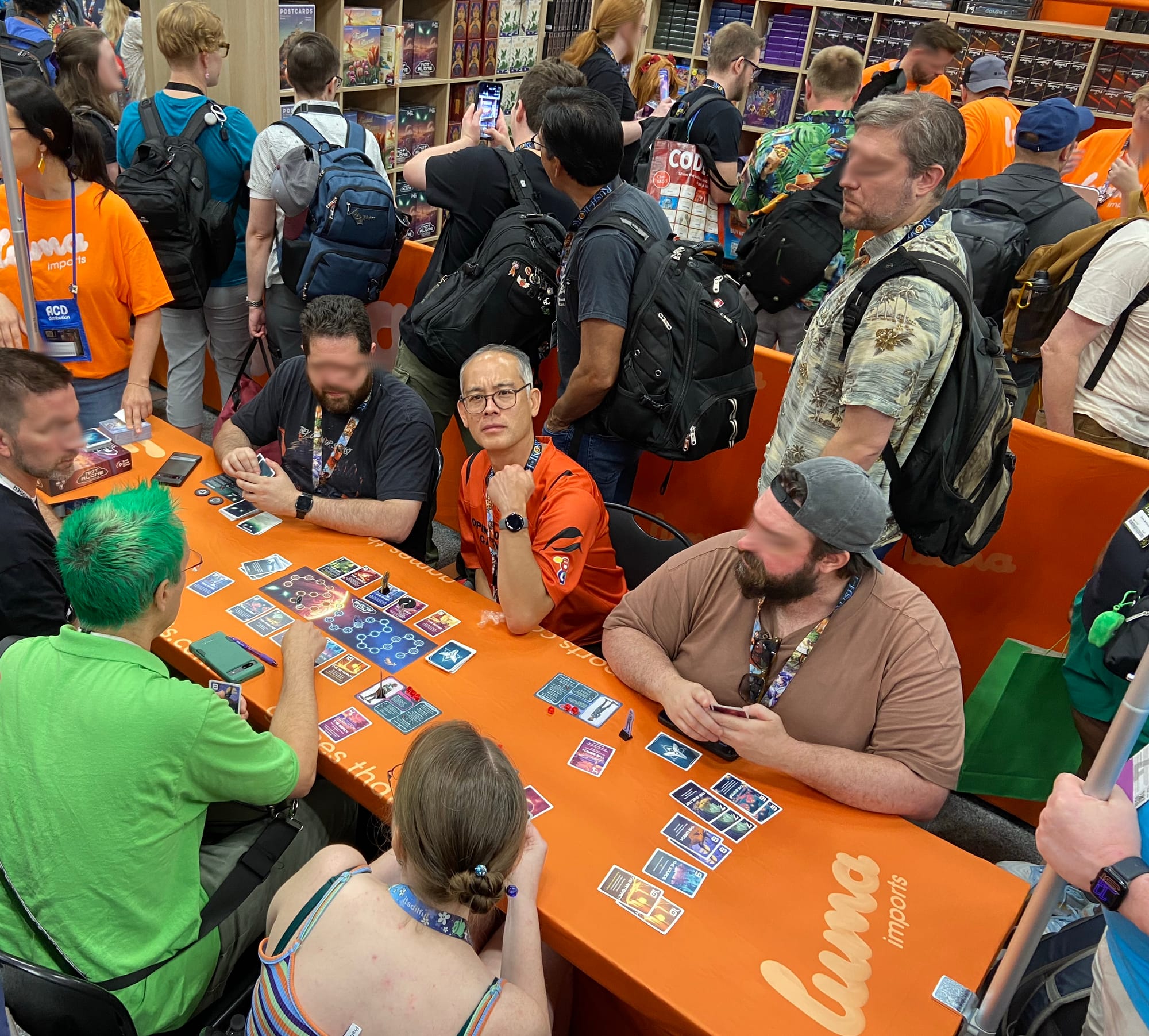
Luma Imports is distributing a "remastered edition" of Ghislain Masson's Not Alone from Geek Attitude Games, which debuted a decade ago(!) in 2016. The game pits one player — the Creature — against up to six other players, who are all being hunted and trying to avoid being assimilated before they can be rescued. (For more details on gameplay, head to Dale Yu's write-up on Opinionated Gamers.)
This new edition contains a "Frozen Lands" module for 4-7 players that changes the victory condition for the Creature as hunted players can now be contaminated, and if anyone in that party is contaminated, then they all perish upon being rescued.
One side note about Gen Con 2026: The convention organizers were cracking down on lines at booths more than in past years, and since the Luma Imports booth was being swarmed by customers on Thursday morning, the employees threaded that line between the tables in its booth to try to keep the aisles clear. Luma failed at that task due to the volume of potential buyers, but I'm not sure what the solution is for this problem.
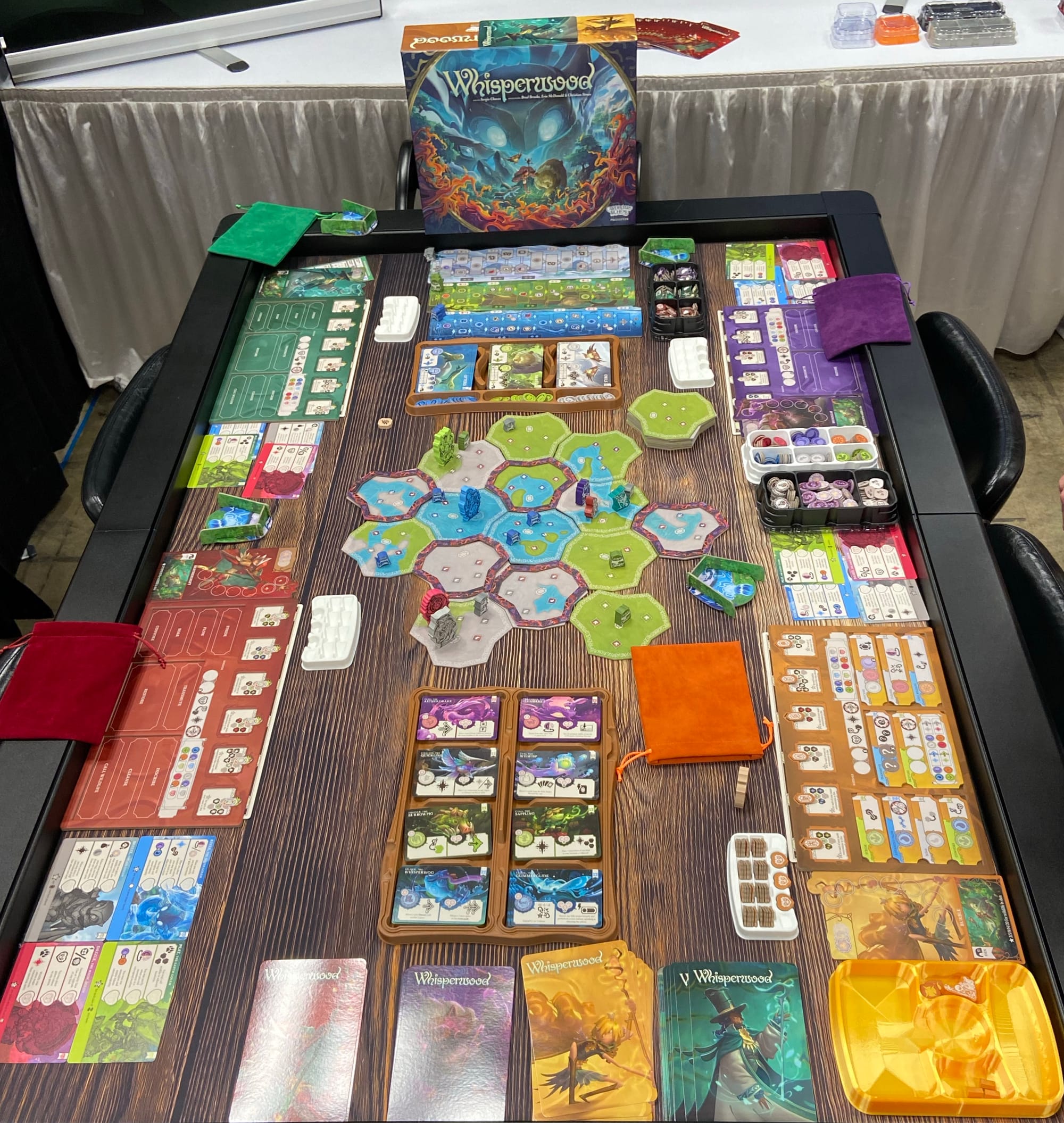
Publisher Cardboard Alchemy has had consistent crowdfunding success with Flamecraft, Andromeda's Edge, and Critter Kitchen, and at Gen Con 2026 it showed off a mock-up of Whisperwood, a 1-4 player design from Brad Brooks, Erin McDonald, and Christian Strain that is being crowdfunded through the end of August 2026 in anticipation of an April 2028(!) delivery date. Here's an overview of the game from the publisher:
In the generations since the war with the Dark Sorcerer, the forest of Whisperwood has stood silent, mired in corruption and lifeless. A council of Druids has taken on the task of cleansing the forest, awakening its Guardian Golems and restoring the flora and fauna. The druid who accomplishes the most in this endeavor will ascend to become the Primus of the Council.
Whisperwood is a bag-building game for player druids who harness the power of the elements and the natural world to restore a forest. Each round, players simultaneously summon magical energy in the form of tokens and plan the incantations they will perform. The players then perform their incantations in turn order, restoring air, water, and earth; partnering with wildlife; inscribing runes; and awakening the Guardian Golems to perform magical tasks. The land is strewn with corruption and the druids must absorb and purify this corruption to heal the forest — but take on too much corruption, and your magical abilities will be compromised!
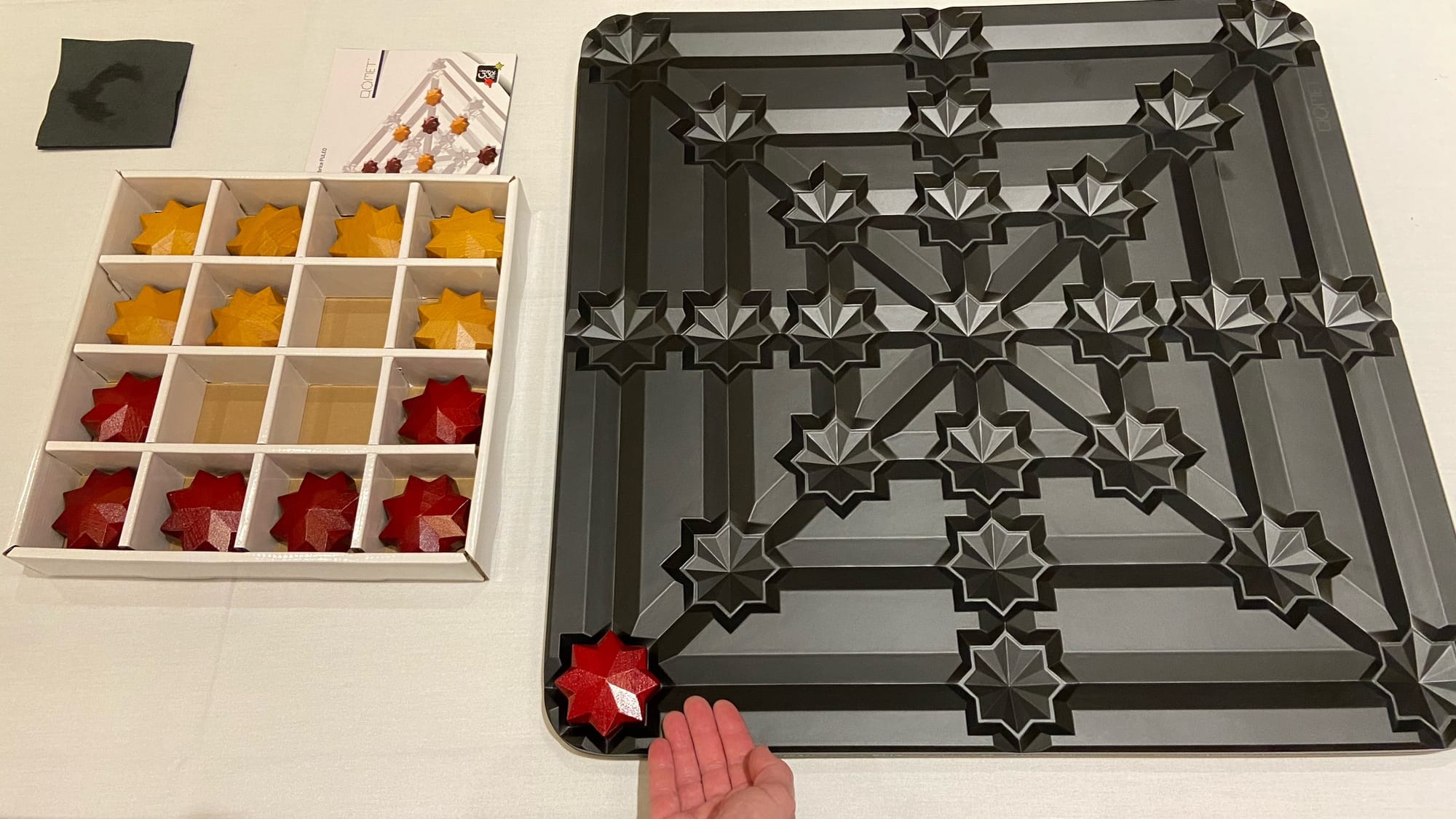
Everybody loves giant versions of games, right?! The Hachette Boardgames USA playing room outside the exhibit hall featured an enormous version of Fabrice Puleo's Qomet, the newest title in Gigamic's abstract Q-labeled game line.
On a turn, add one of your stars to an empty space on the playing board or move one of your stars already on the board by pushing it along a line to the next space, pushing at most one star onto the next space (or off the board). Whoever first places four of their pieces in a square that's in the same orientation as the game board wins.
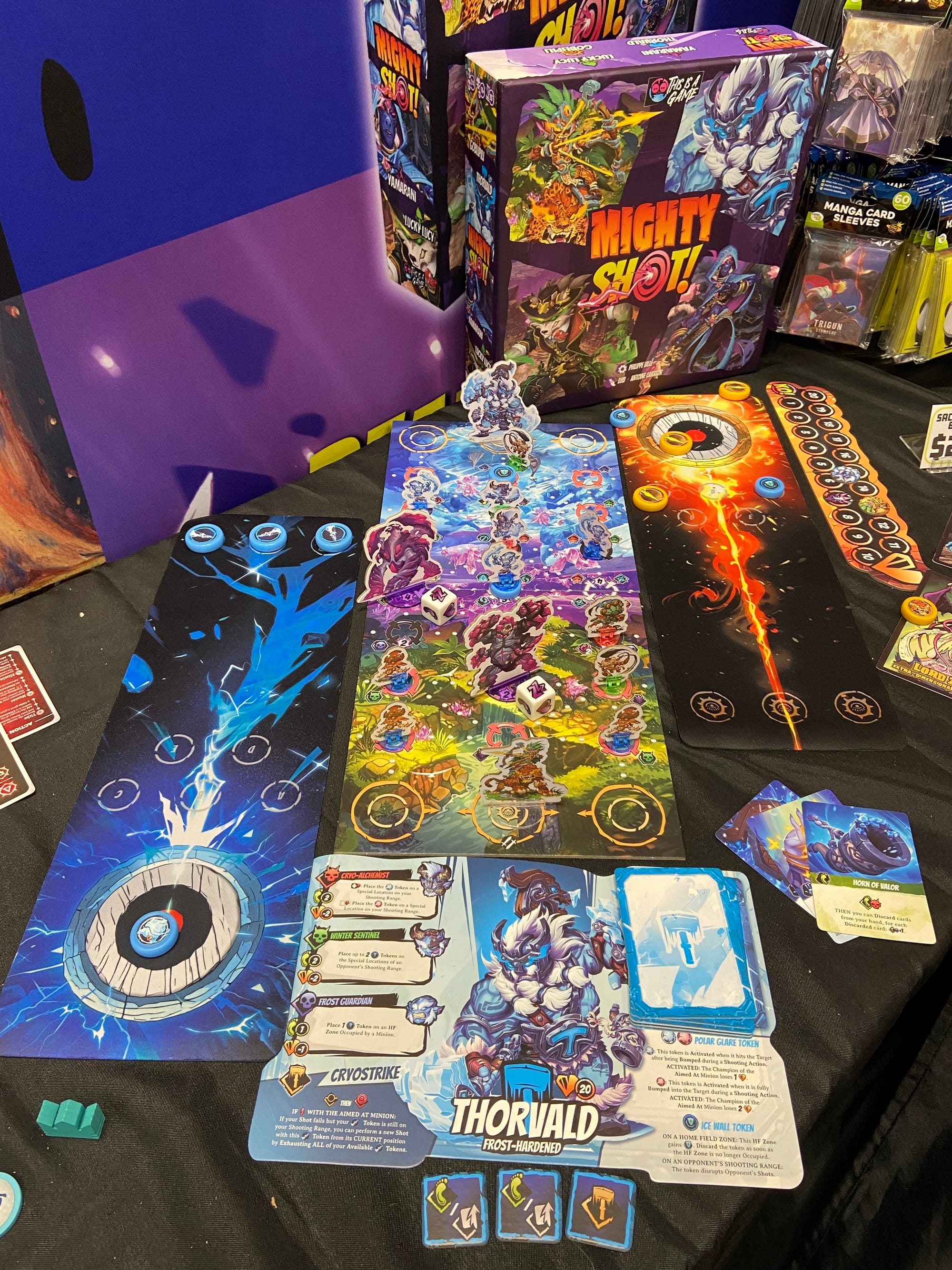
Philippe Ville's Mighty Shot! is the debut title of French publisher THIS IS A GAME, which seems odd written in ALL CAPS, but that's the way it appears on the publisher's page, so let's go with that.
Mighty Shot! was crowdfunded in June 2025, and in this two- or four-player game you control a champion and various minions and must knock out the opposing champion to win. You have champion cards and counter cards at your disposal, along with powers specific to your champion, but the main draw of the draw appears to be a dexterity element in which, curling style, you flick discs down a board, with different targets requiring you to land in red, black, or white zones.
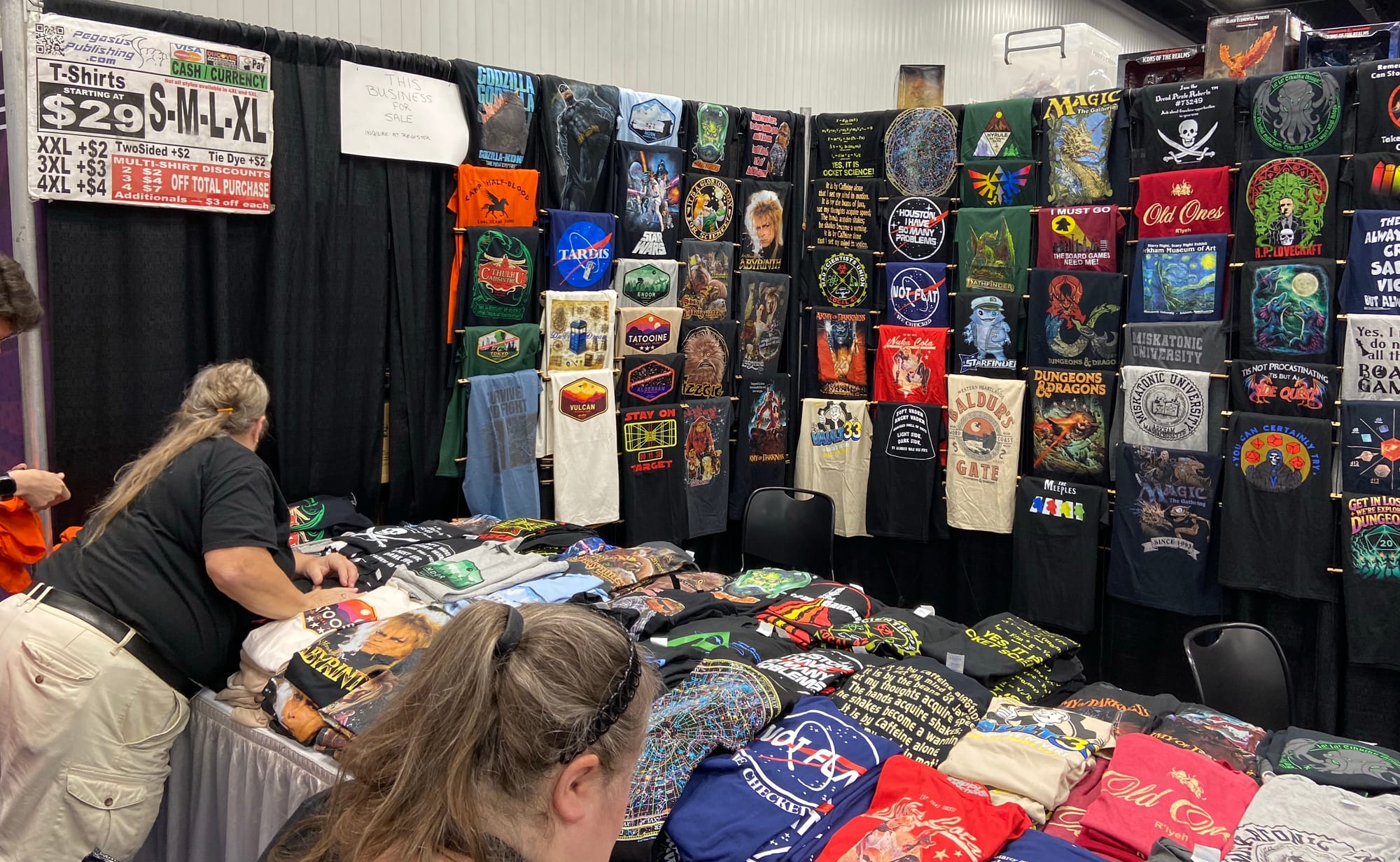
Ah, yes, here's ye old T-shirt stand that features tons of geek callouts that people use to identify one another as geeks while out in the wild. I like looking at these shirts, but I also dislike wearing shirts with stuff on them, so I'd never buy one.
But wait, what's that sign say on the wall?
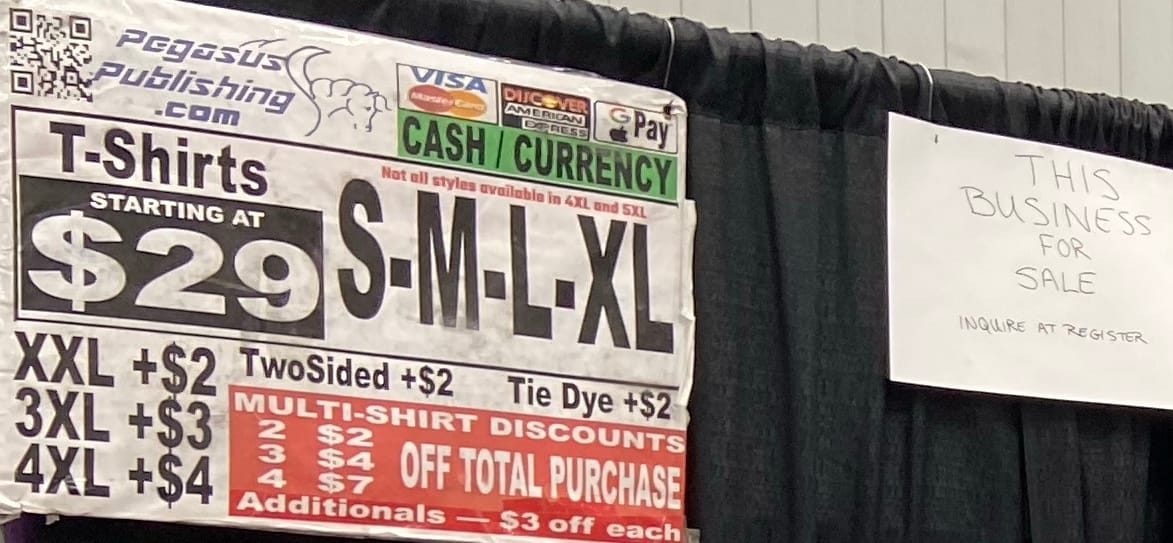
"This business for sale — inquire at register"?! I've never had a desire to own a T-shirt business, but I sure considered it for a few minutes as that would be the absolute strangest thing to bring home from a convention. Boy, would my wife have been surprised!
Like this kind of convention coverage?
Get Board Game Beat’s free posts by email — original reporting, designer interviews, and industry news, with no tracking, no ads, and no spam.


