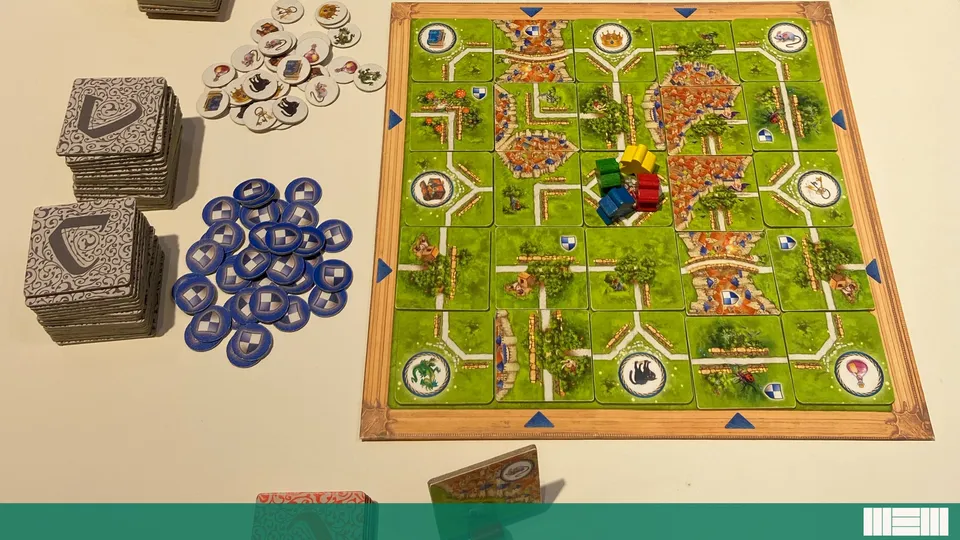
One of the many games that I previewed at SPIEL Essen 25 was Panorama, a 2-4 player game from Melody Leblond and Jules Messaud that Canadian publisher Scorpion Masqué will release in Q2 2026.
Panorama feels like an on-trend design that leans into cozy game-playing, with each person drafting tiles to build a personal landscape. Sure, you're trying to win the game and will compete to claim the three objectives, but hey, look at this fabulous landscape that I've constructed! So cute! Let me take a selfie!
In more detail, each player has a starting tile that depicts the cross-section of a landscape — sky, mountain, forest, river, grassland, and prairie — with their hot air balloon token adjacent to one stack of tiles and 6-8 stacks being arranged in a circle. On a turn, whoever is next to the sun token (the red player in the image above) moves their balloon clockwise to an unoccupied space, adds the top tile from the adjacent stack to the left or right of their landscape, then moves the sun token clockwise to the next balloon.
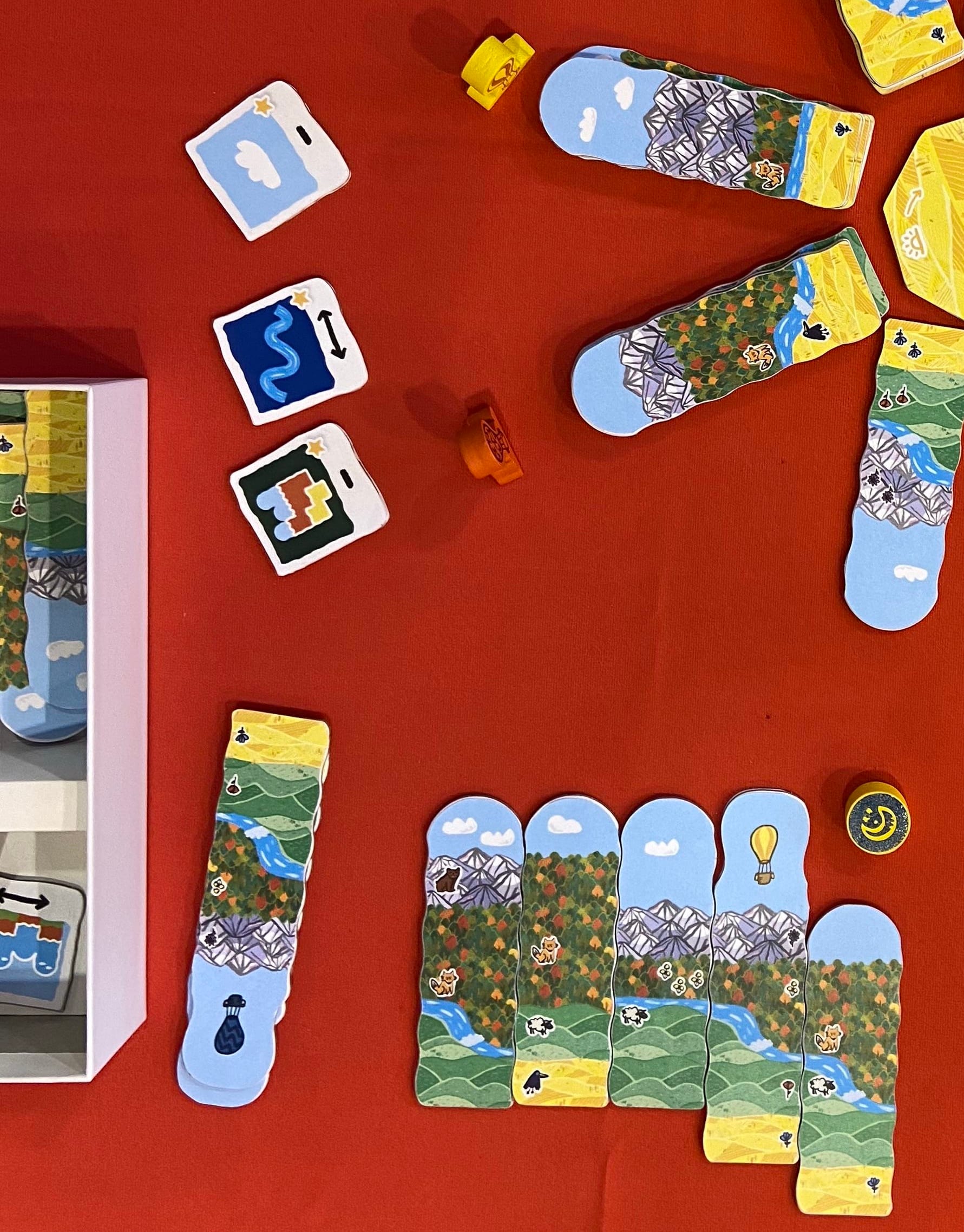
Each tile has undulating edges, so you can place tiles adjacent to one another in multiple ways. What's the best line-up you can make? Well, because you are playing a game from a competent publisher that knows how to create tension in its designs, the scoring rules will pull you in multiple directions.
More specifically, at the end of the game, you will score each terrain zone in your panorama, with a terrain zone being a terrain that's connected orthogonally (not diagonally) across one or more tiles. In the image above, for example, I created one forest terrain zone across all five tiles, but I split the sky, mountains, rivers, and grassland into two zones and the yellow prairie into three zones.
For each mountain, forest, grassland, and prairie terrain zone, you multiply the number of flowers in it by the number of animals to determine its point value. The forest is worth 12 points (3 foxes x 4 flowers), while the rightmost grassland is worth 3 points. Everything else is worthless.
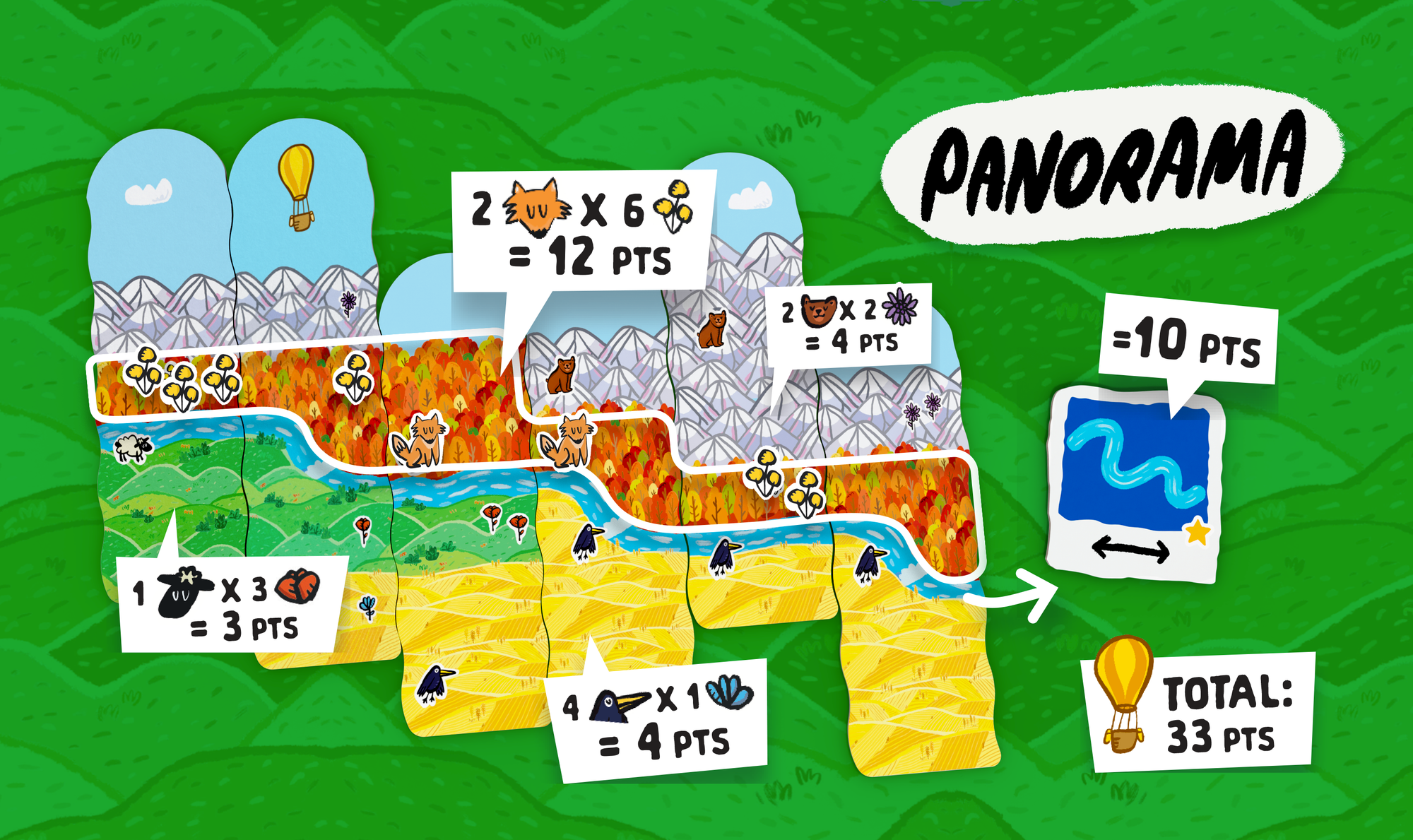
The sky and river areas score points thanks only to the objective tiles, each of which is worth 10 points, with ties being possible. In the image above, the player(s) with the longest river will each score 10 points. Other objectives challenge you to have the most tiles on one side of your starting balloon, have the fewest clouds across your entire sky, place the most waterfalls on one river section, and have the most terrain zones with at least one animal.
For variety, you can use one objective of each type (river, sky, and terrain), one of the suggested scenarios ("Less Is More" or "The Long Way Home"), or any three at random.
Aside from the tension of how to place tiles, you will have a choice of tiles available each turn, but as in Antoine Bauza's Tokaido, the farther you move ahead on your turn, the more tiles you'll allow other players to collect — especially in a two-player game since your opponent could move one space at a time to collect all the tiles you skipped. Once a stack is empty, each player other than the stack-emptier takes a final turn, then you evaluate your landscape-building abilities, realizing only at this moment that you have, in fact, been role-playing a god who is shaping the earth one bit at a time. Surprise!