

I'm always intrigued by the concept of creating a game with as few components as possible, so I keep an eye on several companies who specialize in these types of releases, with one of those being German publisher Nürnberger-Spielkarten-Verlag, a.k.a., NSV.
Qwixx Express
For SPIEL Essen 26, NSV had three new releases, two of which are spinoffs of previous titles. Let's look first at Qwixx Express, designer Steffen Benndorf's newest iteration of his dice game Qwixx, which has been an amazing success since its debut in 2012. I'm astounded to see how many ways in expansions and spinoffs he's iterated on the basic Qwixx game system: a roll-and-write design in which everyone participates at the same time, a concept now present in hundreds of games.
A quick overview of Qwixx: Each player has a scoresheet with the numbers 2-12 in rows of red and yellow and the numbers 12-2 in rows of green and blue. To score points, you want to mark off as many numbers as possible in each row, but you can mark off a number only if it's to the right of all marked-off numbers in the same row.
On a turn, the active player rolls six dice: two white and one of each of the four colors listed above. Each player can choose to mark off the sum of the two white dice on one of their four rows, then the active player can choose to mark off the sum of one colored die and one white die in the row that's the same color as the die. If the active player marks nothing, they're penalized.
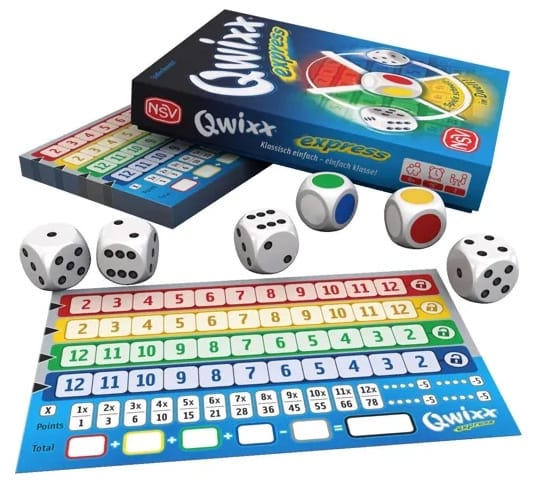
Qwixx Express twists up the Qwixx formula by introducing a real-time game element that makes sense only with a two-player game. Yes, Benndorf previously released the two-player-only Qwixx: Das Duell in 2016, but (1) Express is a different take on 2p Qwixx and (2) Qwixx: Das Duell is now off the market in Germany, with the English-language edition from Gamewright having only just appeared in 2026.
In Qwixx Express, each player has two white dice and a die with colored spots, and each round players roll and re-roll their dice simultaneously until one player says "Stop". The other player can continue to re-roll if they wish, marking a little box in the lower right corner of their scoresheet with each roll and stopping when they choose to or when they mark a -5 space.
The active player then marks the space matching the sum of their two dice and the color of their other die. (If they rolled white, they mark the sum in the color of their choice, and their opponent can do the same.)
Next, the opponent must mark the space matching the sum of their two dice and the color of their other die — and this is what will drive re-rolls. If you're staring at a 1-2-blue after your first roll, then you'd have to mark the blue-3, tanking your score in that color since only the blue-2 would remain. You can re-roll one, two, or three dice at a time, so maybe you just re-roll the color die since you'll have a two-thirds shot at something good.
If someone has marked their fourth -5 space or two colors have been used up, the game ends, and players tally their points.
What will come next in the Qwixx line? Benndorf tells me, "The end in the Qwixx universe certainly hasn't been reached yet, even though it’s getting increasingly difficult to find something new."
Splitter²
The other NSV spinoff title is Stefan Nikolić's Splitter², which features gameplay identical to 2021's Splitter, so I can mostly re-use my description of that earlier game:
In Splitter², you must group numbers together to score points — two 2s, three 3s, and so on — but you're placing two numbers at a time, so things won't always work out.
Each player has their own score sheet, with four patterns included in the box; each pattern has a dashed line through the middle that splits it into two mirrored halves. On a turn, someone rolls two six-sided dice. Each player then writes the results, e.g. 1 and 4, in empty spaces in the pattern, with each number being in the mirrored space of the other. If, say, you place the 1 in the leftmost space of the top row, then you must place the 4 in the rightmost space of the top row.
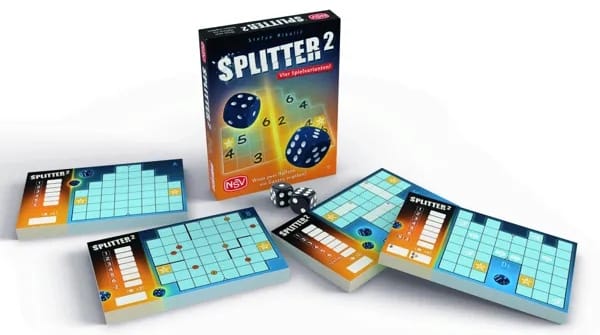
Once the pattern is filled, you score, with a group of exactly six orthogonally adjacent 6s is worth 6 points, a group of exactly five 5s worth 5 points, etc. A starred space is present on each half of the pattern, and a scored group that contains this starred space has its points doubled.
Some of the patterns include additional rules, such as walls that separate numbers to keep them from forming groups, paired spaces that must have identical numbers to keep you from losing points, and regions that grant bonus points if the sum of the numbers included match a target.
The final pattern creates a co-operative variant, with each player taking one of five different sheets. Whenever you place a number on a space with a paper airplane, the player to your right fills one of the postboxes in their grid with that number, thereby allowing you to help one another complete groups. Each player also has a unique bonus scoring rule.
Lightning City: Tokyo
The third new SPIEL Essen 26 title from NSV is also a roll-and-write design in which everyone participates at the same time: Lightning City: Tokyo, from first-time designer Jannik Auth.
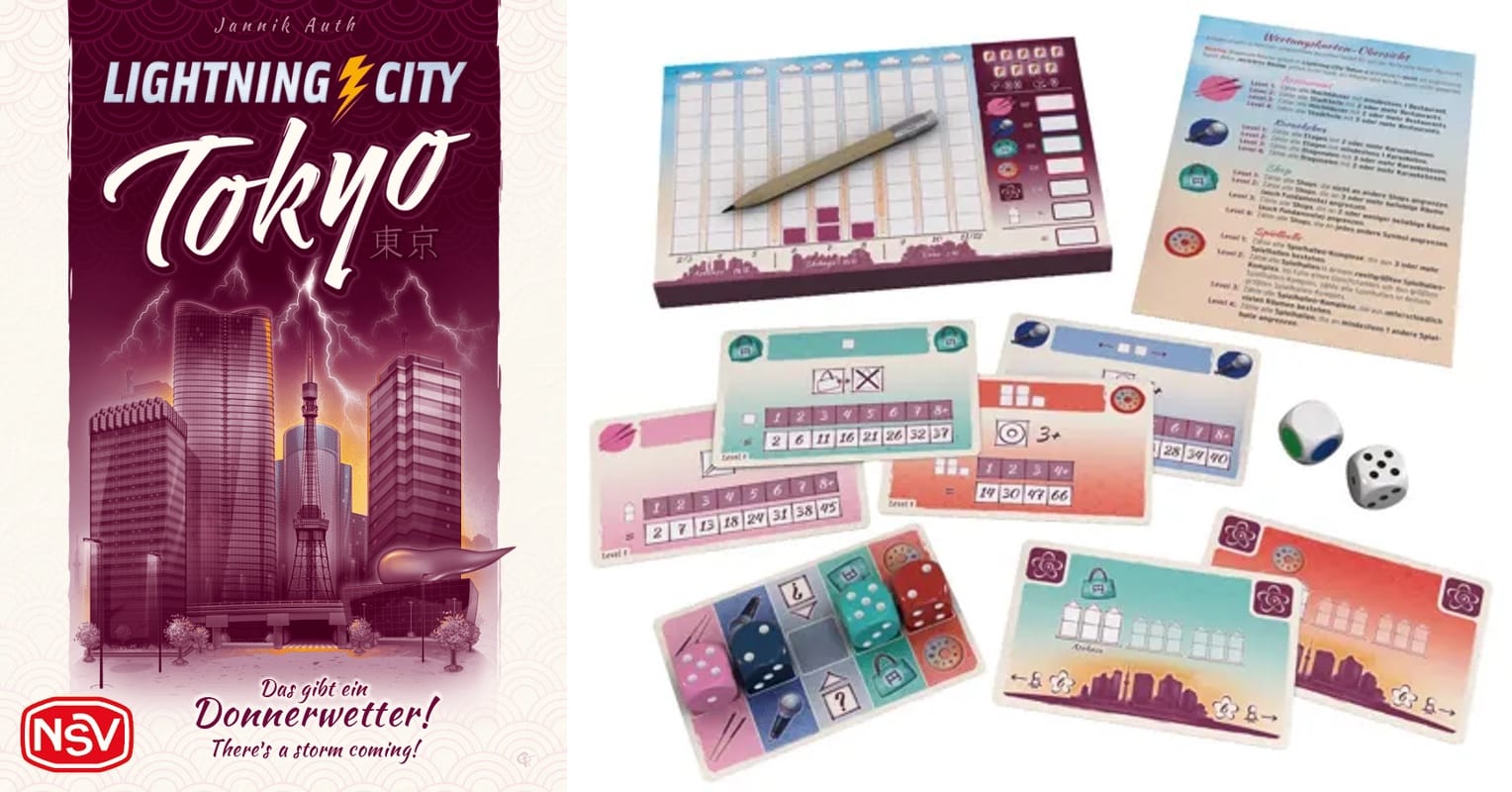
Each turn, roll six dice: four six-sided dice in different colors, one white die, and one die with colored spots. Whichever color shows on that latter die removes that color die from play for the turn.
Next, each player chooses two dice from what remains. Sum those dice to determine in which column you write, then draw the business symbol associated with each color die: pink is food, green is shopping, etc., with white being the symbol of your choice, including a roof, which cannot be topped on future turns. (If you don't like the dice results, you can draw one business or one roof in any column.)
In effect, you are creating buildings that feature different types of businesses, and each business color scores based on the scoring card revealed at the start of play. Maybe you need groups of at least three arcades, isolated food locations, shopping in as many different buildings as possible, and more karaoke spots than your neighbors.
To end the turn, roll two dice, then sum them. If the cloud above this column is white, fill it in. Storm clouds are coming! If on a later turn, this sum comes up again during the end-of-turn phase, lightning strikes this column. If you don't have a roof on this building, draw a line through the entire column. Your building is destroyed! In compensation, draw one of the businesses just destroyed in a different column. Additionally, mark out two "round markers". If this number comes up again later, mark another round marker.
When nine round markers have been marked, end the game, then score points for the businesses, plus 1 point for each business in a building with a roof.
Eine Handvoll Mammuts
Designer Jannik Auth will be a second-time designer with NSV's release of Eine Hanvoll Mammuts ("A Handful of Mammoths") in early 2027. This design is not a simultaneous roll-and-write, but the other type of design NSV publishes: a card game.
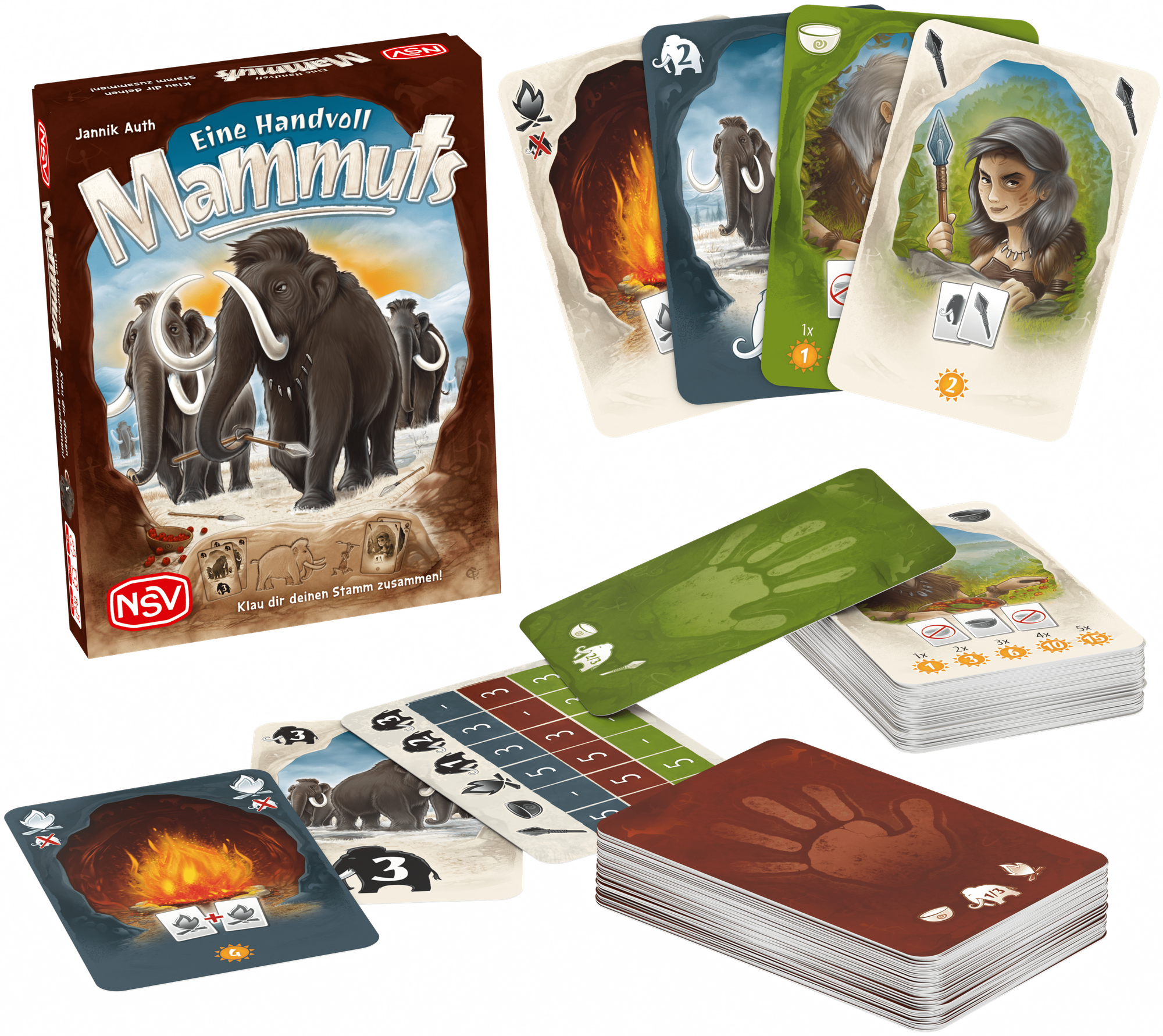
Players start with brown, blue, and green cards in hand, with these cards showing warriors, shamans, fires, and mammoths worth 1, 2, or 3 points. (Not all cards are present in all colors.) White cards showing these six types of cards are face up on the table. Importantly, you cannot change the order of cards in your hand...but those cards will likely change, sort of giving you the ability to move things around.
On a turn, take a blue, brown, or green card from an opponent and discard it, then take the matching white card from the table and add it anywhere in your hand. The opponent who was stolen from draws a card from the matching colored deck and adds it anywhere in their hand. Thus, your hand size increases by one on each of your turns.
Your goal is to arrange a strong scoring hand, with warriors scoring if they're next to mammoths, shamans scoring based on how many you have (although they can't be next to one another to score), and fires scoring if they're next to one another, but away from mammoths.
Want more game announcements like this one?
Get Board Game Beat’s free posts by email — original reporting, designer interviews, and industry news, with no tracking and no spam.


