

Thanks to flight and train delays, I made it to the Spielwarenmesse toy and game fair with only an hour left before the fair closed for the day, yet (thanks to an after-hour event) I still saw more than I can reasonably talk about before I head to bed in order to be primed for tomorrow. Let me mention only three items for now:
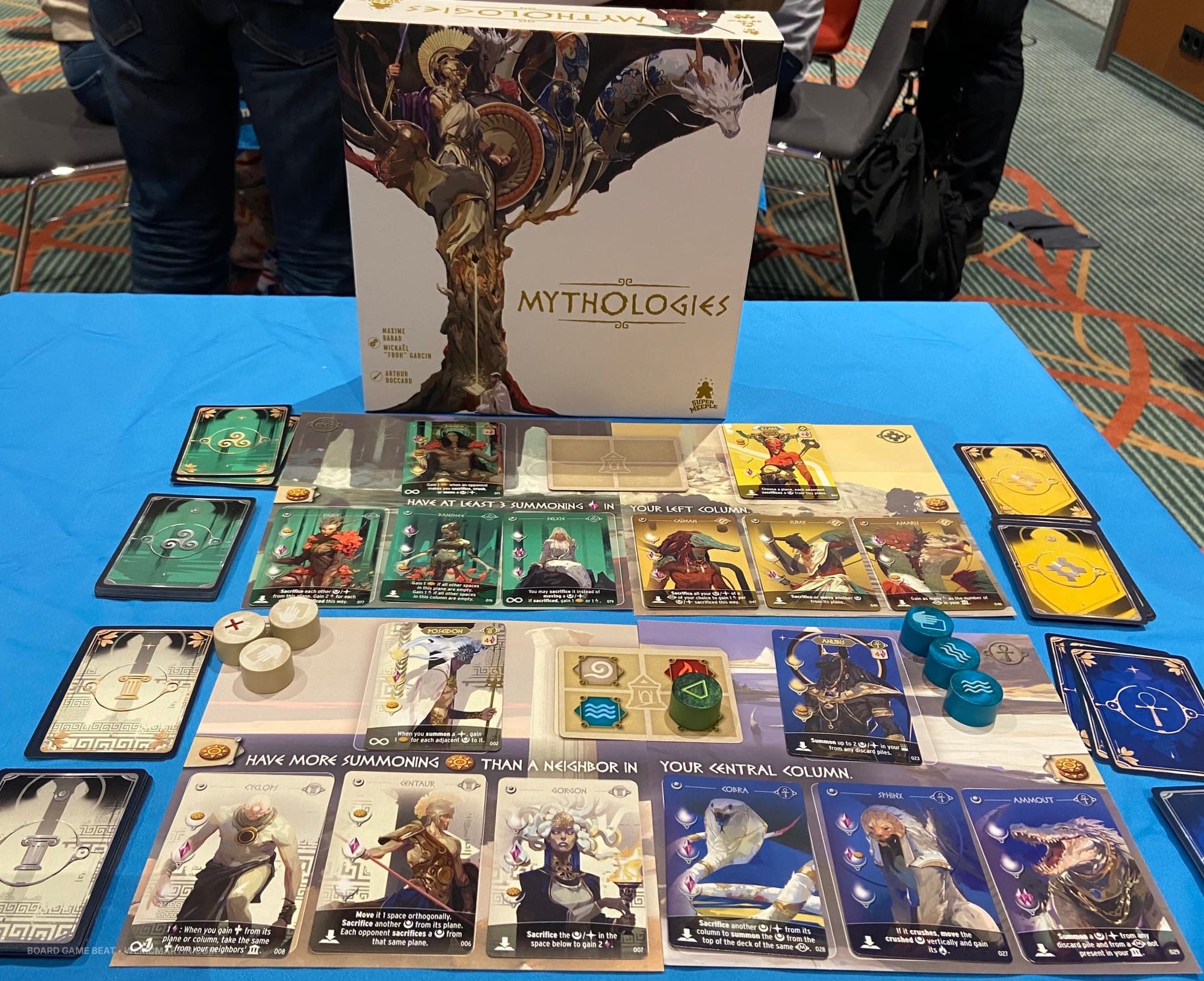
Mythologies is a 2-4 player card combo game from Maxime Babad and Mickaël Garcin that plays in 20-40 minutes, which is quicker than I would have expected based on the "Look at all the unique card powers" element.
To set up, choose four of the eight mythologies in the game, with the game boards for these mythologies forming two scoring conditions across pairs of boards, e.g., in the case above "Have at least 3 summoning (crystal) in your left column" and "Have more summoning (coins) than a neighbor in your central column". (As you might expect, each mythology functions differently, and Charles Amir from publisher Super Meeple says that both cultural and mythological consultants have weighed in to ensure authentic representation.)
The game lasts four rounds, and in each round you draft four times, yet end up with only two cards. How? For each draft you reveal a color symbol card that shows which players can draft where; in the image above, white drafts from the upper left, red from the upper right, green from lower right, and blue from lower left. Each player has three tokens: two that say draft, which are spent when used, and one that says, "Nah!", which is kept. You simultaneously place your tokens, take a card if you drafted it, then place it in your 3x3 grid, gaining a bonus based on which row you placed it in and what's listed on the card — then you carry out the power on the card.
In the second to fourth rounds, each myth has a divinity card available for drafting in addition to three creatures, with a divinity card costing 4 crystals in addition to the draft action, while providing a much stronger action.
French publisher Super Meeple plans to debut Mythologies at the FIJ game fair at the end of February, with an English-language release ideally at Gen con 2026 and a German release at SPIEL Essen 26.
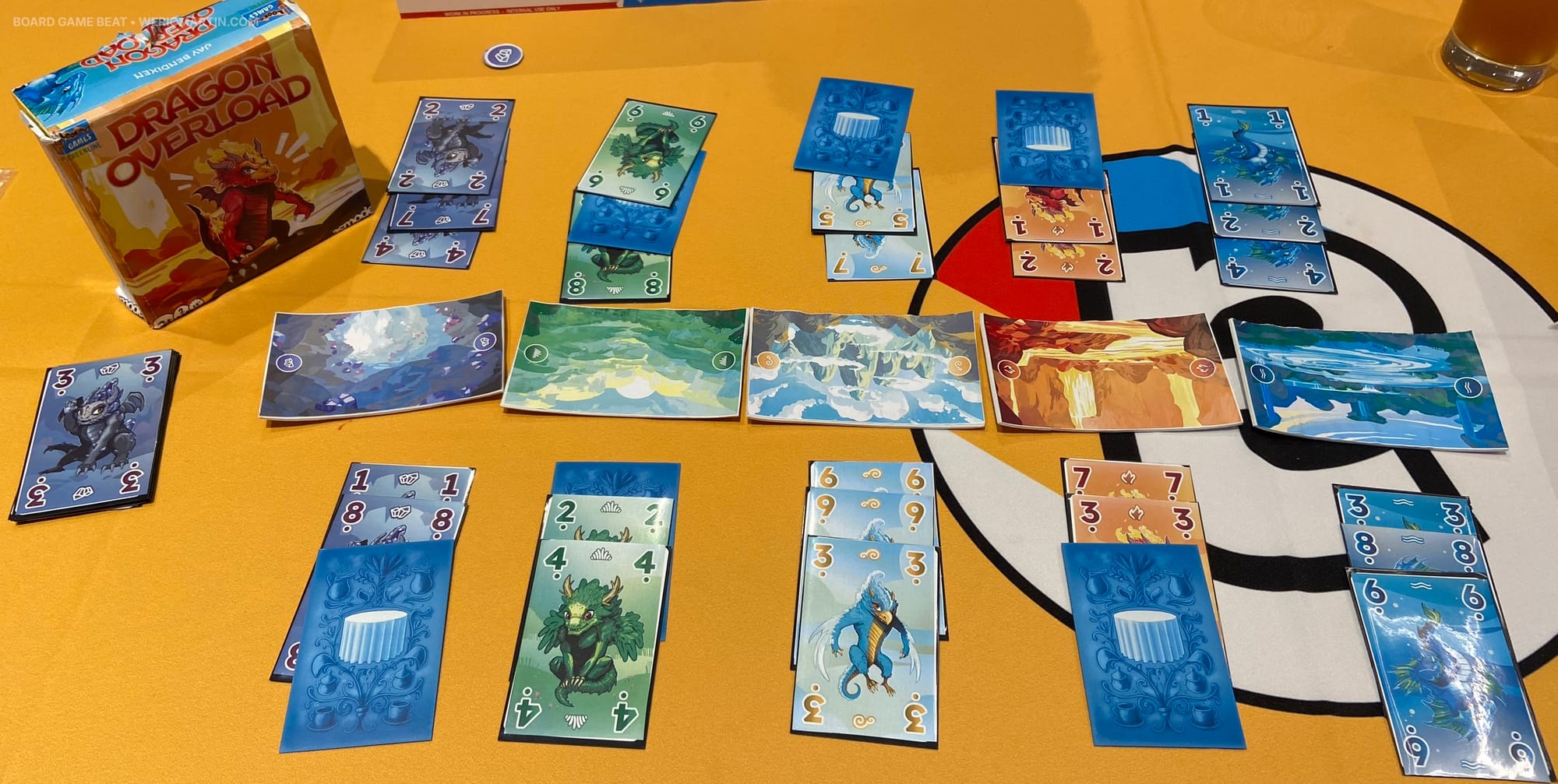
Hanno Girke at German publisher Lookout Games taught me "Dragons Overload", a Q3 2026 release from Jay Bendixen for two players that Girke dubbed "an Eric special", which was a good call.
To win the game, you need to claim ownership of a majority of the five landscapes at game's end or have temporary possession of all five landscapes during play.
On a turn, either play a card from your hand face up in the matching landscape or play a card face down in the landscape of your choice, then give the visible card on top of the landscape to the other player. That's right — you don't control which cards go into your hand except by possibly setting up circumstances in which you force the opponent to give you the card you want. You can play a card face down only three times in the game.
You hand control of the landscape tokens back and forth during play, ignoring the face-down cards. If someone doesn't win during play, at game's end you flip over the face-down cards, then determine who controls a landscape, which is mostly the player with the higher total. However, if a player has at least twice the strength of their opponent in a landscape, they've overloaded their dragons and lose that landscape instead, so how are you bluffing with your face-down cards? To win or to lose...or to lose by a lot and therefore win?
Players each start with a small hand of cards and not all 45 cards are used in a game, so you don't have perfect information about which cards are in play. As much as I love cards with special powers, cards bearing nothing but numbers are pretty appealing, too.
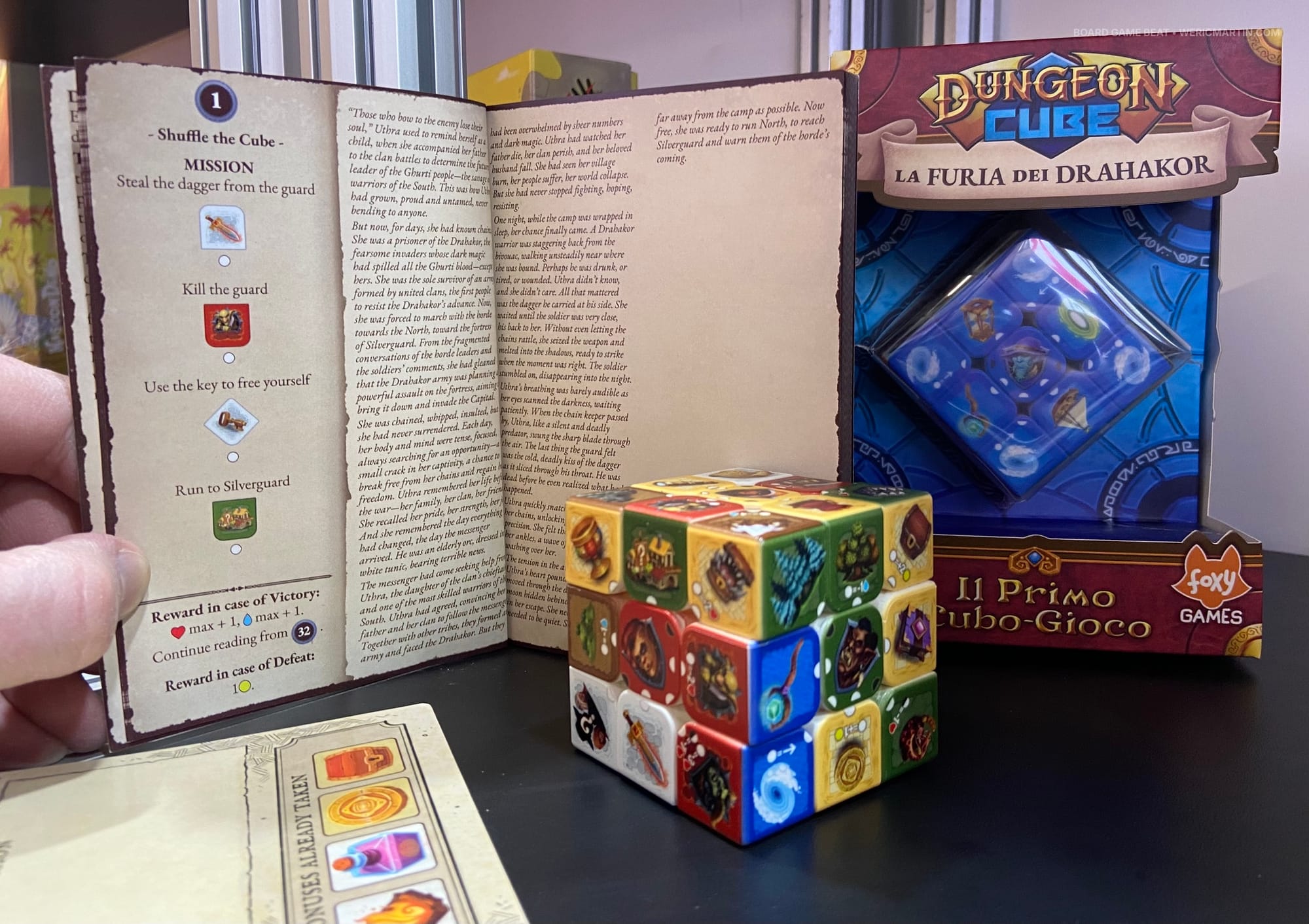
Dungeon Cube is a design for 1-6 players from Nicolò Chioato that will be released by Red Glove through its "Foxy Games" brand.
The core of the game is the familiar 3x3x3 puzzle cube, which features one of six adventurers in each central square and which features weapons, enemies, spells, and more on the other faces. Each player gets a mission depending on their adventurer, and on their turn they hold the cube so that they're looking at their adventurer, then make an unlimited number of turns of the cube that don't change the face they see and at most two turns that affect that face.
If the half-white circle on your adventurer is completed by the half-white circle on something else, you interact with that something else. In the image above, the red adventurer lined up the dagger to complete a dagger, so now they'll mark the dagger on their player sheet. They killed the guard on this same turn, but they also matched a goblin in the lower-right corner...and they didn't want to face a goblin, so they'll take damage.
Completing a quest boosts your stats before you move on to another quest, while failure gives you coins that have uses of their own.

While I'm focusing on games at Spielwarenmesse, the fair is massive and holds an mind-numbing number of retail products. Just as I'm trying to record the details of upcoming games, others are undoubtedly comparing the merits of pens and drafting tools for children, with each of us probably looking at the other booth and wondering, "Does anyone really need all of those options?"


