

Game publisher Korea Boardgames has revealed eight releases that it will show at the Spielwarenmesse toy and game fair at the end of January 2026 ahead of their release in the first half of 2026, and the one that catches my eye immediately is Magicats, a Reiner Knizia design for 2-4 players that was originally published (for 2-5 players) in 2002 as Clash of the Gladiators.
In Magicats, Rome has been banished in favor of the Felinor School of Witchcraft and Wizardry, with teams of cat wizards competing to see who will come out on top. Each player has a team of 3-4 wizards, with each wizard having four slots for spells, which is analogous to players in Clash having 3-4 plastic chariots each filled with four gladiators.
The game is carried out in two phases, with the first phase being a lengthy set-up that primes the action in the second half. Players take turns adding a wizard and a magic token to an empty space in the 6x8 grid or just adding a magic token to one of their previously placed wizards.
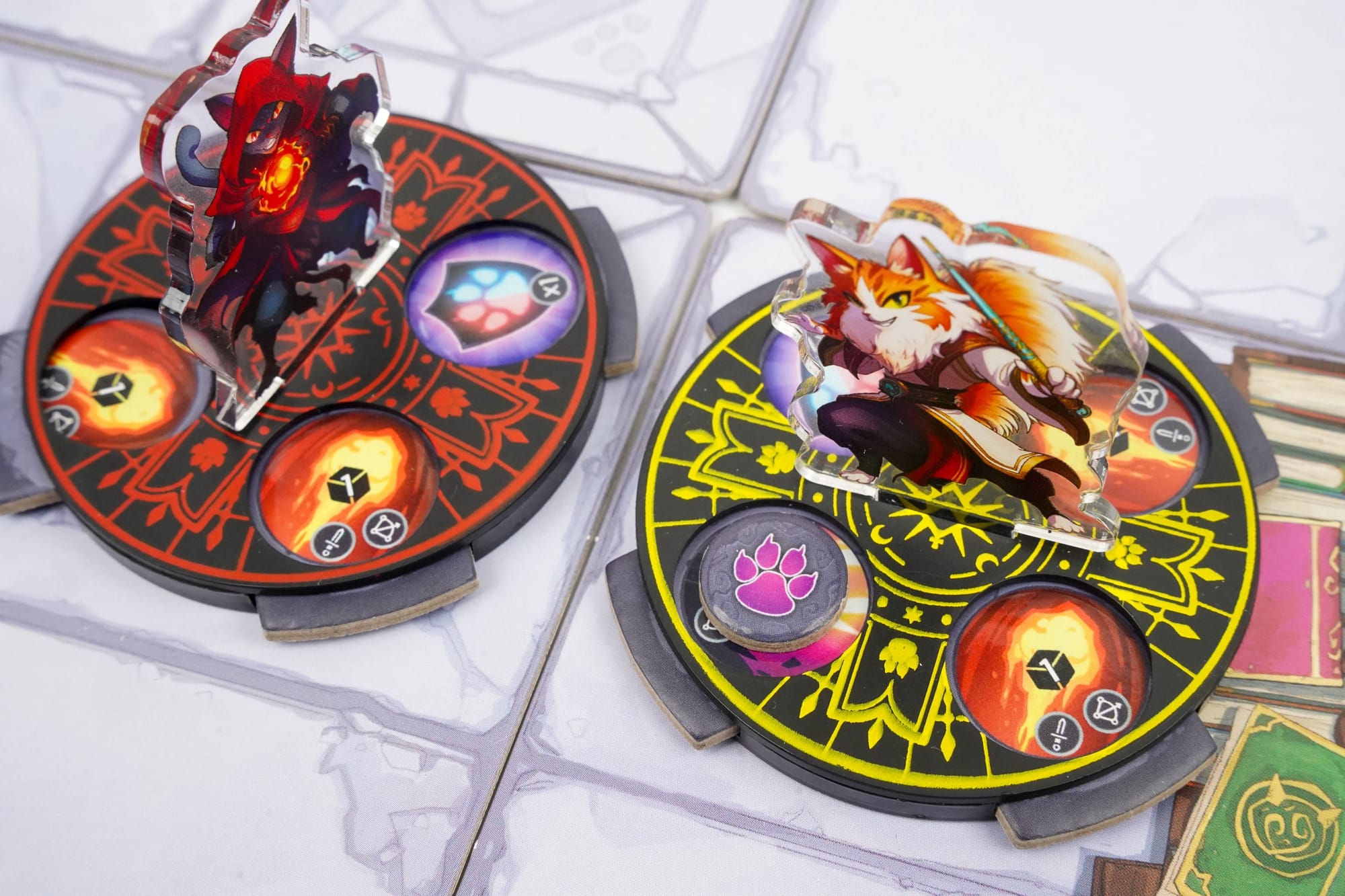
Once set-up is complete, players take turns moving and starting battles with one another. Magic spells come in eleven types, and they resolve in the order shown on the magic display board:
- Jump Kick: Move to any open space.
- Meow Punch: Deal 1 damage immediately before battle.
- Distraction: Place a token on an opponent's magic token to disable it this turn.
- Haste: Determine who attacks first.
- Fireball: Roll a die in combat.
And so on, with both melee and ranged attacks, a blizzard that bombs the opponent with six rolled dice, a re-roll option, and shields to prevent some or all damage. Dice have a single double-hit side, three single-hits, and two blanks. Every two points of damage causes that wizard to lose a magic token, which is claimed by the attacker. Lose all of your magic tokens, and the attacker claims the wizard, too. When only one cat wizard clan remains on the board, see who has bagged the most tokens and wizards.
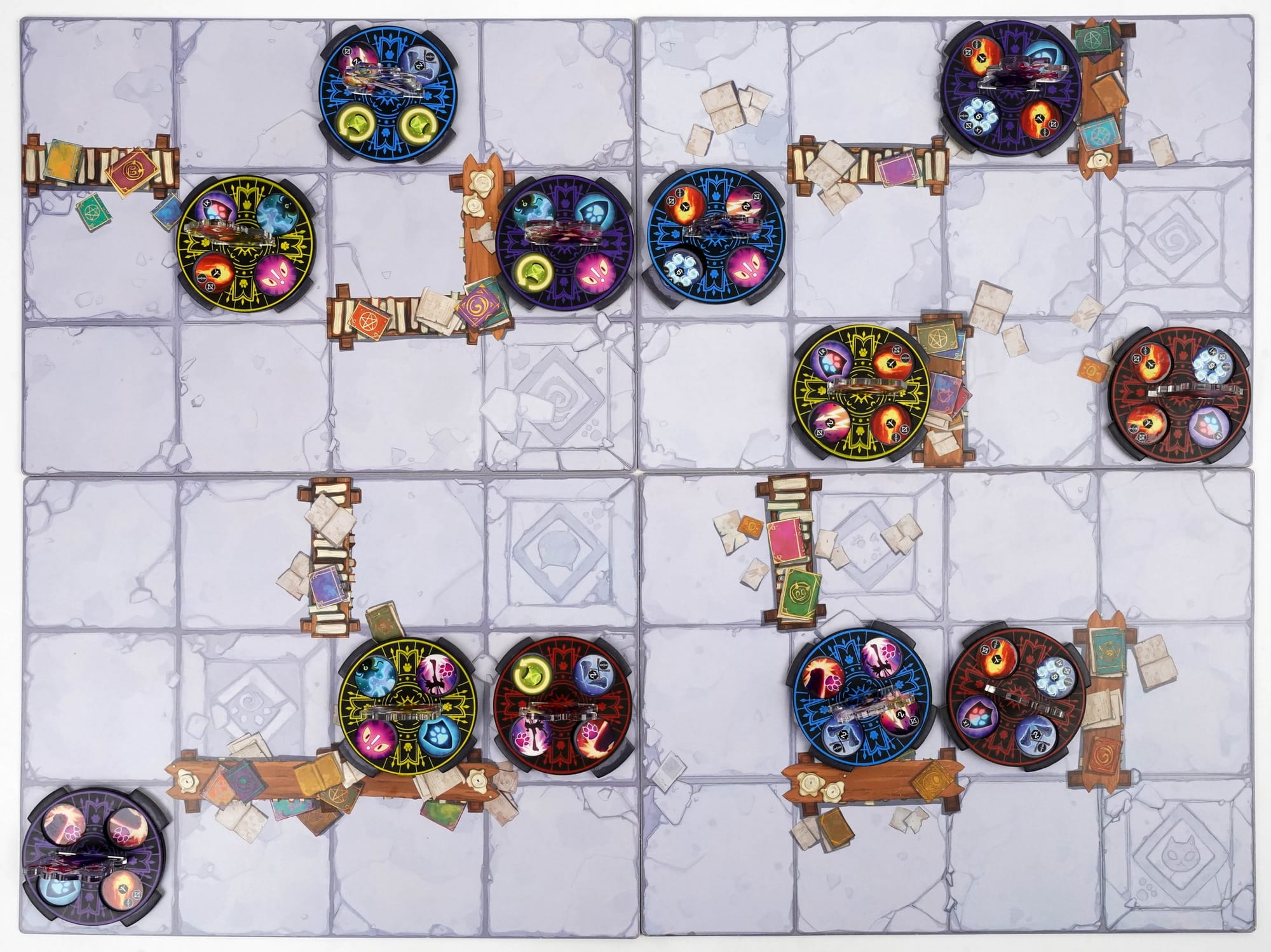
Clash of the Gladiators included beasts that you could attack in the arena as a secondary way to claim points — and as a way that you could continue playing should all your chariots be eliminated. Become a beast, and strike back! In Magicats, once you're gone, you're gone. You still keep all of your points, mind you, but that number is now locked.
Magicats uses double-sided game board tiles, with the reverse side featuring terrain effects for an outdoor battle: gain haste when attacking from a mountain, roll an extra die when attacking from a shrine, and take less damage when being attacked in a forest.
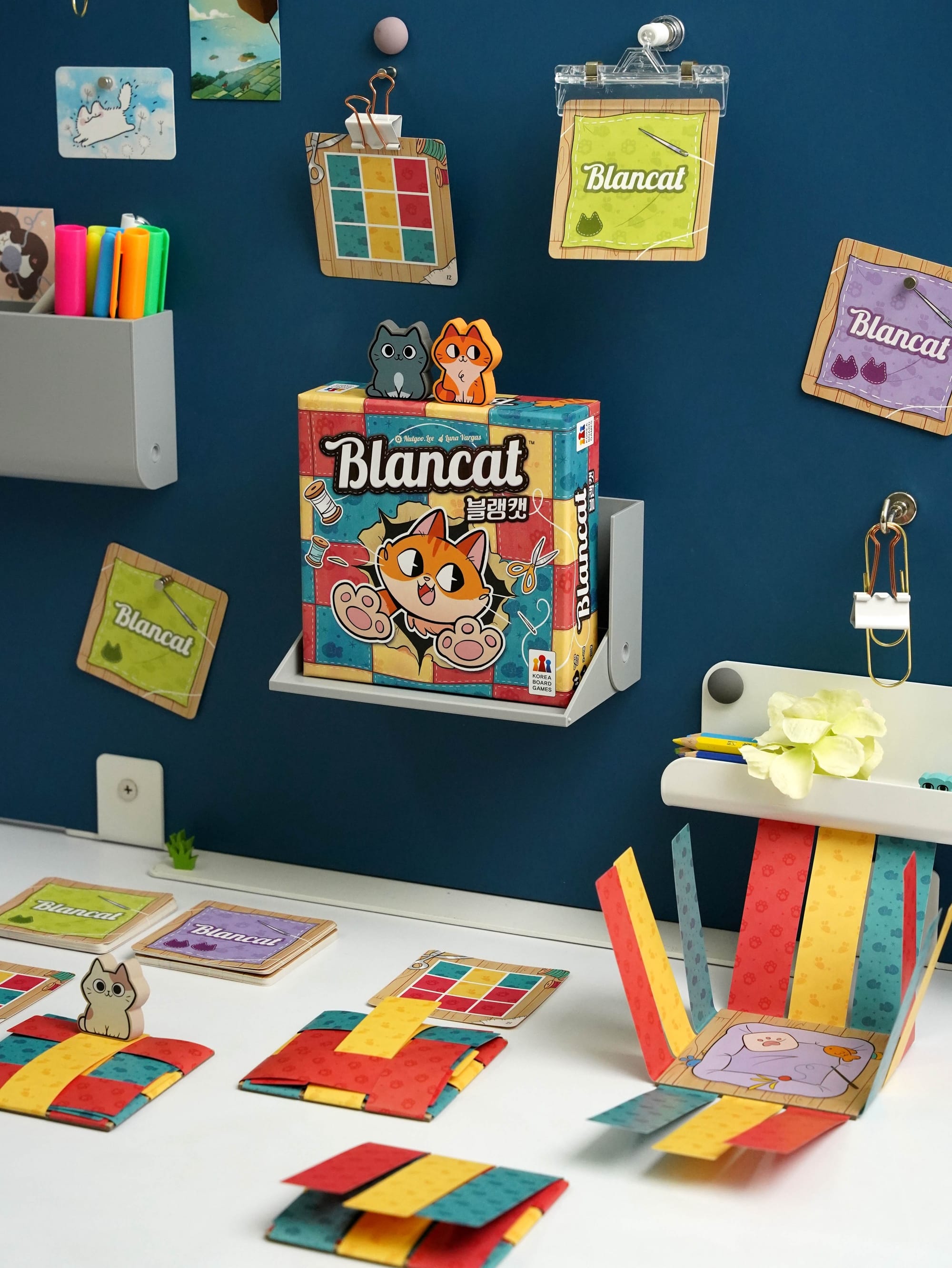
The cats in Blancat are even more peripheral, but the look of the game leans into boop. territory, with cats eager to sit on a blanket on a well-made bed.
As for the gameplay, Blancat falls into territory along the lines of Roberto Fraga and Yohan Goh's Gimbap, which Korea Boardgames published in 2024, as well as many other real-time, pattern-building games. Each round, you reveal a pattern from the deck — easy or hard, as you like it — then everyone races to recreate that pattern by folding twelve blanket strips on top of their square bed, with each side of the bed having three blankets.
When you finish, grab a cat token, with one fewer token available than the number of players. If any cat grabbers messed up, they take a pattern card as a penalty; if not, the person with no cat is penalized. Whoever collects three pattern cards first loses.
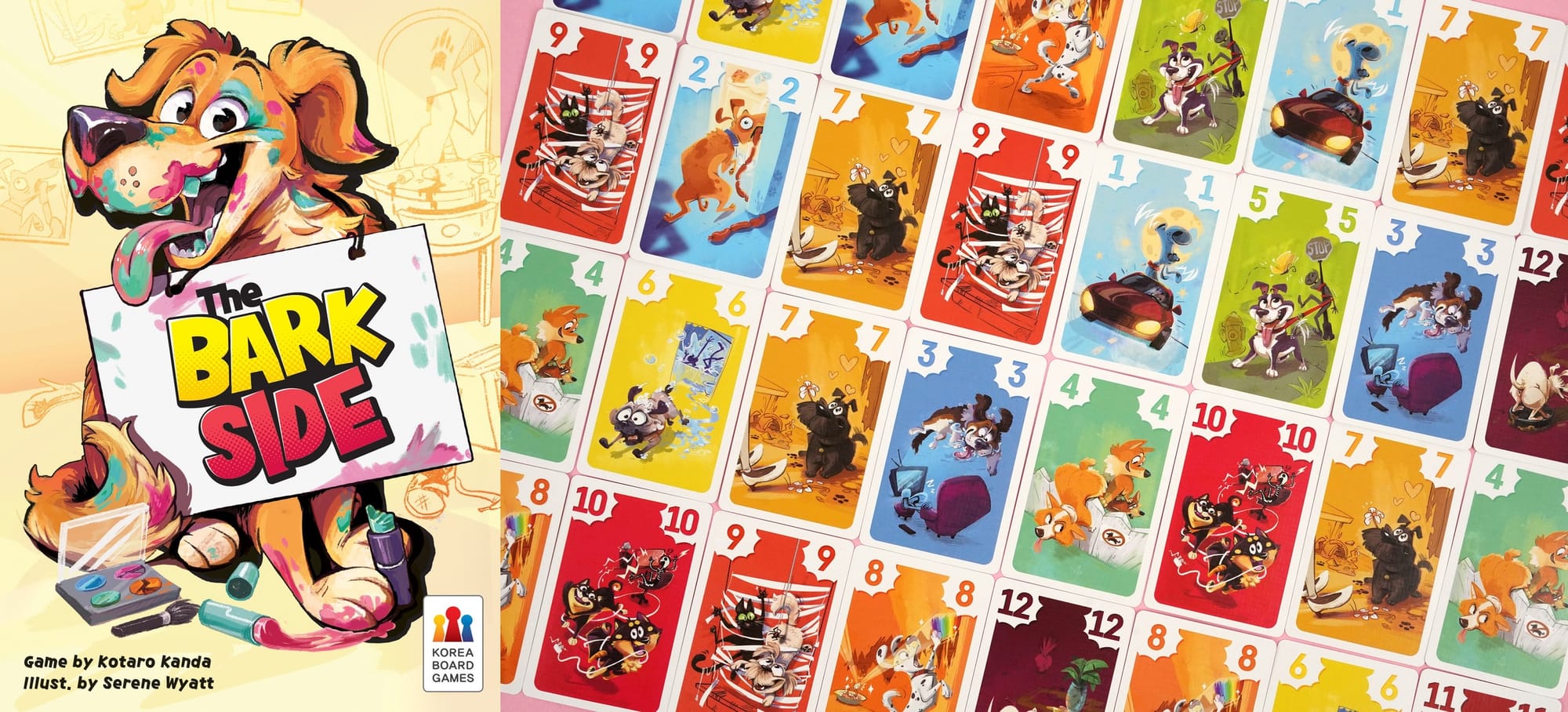
Kotaro Kanda's trick-taking game The Bark Side is a "new" release that Korea Boardgames attempted to crowdfund in 2018, then didn't bring to market when the project didn't gain enough support. The publisher was ahead of the curve on the trick-taking trend, and now the game is finally making its way to print.
Your goal each hand is to not take the final trick. The deck consists of cards numbered 1-12, and the lead player of the first trick plays a single card, with each subsequent player playing a card of the same value or higher — or their lowest card. Whoever plays the highest card leads the next trick.
Once a player throws off their lowest card, at the start of the next trick a player can lead two or more cards of the same value, then each other player most play exactly that many cards of the same value or higher — or discard that many cards of whatever is lowest in their hand. Thus, every time you can't play, you must ditch the low cards you want to save in order not to win the final trick. Whoever claims that poisoned trick keeps cards from this trick face up in front of themselves, then you start a new hand. When someone has 7+ different values in front of themselves (or when you can't deal enough cards to players), the game ends, and whoever the fewest different values in front of themselves wins.
I played The Bark Side four times in 2018 on a review copy, and the shrinking deck is a neat feature because over time playing 3-4 cards of a value will win a trick instead of being overplayed because high-value cards have been pulled out of play.
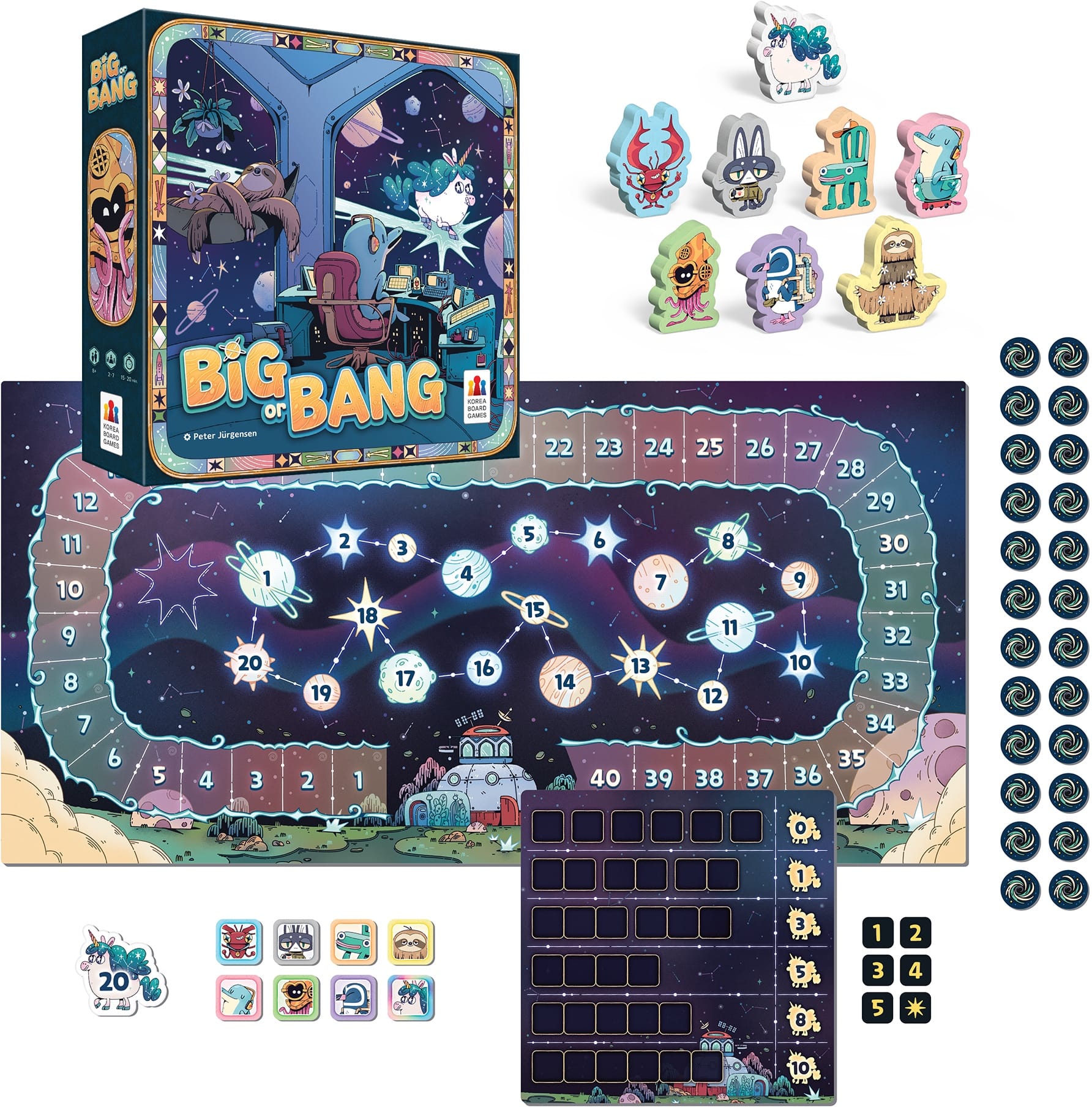
Peter Jürgensen's Big or Bang is a press-your-luck game for 2-7 players of shooting for the stars...and possibly shooting yourself in the foot instead.
On the first turn, the starting player rolls the six dice, then keeps all the dice of one number, with jokers always being set aside. The unicorn figure advances on the central star track based on how many dice you set aside: 0 spaces for one die, 3 spaces for three, 5 spaces for four, and so on. You can end your turn and move your personal figure on the exterior scoring track a number of spaces equal to where the unicorn is located, or you can roll again — but now you can set aside only numbers higher than anything previously set aside.
If you set aside nothing on a roll, you bust, the unicorn resets, and the next player starts from scratch. When you bust, you draw a bust token as compensation, and if you have two bust tokens of the same value, you can cash those in to move your figure spaces equal to that value.
If you set aside all six dice, you keep the unicorn where it is, then either stop and move, or roll all six dice, adding to where the unicorn is already located.
If you stop and score, you slide the remaining dice and dice mat to the next player, who can then decide to start from scratch or "continue" your turn and try to build on where you stopped. If they set aside dice, then the unicorn keeps going up. As soon as a player has 40+ points, all other players get one final turn, then whoever has the most points wins.
I appreciate the graphic approach for this design, calling back to Cosmic Wimpout, the classic 1970s dice game that uses the same "if score all your dice, you can start again" mechanism, although it dates to the 1930s.
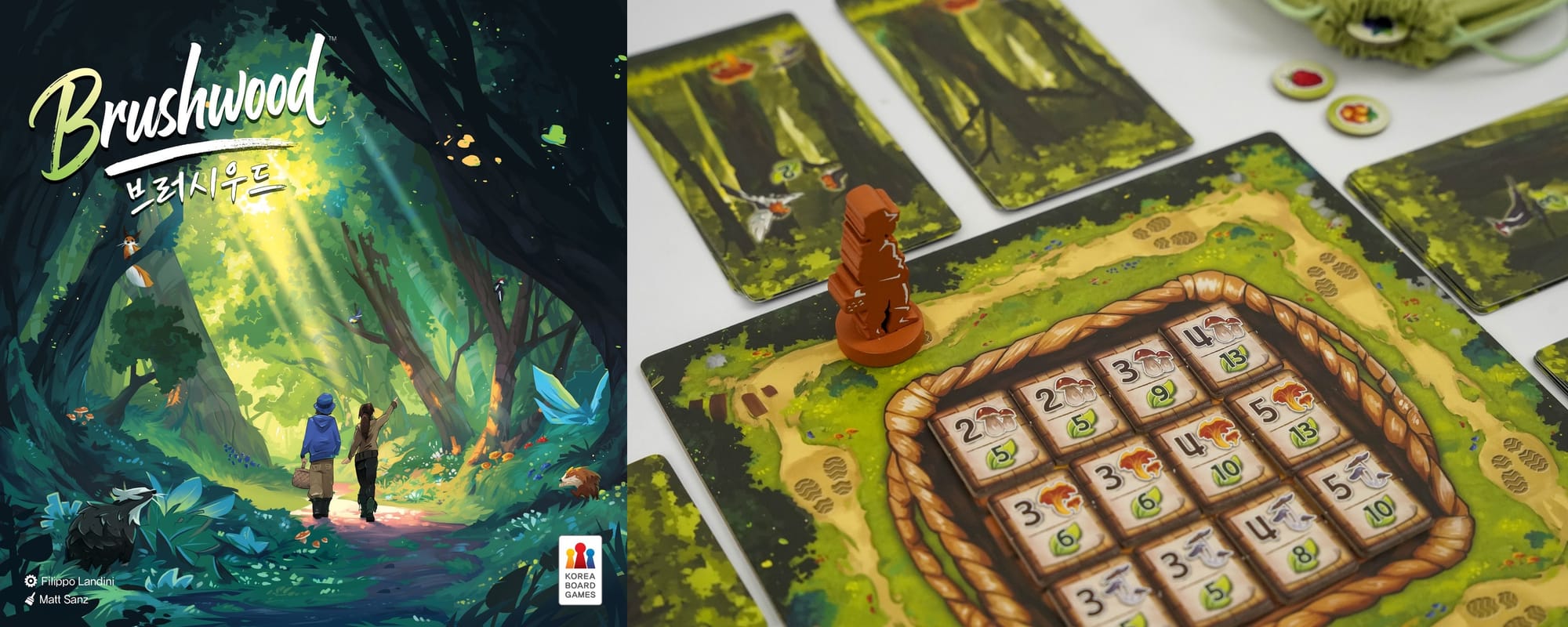
Filippo Landini's Brushwood is a "walk in the woods" game for 2-4 players of trying to see and collect the best stuff.
On a turn, move the shared hiker figure 1-3 spaces, placing a random berry token from the bag on each space you pass over. Add the card you stop at the end of your current hike log, collecting any berries on that card. When you've seen enough of a certain type of mushroom, you can grab one of the objective tokens from the central board.
When two of the eight hiking piles are empty, the hike ends, and players score for having the most or second most of the three types of berries, for seeing animals, for having binoculars at the right time to see birds, and for installing birdhouses for creatures that lack opposable thumbs and can't wield a hammer themselves.
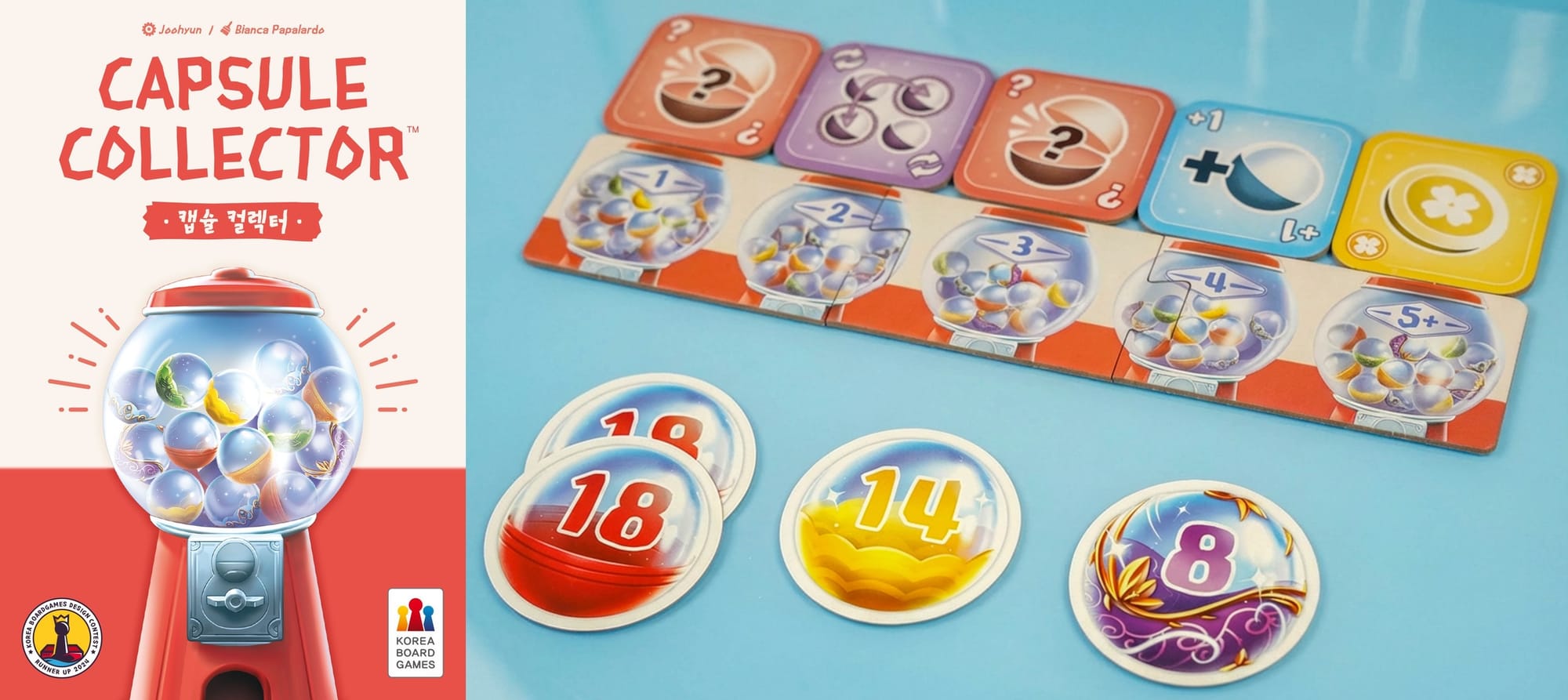
Joohyun's Capsule Collector has you trying to pull valuable capsules from the machine and arrange them the right way so that you can open them for lots of stars.
Each turn, you add two capsules from the deck to the market, grouping like numbers together, then take all capsules of one color and add them to your 4x4 grid, filling this grid from upper left to lower right.
You then take the action corresponding to how many capsules you took (1-5), after which you move that action to the right side of the line, sliding everything else left. Actions let you take another turn, claim a bonus capsule, swap two capsules, and (most importantly) open all capsules of the same value in an orthogonally-connected group in your grid. Instead of taking an action, you can take an open token, which will open a single capsule at game's end.
You score only for open capsules, and in each color you'll find three capsules worth 5 stars and five worth 3 stars, with the rest being worth 1 star each.
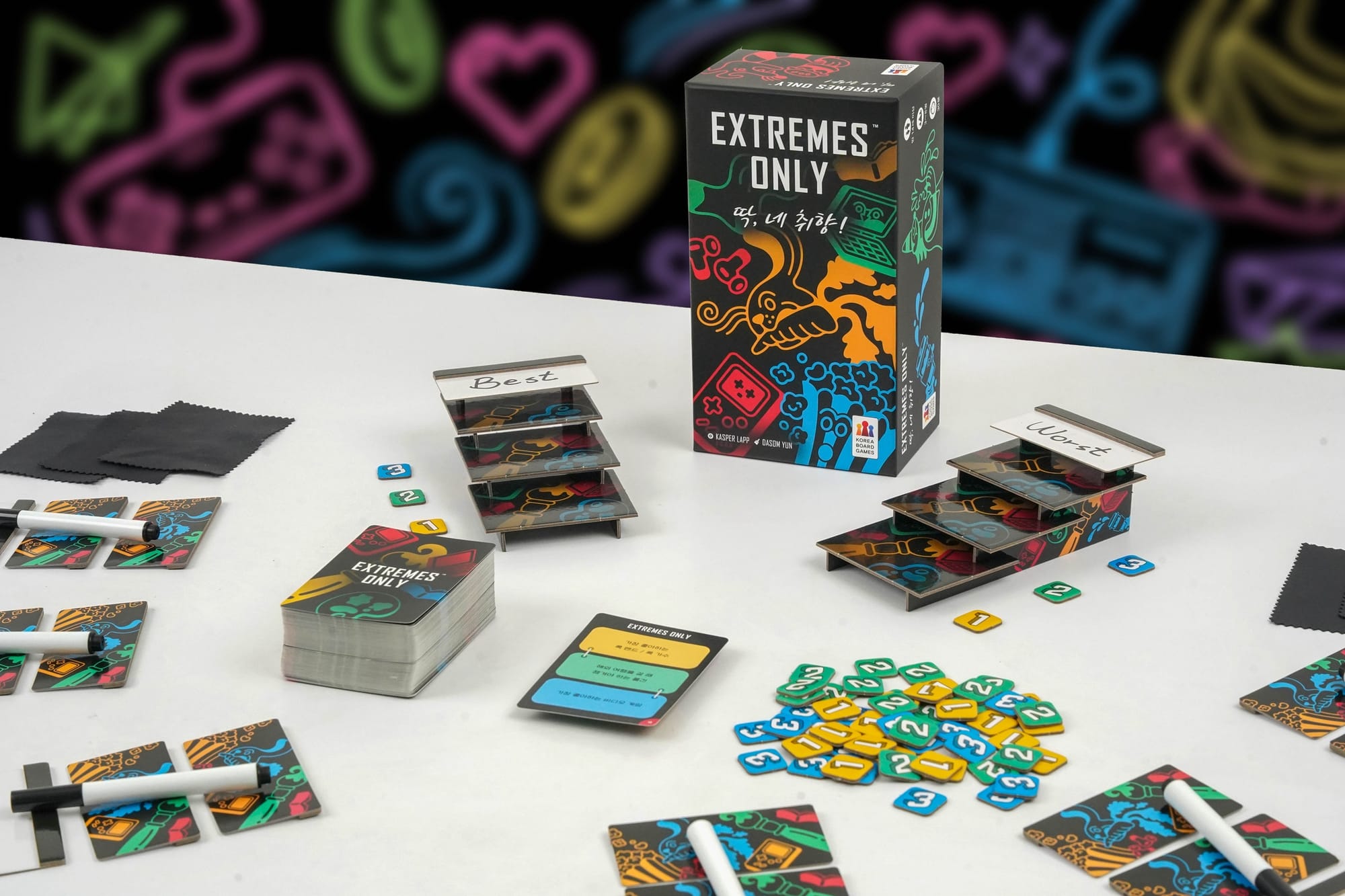
Kasper Lapp's Extremes Only is a "Do you know your friends?" party game for 3-8 players in which you score by going to the extremes.
The round's referee chooses a category, everyone writes an answer for that category, then the ref ranks them from best to worst — then the players each write another answer that's ranked, then a third. Ideally by the third answer, you get a sense of what's the best (and the worst) fit for that person's tastes. Players get 3, 2, and 1 points for the answers at the extreme ends of the answers.
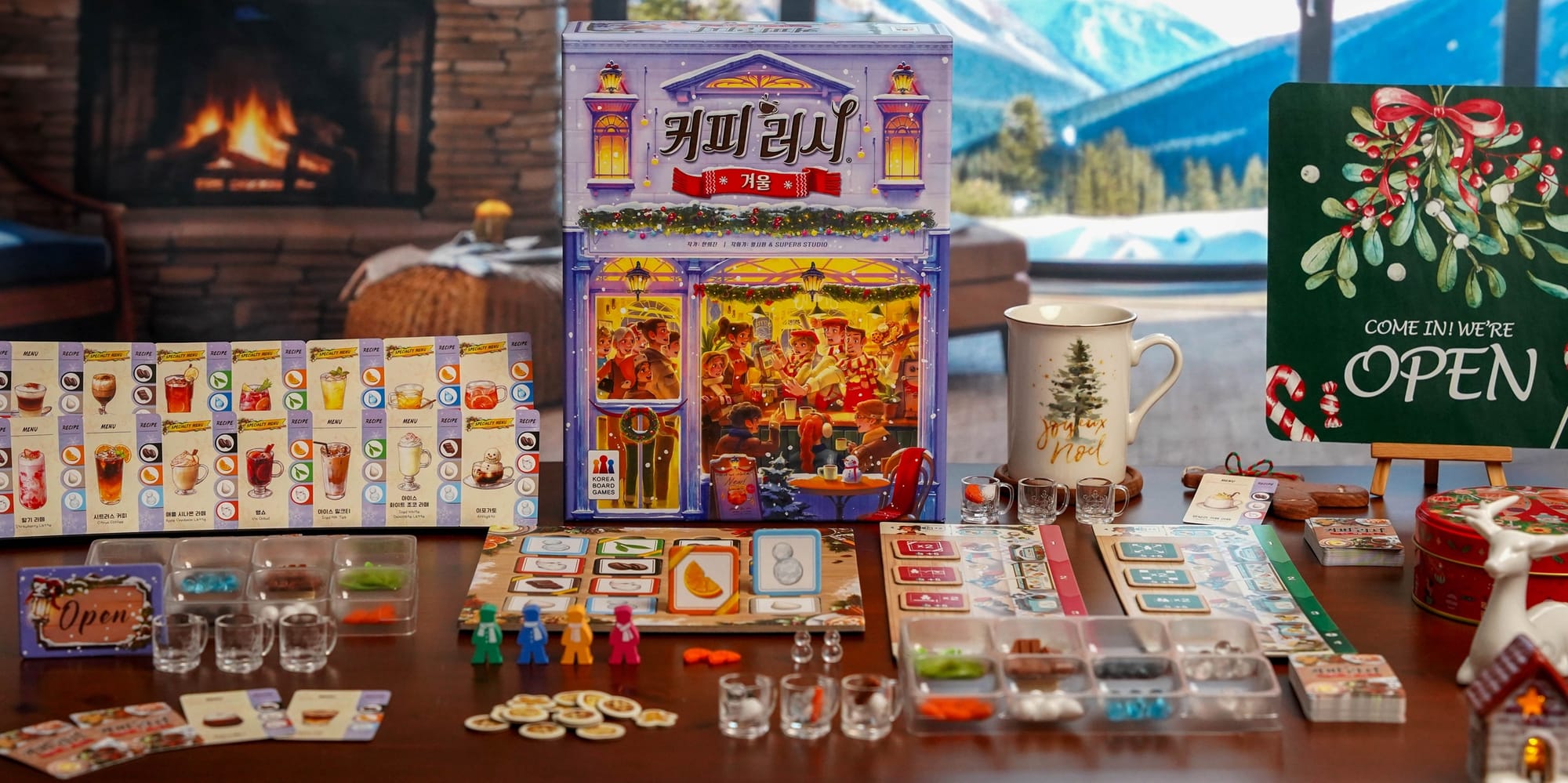
Euijin Han's Coffee Rush debuted in 2023, then was followed by the Piece of Cake expansion in 2024 and a spin-off card game — Coffee Rush: Grab & Go — by Daryl Chow. In 2026, the original game returns in a new form as Coffee Rush: Winter.
Gameplay is the same as in the original Coffee Rush release: On a turn, you move your server on the 4x4 grid, picking up each ingredient you land on, then adding them to the three cups in front of you. Collect the exact ingredients that match one of your orders, and you can serve it, and you'll need to stay on top of those orders as they cascade down your player board at the end of each turn, with you losing points for those that go unfulfilled. You can turn in fulfilled orders to upgrade your server, allowing you to move faster or pick up twice as many ingredients.
Coffee Rush: Winter features new ingredients, new orders, a modified scoring system, and new variable set-ups.


