

U.S. publisher GameHead debuted in 2025 by releasing a half-dozen games in one go, and in June 2026 the company will release its next half-dozen titles, each in a modest 6" (15 cm) square box retailing for US$20.
I've already featured Taiki Shinzawa's Trick to the Future in a March 2026 card game round-up, showing off the look of this trick-taking game from GAMA Expo 2026, and now here's an overview of the remaining handful of titles:
▪️ Friendly Fishing is a new version of Bruno Faidutti and Alex Randolph's 2019 game Tonari, which was itself a new version of Randolph's 1986 game Veleno, a.k.a. Nachbarn ("Neighbors").
Veleno has a simple concept: In a field of colored discs, take turns moving a pawn to an adjacent space to collect the disc there. The more you collect of a color, the more valuable it is, and your final score (in a game with more than two players) is the sum of your points and the points of your left-hand neighbor. Thus, you want to help that neighbor without somehow letting them help their own left-hand neighbor!
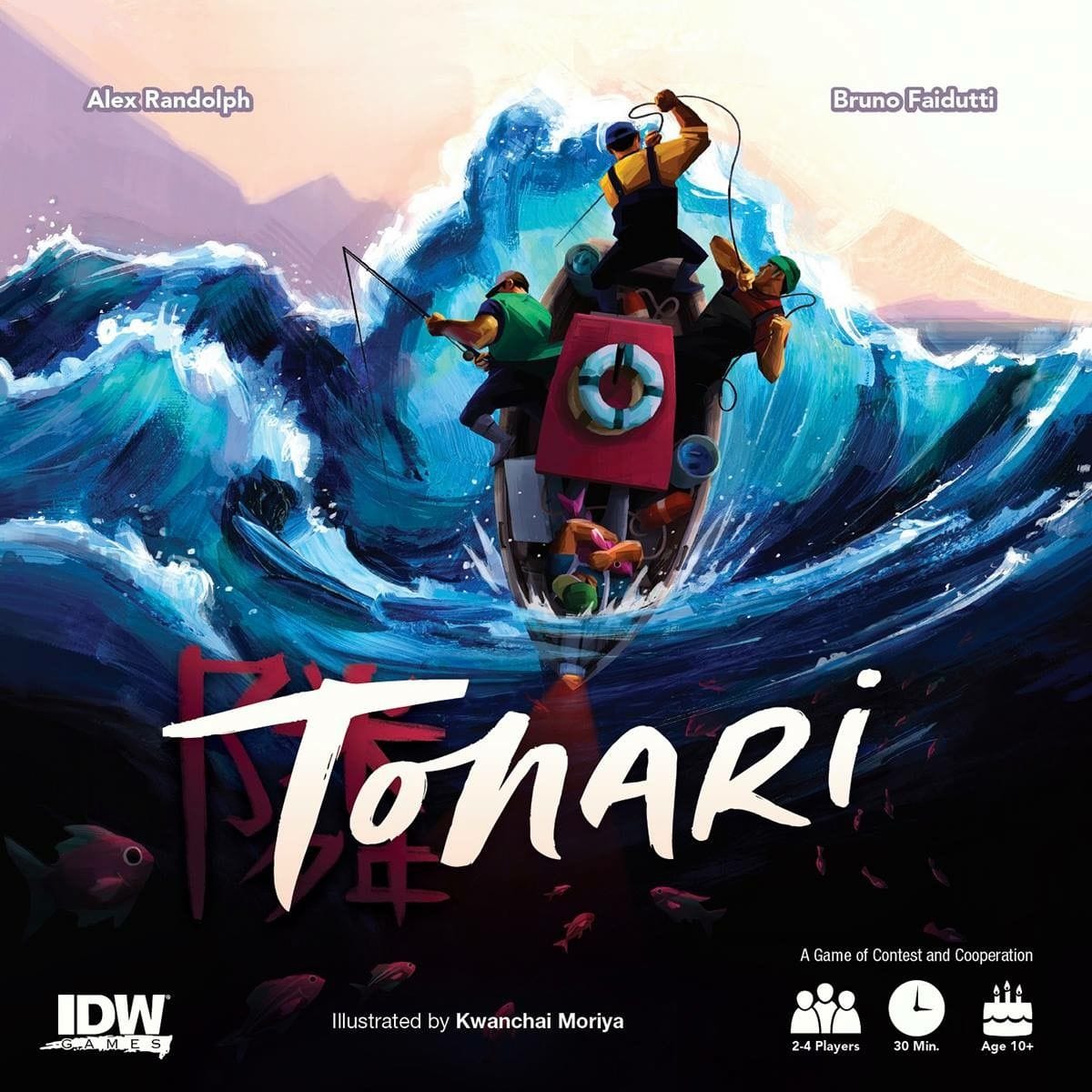
Faidutti described in 2019 how he developed Tonari from the original game by expanding the playing area and adding a few special action tiles. (For more on Tonari, read my write-up from 2019.)
Now GameHead developer Paul Salomon has modified this system once again, adding a second tile layout to allow for longer games or play with up to five, introducing new action tiles, and adding groups of special-powered fishes, with only a few in use each game. Also, the game doesn't end when the pawn has no tiles around it; now you return to the central area and continue play from there, if possible. Whatever the details, though, the core concept remains the prime draw for me as your fate is linked to what everyone is doing.
▪️ Another new edition in GameHead's 2026 line-up is Wild Magic, which is based on Reiner Knizia's 2000 card game Vampire. In the earlier game, you're collecting melds of cards in six colors, with some turns consisting of drawing two cards, then discarding any one card to its colored location. Alternatively, you can pick up all the cards at a location, then meld cards of a single color. (You can also meld after drawing two cards, skipping the discard.)
As soon as a player has melds of all six colors or the deck is empty, the game ends, and for each color, whoever has the smallest meld of that color discards those cards. (If you lack a color, you have the smallest meld.) After this culling, you add the points — 1 or 2 — on each card to see who has the highest score.
Wild Magic modifies this gameplay with three elements. First, instead of each color having the same number of cards, a color has from 11 to 21 cards, which is a nice way to differentiate the value of one color from another. Second, when you play a meld that's larger than other melds of that color, you claim that color's power token, which is worth 2 points.
Finally, the game includes twelve optional double-sided guardian tokens, and before the game begins you can deal out a guardian above each colored location. Whenever you meld, you get the guardian's bonus or carry out its effect, which might be negative. (I can appreciate wanting to add variability to a game, but going from zero special powers to 24 seems like a huge leap. Still, they're optional, and I might never pick up this game, so what am I worrying about?)
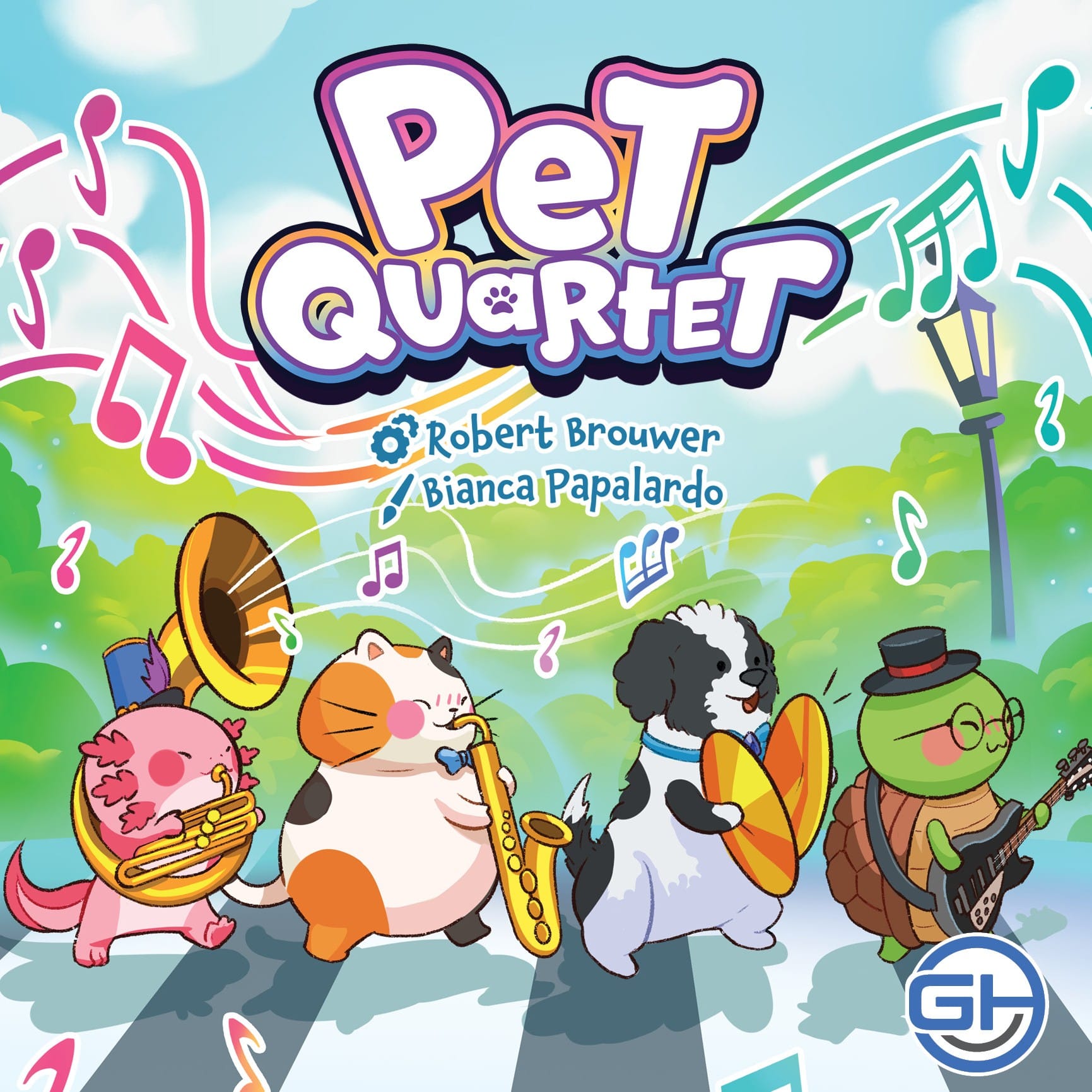
▪️ Pet Quartet also updates an older game, although not nearly as old as the previous two, being a new version of Robert Brouwer's 2023 game Audition.
The game includes cards numbered 3-13, with three 3s, four 4s, etc. Each round plays out in the manner of Michael Schacht's Coloretto: On a turn, either draw a card and place it face up in a row, or take a row that has at least one card in it. A row can have at most four cards in it. Once everyone has taken a row, start a new round.
When the deck runs out, everyone takes a final turn, but you can skip taking a row if you want — which is important because you score for a card value only if you have exactly one or four cards of that value. In both cases, you score 1 point for that value, so the winning score won't be too high! Alternatively, you can award 4 points for a quartet and the card's face value in points for a soloist, complicating your incentives for taking one value over another. Can you land a 13-point soloist? If so, you deserve a standing ovation!
You can choose to play with maestro cards that give each row a special power, such as having at most two cards in it, giving a card to your left-hand neighbor, or taking a row when you add a card to it.
▪️ Size Wise is a 3-8 player design from Scott Brady that falls into the small category of "party games in which you measure things" — although in this case the "measuring" is all conceptual rather than actual.
Each player gets a string that features a ring at one end and a bead that you can move up and down the string. Each turn, you're presented with a random object — bag of chips, suitcase, washcloth, dog's tail, etc. — then asked to demonstrate the size of this object by placing your bead somewhere along your string.
All of the strings are then placed on a wooden dowel so that the strings hang down, and whoever has indicated either the shortest length or the longest length loses a wisdom token. When a player has lost all of their wisdom, the game ends and whoever has the most wisdom wins.
▪️ The final 2026 GameHead release is This/That: Showdown, a party game for 3-10 players from April Mitchell that lets you run a "March Madness" style tournament at home.
Each turn, you're presented with two cards, and you secretly choose one or the other — i.e., this or that. Whichever card gets the most votes wins and advances to the next round, while the other card is eliminated, and everyone who voted for it receives a strike in the first round, two strikes in the second round, and so on. Eventually only one card remains, at which point whoever has the fewest strikes wins.
A neat feature of the design is that after each game, you can place the final four cards aside in a legacy folder, and when you have enough cards in that folder, you can run a game solely with these winners. (In the meantime, those cards are pulled from play so that they won't dominate future games, too, a problem I recall from Craig Browne's Compatibility, another party game in which you're trying to think alike.)


