

Two stories related to generative AI have hit the board game industry in the past week:
First, on February 23, 2026, the crowdfunding platform Gamefound issued updated Terms of Service for both Creators and Backers, and amongst items such as the ability for Backers to place orders without creating a registered account and for Gamefound to "withhold creator payouts, for example in cases of suspected fraud, abuse, legal violations, or regulatory non-compliance", item #7 reads:
Use of generative artificial intelligence
We've added specific rules for creators regarding the use of generative AI when creating, presenting, or promoting projects on Gamefound.
And here are those rules from Gamefound's Terms of Service for Creators:
9. USE OF GENERATIVE ARTIFICIAL INTELIGENCE
If a Creator uses generative artificial intelligence (AI) tools (including but not limited to AI-based text, image, video,), to produce any content published on their Gamefound Project page (such as campaign descriptions, visual assets, promotional videos, or other marketing materials), or in the creation or development of the product offered as part of the campaign or Pledge Manager (particularly where AI contributes to visual, textual, narrative, mechanical elements), they must clearly disclose this fact on the Project page. Such disclosure must:
- identify which specific elements of the content were generated using AI;
- be visible to Backers before pledging begins;
- maintain clarity and transparency in how the Project is presented.
If a Creator fails to disclose the use of generative AI in content posted on their Gamefound project page, Gamefound may, at its sole discretion:
- suspend the visibility of the Project on the platform, making it temporarily inaccessible to Backers;
- temporarily hide or suspend the campaign;
- issue a public notice to Backers about the missing disclosure;
- restrict the Creator’s account or some functionalities;
- exclude the campaign from Platform promotions.
Repeated or intentional violations may result in permanent removal from the Platform, especially if the lack of disclosure misleads Backers or infringes third-party rights.
Gamefound is not responsible for the content provided by the Creator on the Project page, including any information or claims relating to the use of generative AI. All content remains the sole responsibility of the Creator.
I welcome a requirement like this as I'd prefer to avoid backing or even writing about any game that uses generative AI art. (I state exactly this on Board Game Beat's policies page.) I've written to Gamefound to ask why this change to the Terms of Service was added, whether Creators need to follow a specific format for disclosure, and whether it can provide an example of a project that discloses the information in the right way, and I'll update this post should I receive a response.
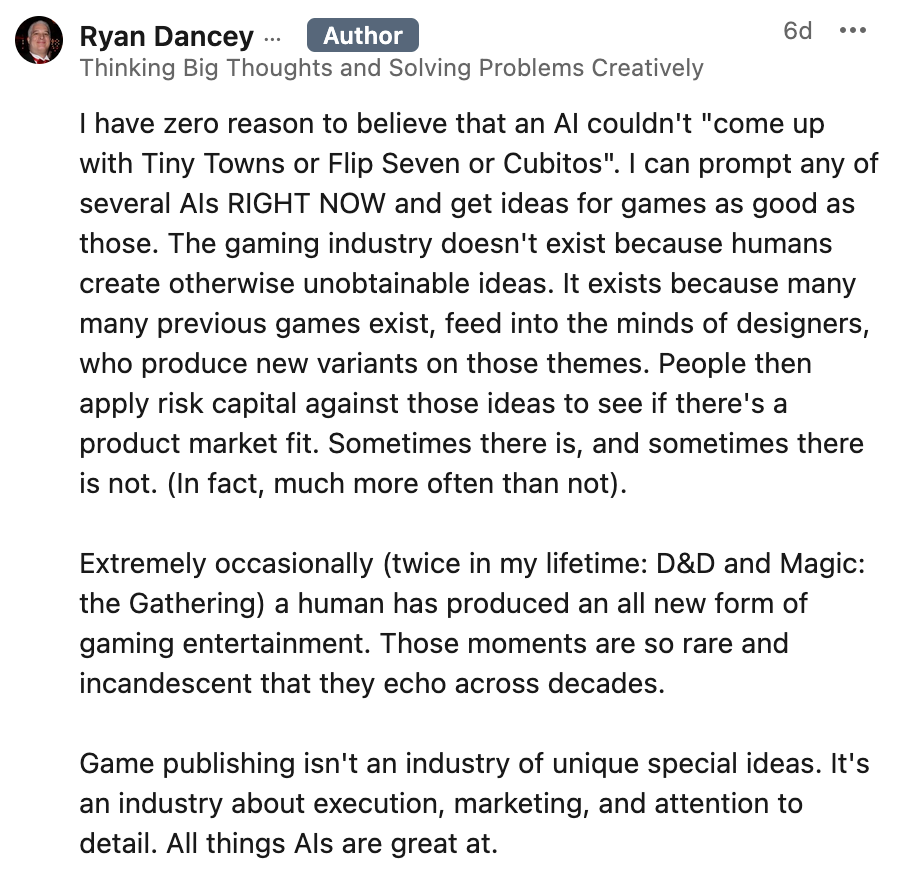
Second, on February 17, 2025, Ryan Dancey, then-COO of U.S. publisher Alderac Entertainment Group posted the following as a comment on his own LinkedIn post about the inability of Claude, Anthropic's AI tool, to correctly intuit how to answer a question:
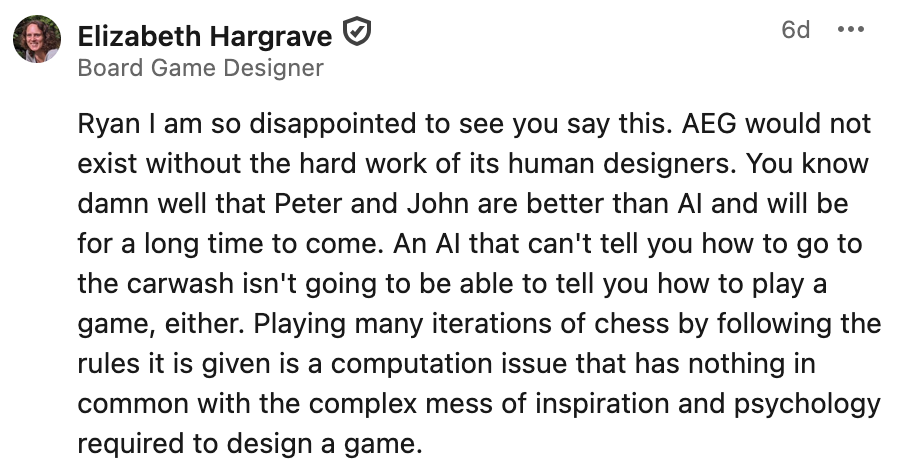
Many people protested this comment, including designer Elizabeth Hargrave, who has had two titles published by AEG and who referenced Tiny Towns designer Peter McPherson and Cubitos designer John D. Clair in her response:
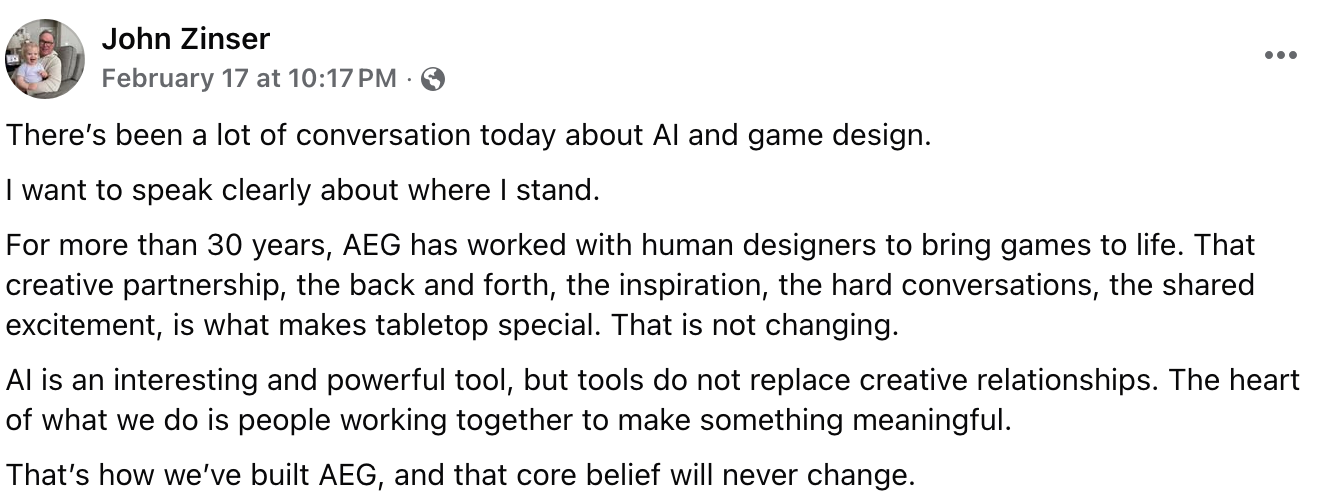
On Facebook, Alderac CEO John Zinser first posted a non-direct response to Dancey's comment:
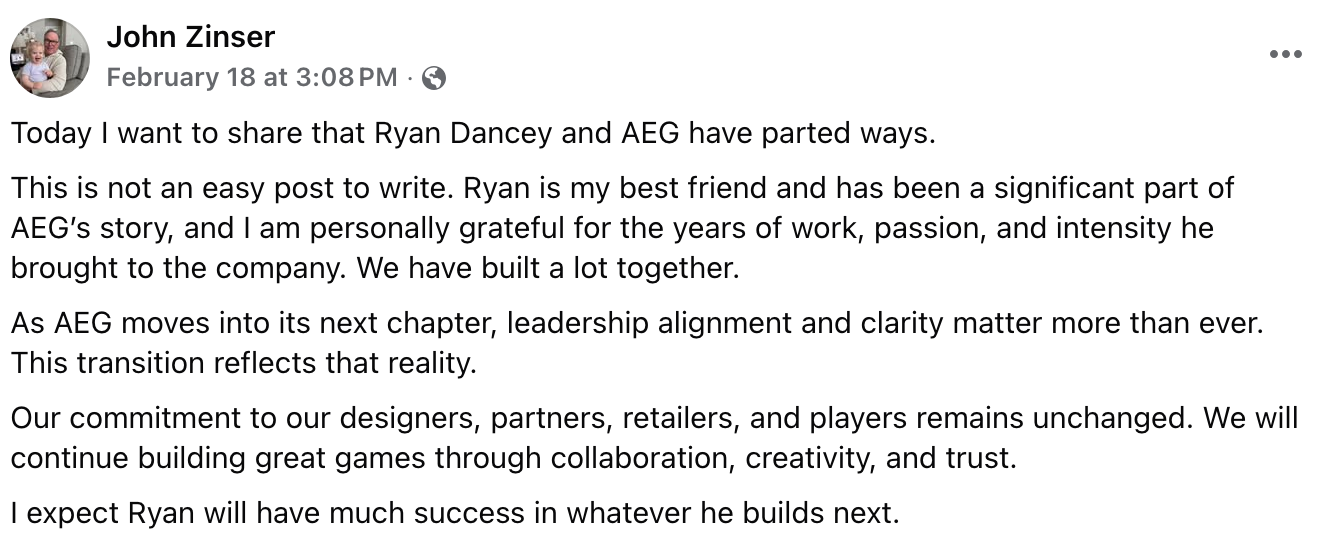
Then on February 18, 2026, posted that Dancey was no longer with AEG:
This was the second time that Dancey had become a flashpoint for criticism, with the first being in 2023 when he offhandedly speculated that fewer women than men are game designers because "females are socialized in the West to avoid situations where they're subjected to fairly harsh criticism of their abilities and creative ideas", whereas "[m]ales are socialized to take the punches and keep moving forward".
In a February 19, 2026 article on BoardGameWire, Dancey clarified that in that LinkedIn comment he meant only that AI could produce "ideas for games as good as those", not that it could design from start to finish games as good as those, which is how many (including me) translated "come up with". (In that BoardGameWire article, he said much more about AI and clarified that AEG had never used generative AI in its products or "creative pipeline".)
I understand the distinction between the two concepts that Dancey is describing — AI can produce good ideas, not finished games — but as many game designers have stated over the years, having ideas is the simplest part of game design. Let's ramble off a few: "a co-operative game about building the Golden Gate Bridge", "a deck-building game about establishing your credit rating so that you can buy a house", "a dexterity game that challenges you to build the strongest palanquin with unusual materials", "a trick-taking game in which the suits are literally suits and you want to assemble the best wardrobe", "a racing game in which you use dice to determine how far you move, with the ability to buy better dice", and so on.
Are these good ideas? Maybe, but that depends on everything that comes after those brain flashes. Saying that AI can produce good ideas isn't really saying much, but Dancey said this nothing much is such a dismissive, demeaning way that apparently Zinser decided it would be better for Dancey to not represent AEG in the future. (I reached out to Zinser for a comment on Dancey's dismissal on February 18, but have not heard back.)
Aside from the issue of generative AI art using without compensation thousands of pieces of existing art as the source material for its products, what I find most damaging about generative AI art is the amount of distrust that it's created between gamers and publishers — not to mention, of course, among all human beings as they question whether what they see online is real or not.


