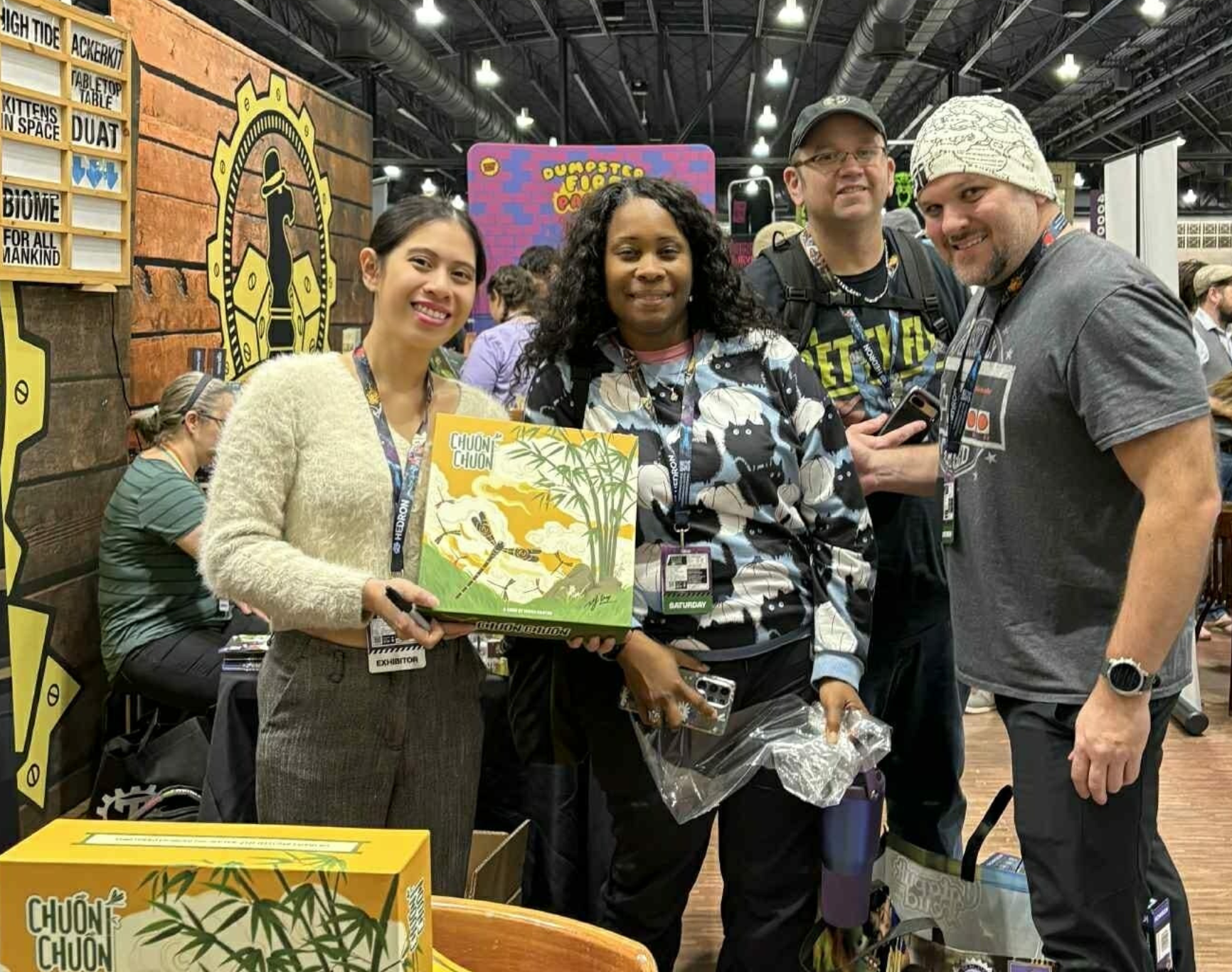
The tagline of the game Tech Race — "Forge your startup empire!" — encapsulates the challenge both for players of the game and for designer Ionah Nguyen, who launched her Brainy Hearty publishing company in Seattle, Washington in February 2024.
Tech Race draws on Nguyen's personal history: "For most of my adult life, I was immersed in business and technology: first in Vietnam's fintech scene, then through my MBA in the U.S., and later in roles at Amazon and an AI-driven agriculture startup in Seattle."
While living this fast-paced, high-pressure life, Nguyen says that hosting game nights were what kept her grounded. "Board games were where I saw people truly connect," she tells me. "Friends, coworkers, even strangers would sit down at a table and, within minutes, be laughing, negotiating, and forming little alliances."
Teaching rules, watching people absorb them, and seeing relationships develop through play were moments that Nguyen loved — then she realized that she didn't have to wait for game nights to make those moments happen.
"At some point, it clicked: everything I loved about my professional life — systems thinking, strategy, building something from scratch — may live inside a board game," she says. "After a decade of working for other people's visions, I felt ready to build my own. Brainy Hearty was born from that desire to turn business experience into meaningful, human-centered play."
The "Brainy Hearty" branding represents Nguyen's mission for the company: to create games that challenge the mind and warm the heart. In her words:
"Brainy" speaks to the strategic, thoughtful side of games. Whether it's strategic planning, tactical timing, or reading the table, we want our games to give players that satisfying sense that their choices matter and that every turn creates new possibilities.
"Hearty" speaks to warmth, emotion, and human connection. It's the laughter, the friendly rivalry, the moments when people lean in, make deals, and form little stories together. To me, games are one of the most powerful ways to build connections. I like games that strengthen memory, focus, and problem-solving, but more than anything, they bring people together because there's so much fun playing.
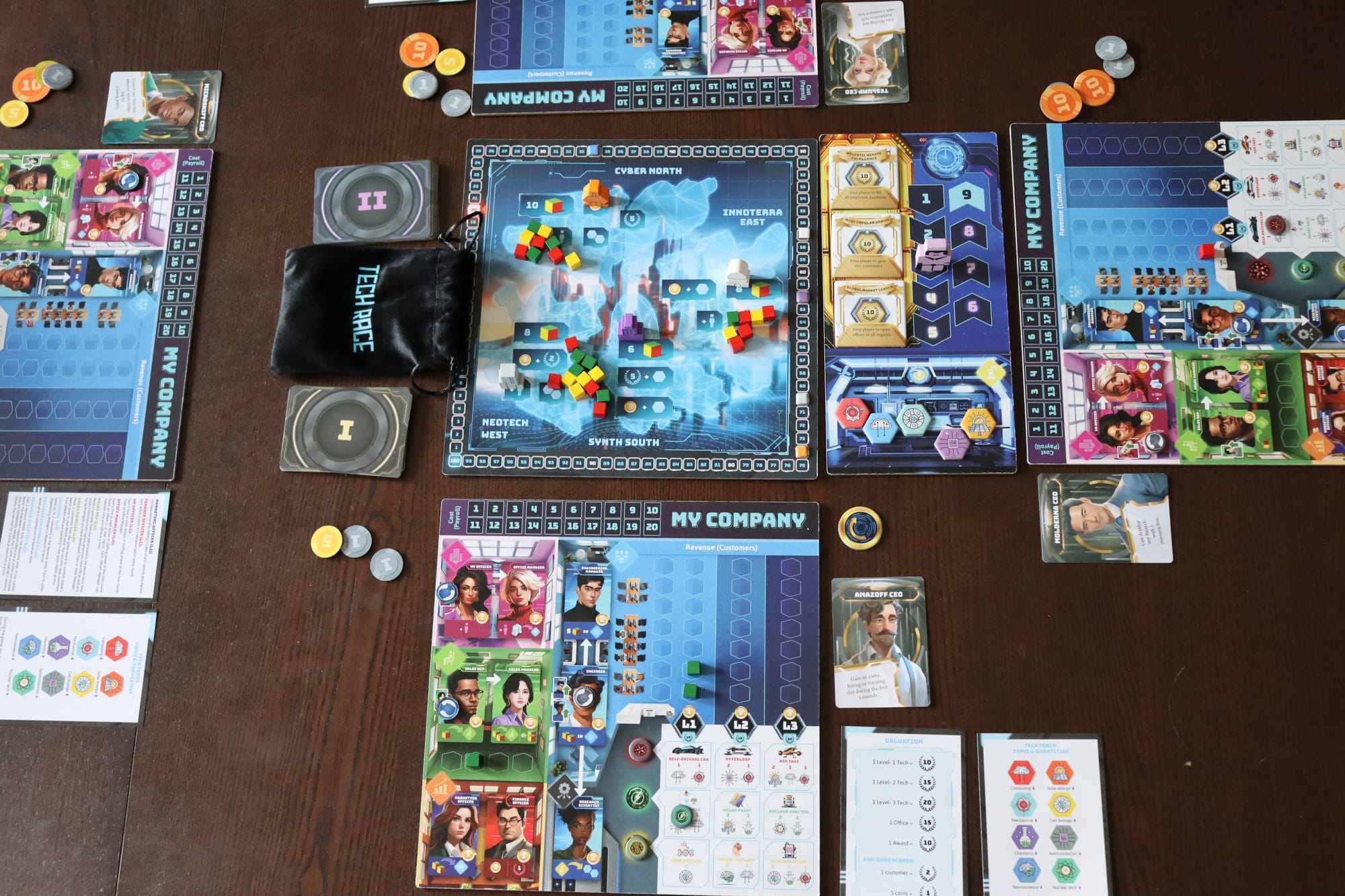
Nguyen drew on her business experience for her first design: Tech Race, a game in which each of the 2-5 players runs their own startup: "When I first started brainstorming ideas, I wanted a game that was genuinely fun but also captured a real slice of the world. I kept coming back to the tech industry and startup culture because it's intense, unpredictable, and shaped by sudden breakthroughs and collapses — perfect material for a game."
She continues: "My background in business and tech gave me a front-row seat to that chaos. The pressure of managing cash, hiring talent, racing competitors, and adapting to trends like AI or tech layoffs. I didn't just want to simulate a company on paper; I wanted players to feel the stress, excitement, and risk that founders live with every day, but in a light-hearted, humorous way. That's why Tech Race revolves around juggling finances, talent, and timing, and how players interact — competing for customers, trading resources, even lobbying the government — sits at the core of the design. It's a living, volatile system, just like the startup world itself."
Nguyen ran two Kickstarter campaigns for Tech Race, first in September 2024, then in January 2025, with neither coming close to funding, and while humbling, she said the experience was incredibly valuable, listing three lessons she learned:
Clarity matters. We received feedback that our Kickstarter page didn't clearly communicate the target audience for Tech Race. In trying to appeal to both casual and seasoned gamers, the pitch became too broad. This experience reinforced the importance of clearly spelling out who the game is designed for and keeping the messaging focused from the start.
Community matters. Throughout the process, the most valuable insights came from designers, players, and early supporters who commented, questioned assumptions, and took the time to playtest. Their feedback helped surface blind spots and sharpen the game in ways that internal iteration alone couldn't.
Timing matters. Tech Race was launched before we had built a sufficiently strong pre-launch community. While a great deal of work had gone into preparing the campaign, the audience size at launch limited its momentum. This highlighted how important it is to launch at the right moment when the product, presentation, and community are all ready. Building momentum takes time, and a strong pre-launch audience is just as critical as the campaign itself.
Nguyen says that her decade of experience in the tech and business worlds has been incredibly helpful, while also creating false expectations for how things work in a different economic sector: "Running a studio requires the same skills as running a startup: project management, budgeting, manufacturing, marketing, customer communication, and long-term planning. My experience in fast-moving tech environments also trained me to iterate quickly, analyze feedback, and stay calm when things go wrong, which they often do in game development."
"At the same time," she says, "that background was also a hurdle. In tech and corporate roles, things move fast and are often driven by metrics and deadlines. Game design moves at a very different pace. It requires patience, playtesting, and listening deeply to players. I had to unlearn some of that urgency and allow space for creativity, failure, and exploration."
"In many ways, Brainy Hearty sits right at the intersection of those two worlds: structured enough to ship real products, but flexible enough to let play and imagination lead."
Nguyen has since published Tech Race without crowdfunding, and the game is now available through the Brainy Hearty website, but she's moved ahead with a second release — Chuồn Chuồn — that's quite different from her first design: "Tech Race grew out of my background in tech and business, while Chuồn Chuồn emerged later when I returned to Vietnam and reconnected with my culture and childhood memories. After finishing Tech Race, I also realized I wanted to design games that are more accessible and family-friendly, not just for hobby gamers."
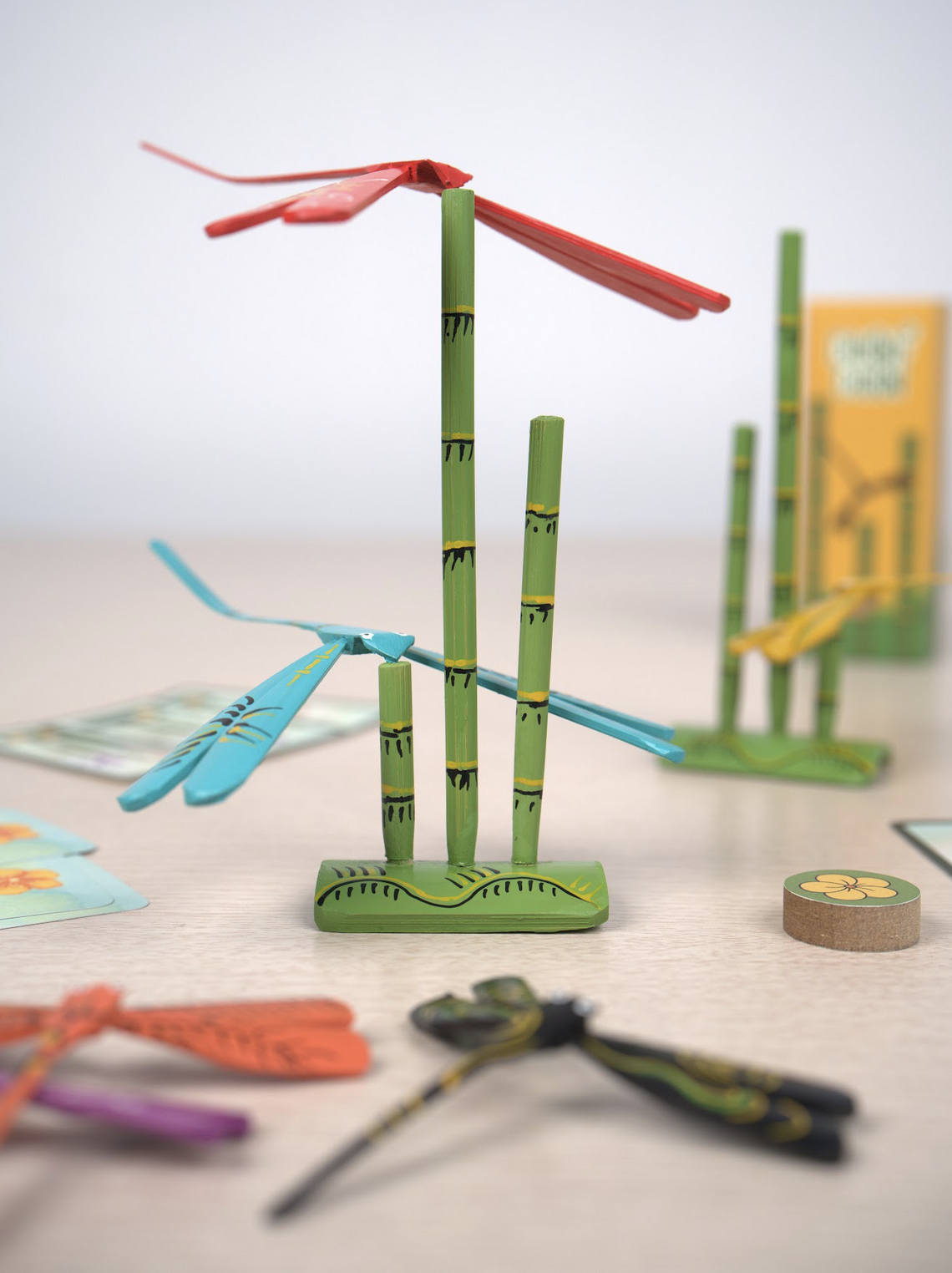
Chuồn Chuồn — pronounced "choon choon" and meaning "dragonfly" in Vietnamese — was inspired by traditional bamboo toys from Nguyen's homeland. (For background on these balancing, bamboo dragonfly toys, read this 2016 article from Viêt Nam News.)
Gameplay is straightforward in Chuồn Chuồn: Each player starts with two objective cards, two magic cards, and two bamboo stands, with poles at three heights. Large and small dragonflies in seven colors are available on the table, and a river of objective and magic cards are revealed. On a turn, you can:
- Add two small dragonflies or one large dragonfly from the table to your bamboo stands.
- Draw two random objectives from the deck or one face-up objective from the river.
- Draw two magic cards from the deck or one face-up magic card from the river.
To end your turn, play zero to all of your magic cards, which allow you to rearrange dragonflies on one stand, raise all dragonflies in play up one level (with those on the highest level returning to the table), lower all dragonflies one level, swap two dragonflies, and so on.
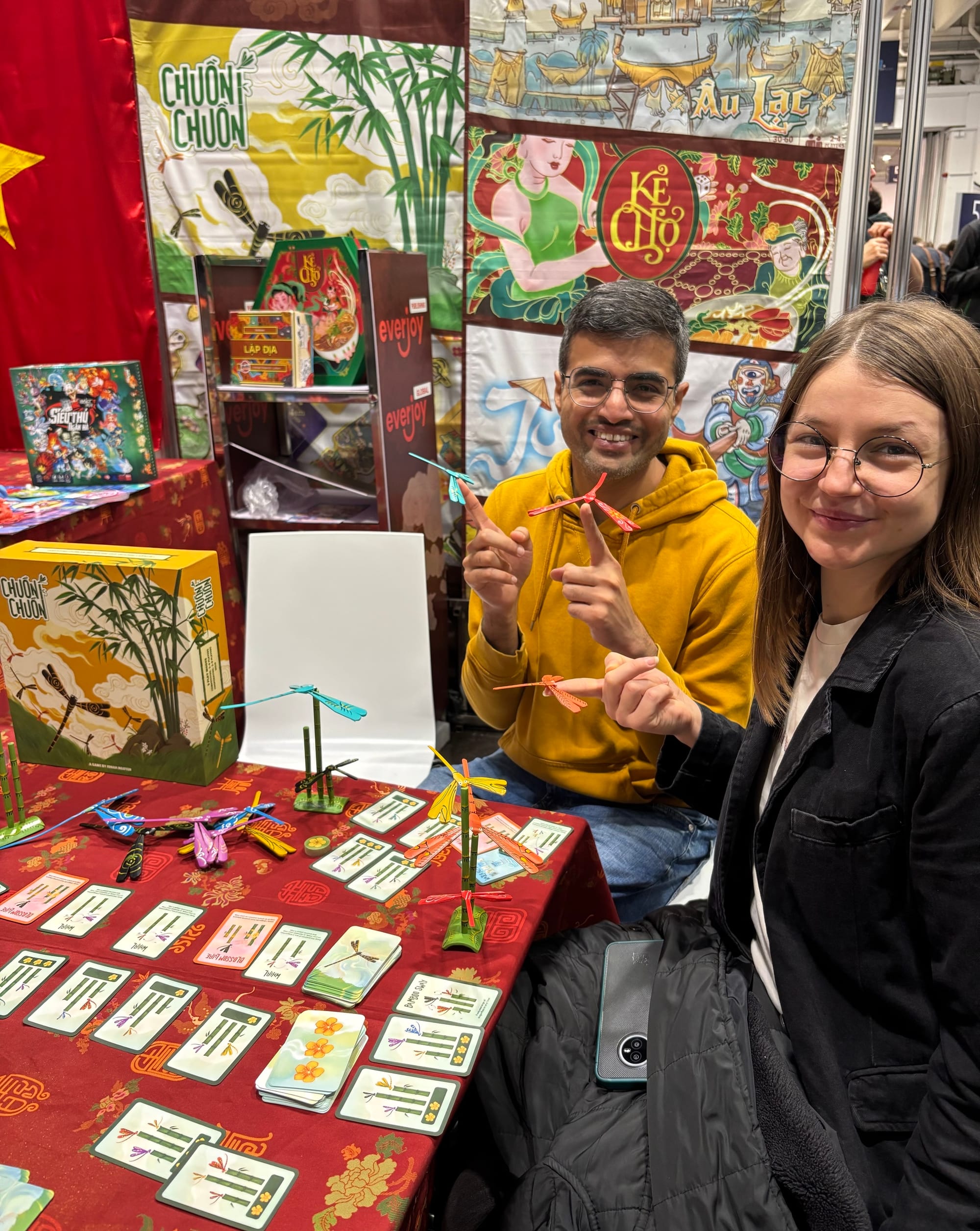
You start with two objective cards in hand and can hold at most four. Each objective shows a combination of dragonflies (and sometimes empty bamboo poles), and as soon as an objective is met — even on another player's turn — you lay that card in front of you. As soon as someone has scored enough objectives, you complete the round, then tally points, with balancing dragonflies being the tiebreaker.
Chuồn Chuồn, which is also available via the Brainy Hearty website, includes rules for solo and co-operative play, with players trying to score as many points as possible over 5-7 rounds — and with the game supporting up to eight players, I can imagine plenty of helpful magic taking place to try to satisfy multiple objectives at once.
As for what's next, Nguyen says, "I'm still a new designer with a lot to learn, and this phase is about trying ideas, following curiosity, and slowly discovering my own direction. For now, I'm guided less by a fixed style and more by Brainy Hearty's mission: creating games that challenge the mind and warm the heart."