

If anyone's looking for trends in the game industry these days, we can point to an infestation of rodents that's taking place in the mid-2020s, with those rodents specifically being capybaras. Is it their fun name? Their doofy look? Whatever the reason, capybaras are having a moment, mostly in card games.
One of the earliest such titles was Hisashi Hayashi's Capybara 'n' Capybara from 2021, a 2-4 player game from his OKAZU Brand company in which you build a row of lettered capybaras in order to walk back and forth across it with a monkey in order to collect pumpkin cards and meet the conditions on a bonus card.
Despite the title, dylan coyle's Capybara Crush features no capybaras macking on one another. This 1-4 player game coming from Coyle's Charming Games Collective in September 2026 instead challenges you to create a rodent row in which they stack tiny things on their heads. Each card in the deck features a capybara head on the back and three stacked objects on the front. On a turn, you draw a card from the deck or river, then play a card as either a capybara (with your row holding up to eight) or as objects on a capybara's head. Your goal is to make horizontal chains of like objects, with the objects being at most one level up or down in the stack.
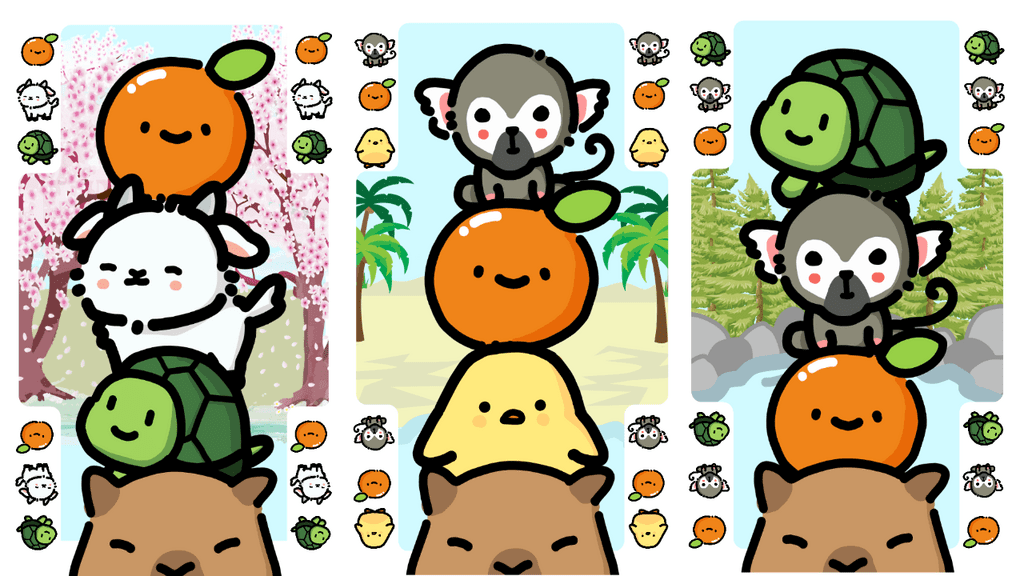
Capybaras vs Pelicans is a "take that" game due out in May 2026 from newcomers Merinda Lyne, Dougal Mordike, and Jim Rippon of Australian publisher Disco What in which players take turns laying down a card from the three in their hand. Capybaras pile up in front of you, pelicans let you steal an opponent's capybara card (which has 1-3 creatures on it), super pelicans let you steal all of a player's capybaras, and a hot springs lets you save all capybaras in front of you. Play all the cards, then compare your capybara count, scoring only those that made it to the hot springs.
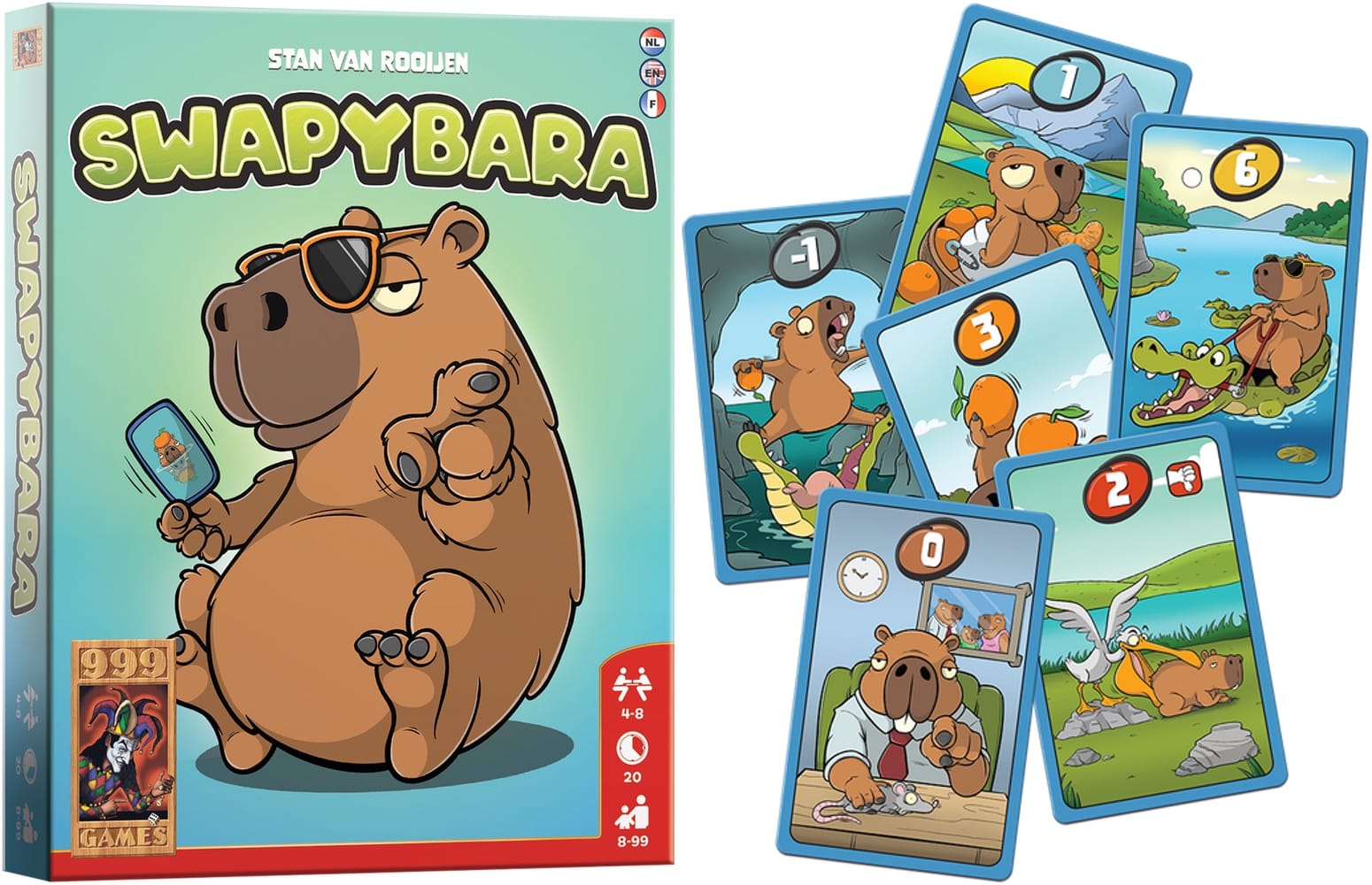
Another May 2026 release is Swapybara, a 4-8 player game from Stan van Rooijen and Dutch publisher 999 Games in which you — wait for it — swap capybaras.
Each round plays out similarly: Each player receives a card with value from -1 to 6, and on a turn you must ask a player (other than who you asked last turn) to swap cards with you. If they agree, swap; if not, don't.
After three turns like this, players score points for their card...but several capybaras have special conditions. If you hold the 0 at the end of a round, before everyone reveals their card, you reveal your 0 and swap it with someone else's card. Yoink! If you hold a 4, you must agree to a swap, and if you hold a 2, you must decline. If you score the 6, then you take the 6-token as a reminder, and if you score the 6 again next round, you score -1 points instead. The reverse is true for the -1 card. If you hold a 5, you can ask to swap only with your immediate neighbors.
Once you deal out value cards for the first round, you use the same cards for the next two rounds, so you'll know which cards are in the mix and who might decide to swap or not based on what they hold. Finally, whoever scored a 1 gets to choose which card they start with to add a bit more mind games to the mix.

In 2025, Italian publisher Creative Jam released Capybattle, a two-player game by Domenico Stellato and Francesco Ubbiali in which you want to maneuver your pieces to get five in a row.
The game board features a 5x5 grid, with a perimeter wall along two connected edges. Five action tiles are placed at random along each wall, and each player starts with two capybaras in their color in a grid space next to a wall.
On a turn, you move your leader to one of your capybaras, then take the action in the row and column where that capybara is located, with actions including moving a capybara (your own or the opponent's), building a structure, "teleporting" a capybara, and swapping two action tiles. The capybara where your leader is located cannot be moved on your turn, so you're trying to use actions from one to set up positions with others as more capybaras come into play as the game progresses.
If you place your leader on a structure in the opponent's color, you flip it to your color, which can help you make a row of five. Alternatively, if no one has created a row by the time all pieces have been added to the board, whoever has the most structures wins.


