▪️ Korean designer Geonil creates fantastic two-player-only trick-taking games, with 2021's Jekyll vs. Hyde probably being his best known design. I've previewed a couple of his designs in this category — The Yellow House in 2024, and Faust vs Mephisto in 2025 — and I was excited to discover that he has a new design due out at Game Market Spring 2026 through his Schemers brand.
Here's an overview of The Four Deuces, which will ideally also show up at SPIEL Essen 26:
Al Capone is facing off against Bugs Moran for control of Prohibition-era Chicago, but in their efforts to lock down the city, they can't attract too much heat.
The game lasts at most seven tricks, and it includes a deck of sixteen cards, with four unnumbered cards in four suits. These suits are randomly ranked from high to low using tokens on a board. Each player starts with a hand of four cards, and three additional cards are a supplemental hand that starts face down on the table. (Players can look at these three cards.) Each player rolls seven six-sided dice, and the values on these dice will be assigned to played cards over the course of play.
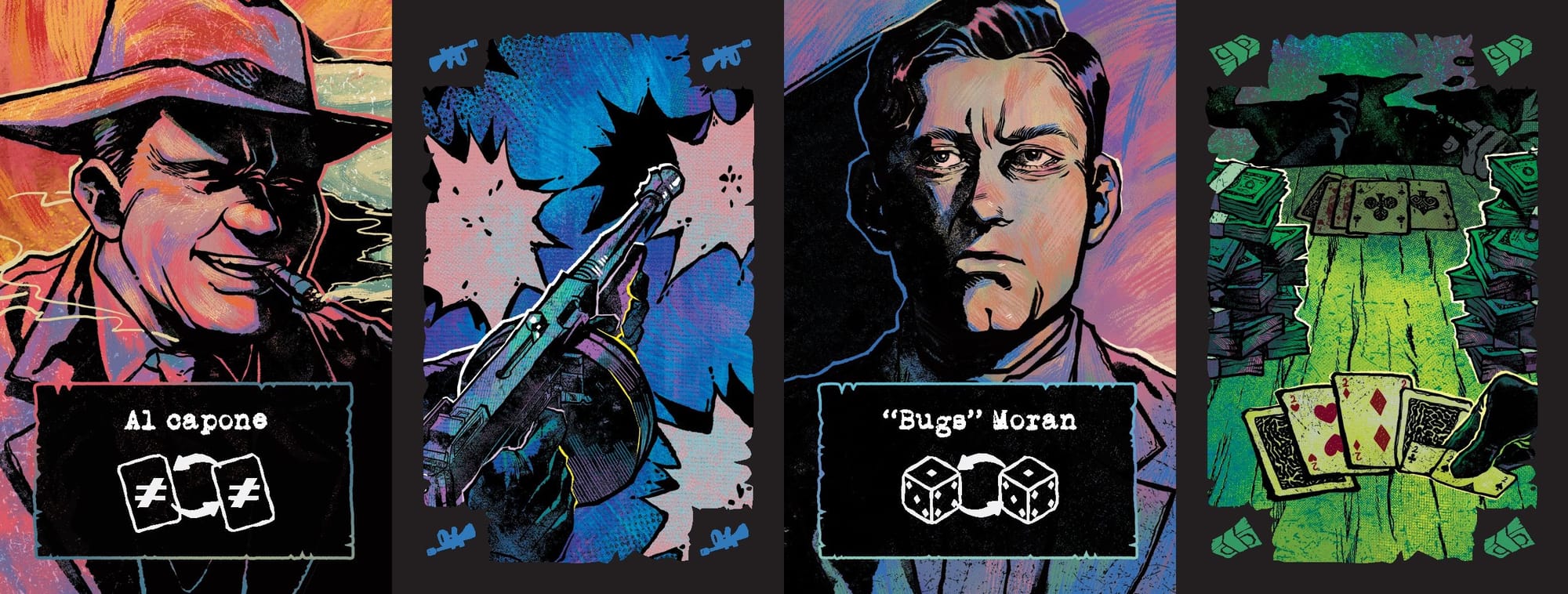
To lead a trick, a player lays down a card from their hand, then places a die on it. The other player must follow suit, if possible, and if they do, they must place a different valued die on their card. Whoever plays the higher value wins the trick and leads the next one.
If the second player must play off suit, they can place any die on this card. If the dice have different values, the suit of the card with the higher value moves up one space on the rank chart, then whoever played the higher-ranked card wins the trick.
After four tricks, players pick up their three-card hand, then continue play. If a player wins a fifth trick, they've attracted too much heat and lose the round; if this doesn't happen, whoever wins four tricks wins the round. The first player to win two rounds wins the game.
Each player has a power through their character they can use once each round, either swapping one card in hand for a card of a different suit from the opponent, or swapping one of your dice with an opponent's die.
▪️ To go from one trick-taking design master to another, let's look at two titles from Matsumoto Yusuke, designer of Nokosu Dice, who releases titles as Quoth Games.
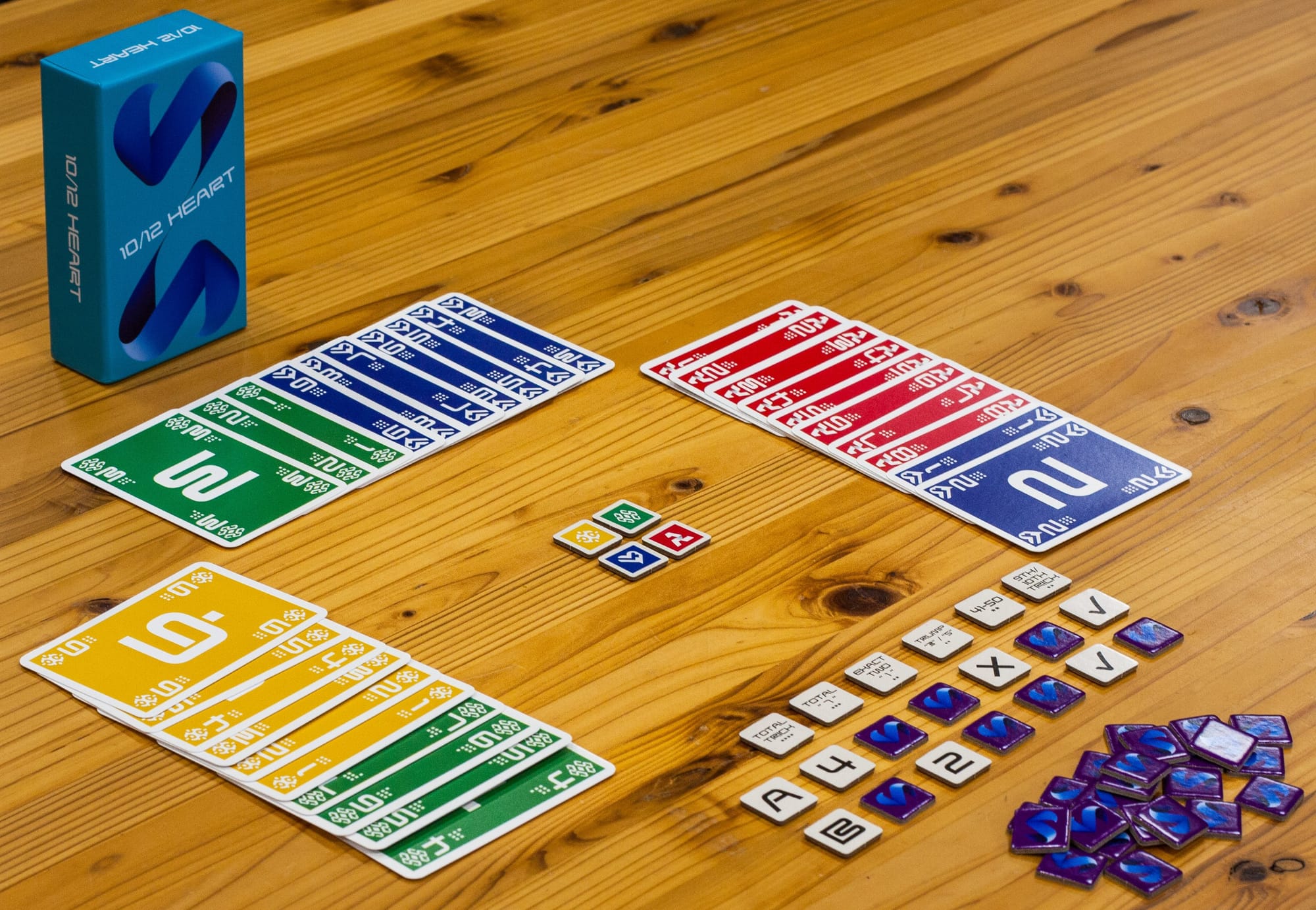
The designer's late 2025 release was 10/12 Heart, a trick-taking game for exactly four players, with each player taking turns as one of four roles in the game. The primary role is the dealer, a.k.a., the mastermind, which is in the lower right of the image above. Going clockwise from the dealer, you have players A, B, and C, and the dealer will deal each player ten cards face up while they're away from the table or otherwise not looking at these cards. (The deal above is wildly improbable, so let's assume the cards are laid out this way so that you can easily see the deck composition.)
The dealer chooses a trump suit at random from the four tokens at the center of play, then they "program" their dashboard, estimating how many tricks and how many 7s players A and B will take, as well as whether these players will:
- Take exactly two 1s
- Take either the trump 3 or the trump 5 or both
- Take either the ninth trick or the tenth trick or both
- Take cards in tricks that sum from 41 to 50
The dealer reveals two of these tokens, then gives everyone their cards. Standard rules follow: Player A leads to the first trick, and everyone must follow suit, if possible. Highest trump wins if trump if played; otherwise the highest card in the lead suit wins, with that player leading the next trick.
Whenever the dealer's turn comes around, they reveal a token in their dashboard, trying to give direction to players A and B as to what they should be doing. Once all ten tricks have been played, tally points. The dealer scores 2-4 points for each correctly predicted token for a maximum of 30 points. Player C scores 30 points minus whatever the dealer scores, so player C wants to be spoiler. Players A and B each score 2-4 points for each token in their row that matches their results — and if they matched their token while the other player didn't, they double the score for that token, so they're playing spoiler for one another. (Thus, players A and B also split 30 points between themselves.)
After four rounds, whoever has the most points wins.
▪️ Yusuke's newest release, which will debut at Game Market Spring 2026, is In Order 2 Chance, a card game for 4-5 players that combines bidding, set collection, reverse bidding (as in High Society), and an I split-you choose element.
Each player starts with a hand of bidding cards. Most cards in the deck are one of 6-7 colors and show one of three symbols and 0-2 stars; special cards showing five stars, two symbols, or the number 5 are also mixed in the deck.
On a turn, the active player reveals 7 or 9 cards from the deck (depending on the player count), setting aside any exclusion cards (which show three X symbols) that are revealed. Players take turns bidding on this lot of cards, with you needing to outbid players who are not your immediate neighbors in order to stay in the round. When all but one player passes, the high bidder is this turn's "first winner"; their neighbor who bid higher than their other neighbor is the "second winner". Winners discard their bids, while other players return their bids to hand.
The first winner decides which winner will split the card lot into two piles, with the other winner having first choice of which pile to claim. Winners stack their cards in a somewhat pyramidal shape.
During a turn, if a third exclusion card is revealed, you stop everything to bid on NOT taking these cards. When all players pass, the lowest bidder is the first winner and their neighbor with a lower bid is the second winner. All non-winners discard their bids, while winners keep them. The second winner chooses one exclusion card, then the first winner gets the other two. Exclusion cards show a color, a symbol, or stars, and when you get one, you must discard three cards with this feature from your collection, losing 3 points for each card you can't remove.
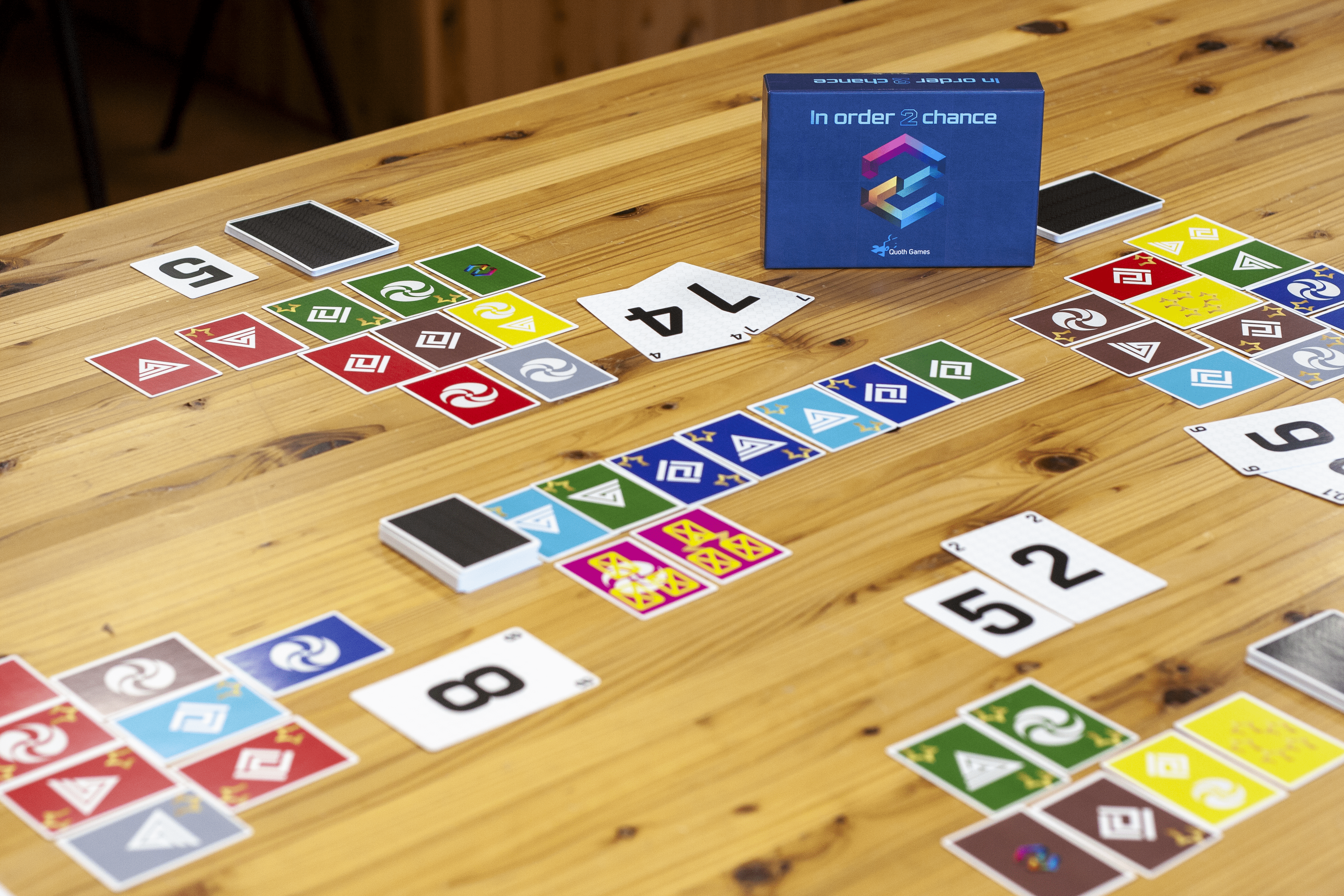
After the third exclusion card auction, the game ends immediately, and the player(s) with the lowest sum of bidding cards in hand must apply the final exclusion card in the deck to their collection. Players then score for groups of colored cards in their collection; in the image above, the player in the upper right scores 9 points for a group of three brown cards, 4 points for a group of dark blue, then 1 point for each other single-card group.
You also score 1 point per star, 10 points for having at least seven colors, 5 points for the highest sum of bidding cards, and 5 or 15 points for having three or five symbols in a group.
Seems like a lot to explain for your first play, but I dig the concept of bidding to mooch off a high-bidding neighbor and splitting cards with them, while trying not to collect what they're collecting — in addition to weighing the bidding cost of not having your collected cards blown apart via exclusions.